Field report · · AgentConn Team
10x PRs, 1x Reviewers: The Code-Quality Bottleneck
AI agents produce 10x more PRs, but review capacity is fixed. LinearB data, FrontierCode scores, and the gate patterns that actually work.
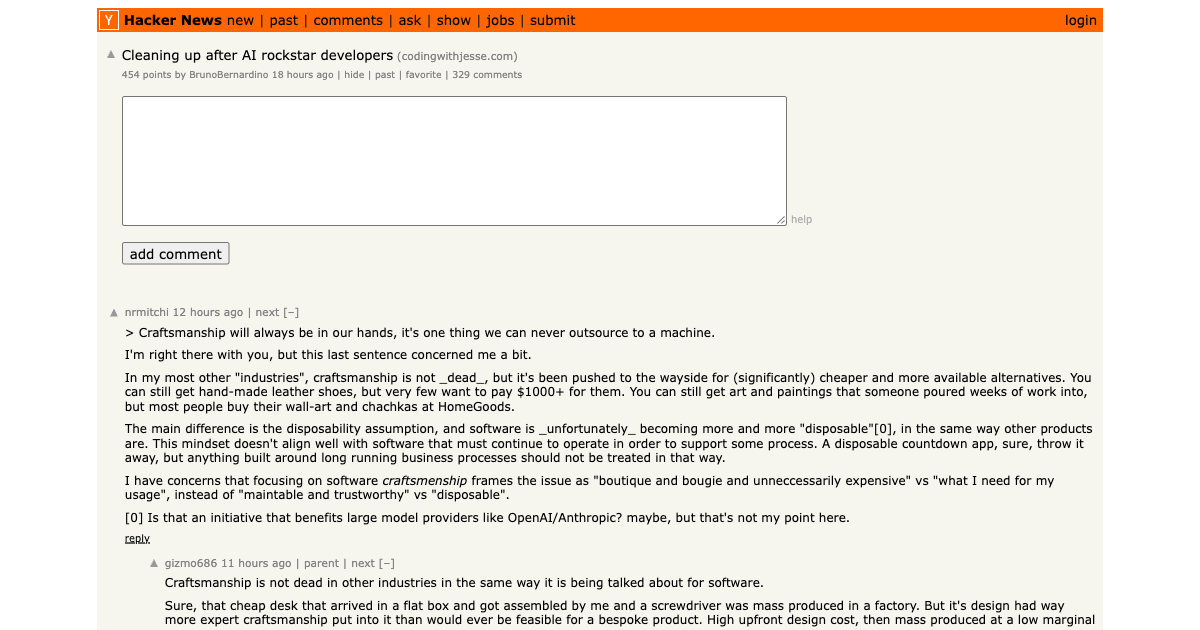
Amazon employees have a Slack channel called “Sloppenheimer.” They use it to mock Kiro, the company’s AI coding tool, sharing memes edited to carry its purple ghost logo. When leadership launched an internal AI usage leaderboard to encourage adoption, engineers gamed it — so Amazon shut it down. The gap between “our agents ship faster” and “our engineers are drowning in slop” has never been wider.
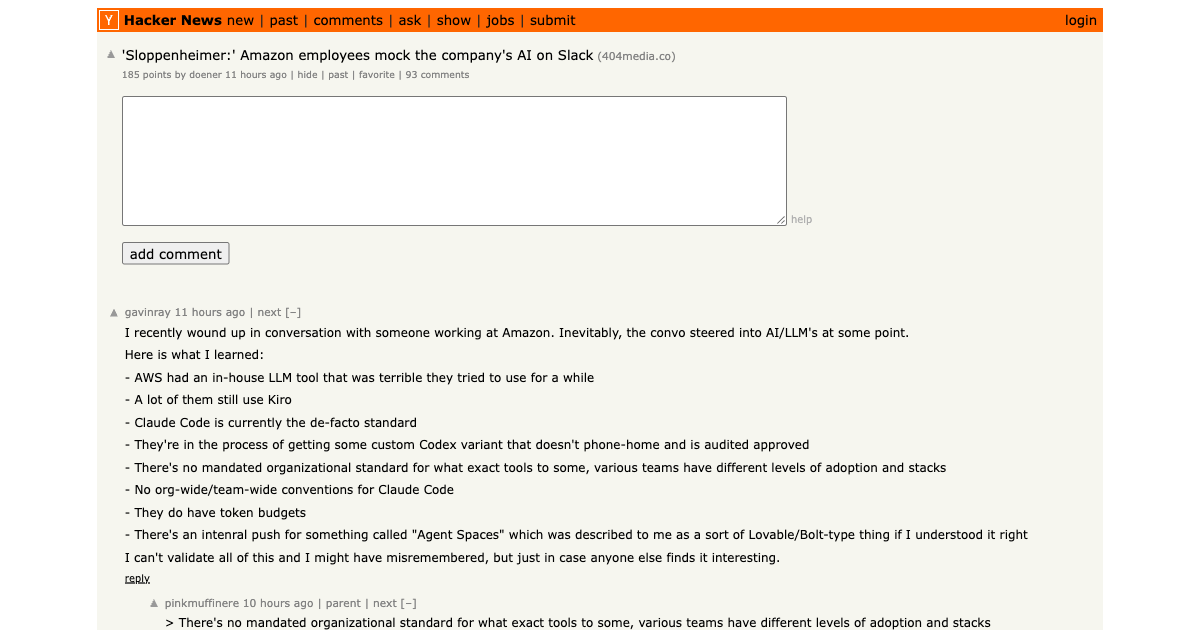
The same week, Jesse Skinner published “Cleaning Up After AI Rockstar Developers” and it hit the top of Hacker News with 264+ comments. He’d inherited a Next.js app that required 10GB of RAM to compile, contained thousands of lint errors, and had been “vibe coded” across dozens of different AI chat sessions. His description landed like a punch:
“A vibe coded pile of slop wasn’t written by a single artificial developer. It was generated across many different chats, and many different contexts. It’s like a codebase written by hundreds of different rockstars, one feature at a time.”
These aren’t isolated incidents. They’re symptoms of an industry-wide structural problem: AI coding agents have 10x’d code generation, but human review capacity hasn’t moved. The bottleneck was never writing code. It was always judging whether code should ship.
The Numbers: 4.6x Longer Wait, 67% Failure Rate
LinearB’s 2026 Software Engineering Benchmarks Report analyzed 8.1 million pull requests across 4,800+ organizations and found the bottleneck in hard numbers:
- AI-generated PRs wait 4.6x longer before a human reviewer even opens them
- 67.3% of AI-generated PRs fail on first review, compared to 15.6% for human-written code
- AI PRs are 154% larger on average and contain 75% more logic errors
- Teams generating 25-35% more code with AI see 91% longer PR review times
That last number is the one that should alarm engineering leaders. The productivity gain from AI code generation is being eaten — and then some — by the downstream review cost. You’re not shipping faster. You’re shipping more code into a queue that’s growing faster than it drains.
GitHub’s own data confirms the scale: more than one in five code reviews on GitHub now involve an agent. Copilot code review has processed 60 million+ reviews, with 10x growth in under a year. The flood is real, and it’s accelerating.
A freeCodeCamp guide on the PR review bottleneck put the experience bluntly: “Within weeks of widespread AI adoption, my review queue doubled, then tripled. Engineers were opening PRs faster than I could read them. I was the bottleneck, and my team’s velocity was capped by my reading speed.”
The Silent Debt: Reviewers Feel Good While Quality Drops
Here’s the counterintuitive part. A paper presented at MSR ‘26 — “More Code, Less Reuse” — studied AI-generated pull requests in real repositories and found that LLM agents frequently ignore code reuse opportunities, producing higher levels of redundancy. But reviewers don’t catch it. The paper found that reviewers tend to express more neutral or positive emotions toward AI-generated contributions than human ones.
The debt accumulates unnoticed. A related empirical study confirmed that AI-generated code introduces measurably more technical debt per change than human-written code across real-world repositories. The green checkmark on CI is hiding a growing problem.
Stack Overflow’s blog named the cognitive dimension that LinearB’s numbers miss: decision fatigue. “If we’re shifting the majority of software work from coding to making decisions, everyone will feel the strain of decision fatigue. 80% of AI-generated content is edited before finalization, and for AI-generated code, the context needed is greater since no one wrote the original code.”
Addy Osmani, engineering lead on the Google Chrome team, put the reframe cleanly: “Code review in the age of AI is a different job. Reviewers aren’t validating correctness — they’re judging necessity.”
And Leonardo Stern at Agoda told InfoQ the quiet part out loud: “While AI coding tools have measurably raised individual developer output, the resulting velocity gains at the project level have been surprisingly modest, because coding was never the real bottleneck.” The bottleneck has always been upstream — specification and verification. AI accelerated the part that was already fast.
Meanwhile, LogRocket’s analysis surfaced a telling stat: 68% of senior engineers report quality improvement from AI coding tools, but only 26% would ship AI-generated code without human review. That 42-point gap is the trust deficit. Engineers feel more productive, but they don’t trust the output enough to merge it.
FrontierCode: The Benchmark That Measures Mergeability
The testing problem goes deeper than failing PRs. The benchmarks we’ve been using to evaluate coding agents were measuring the wrong thing.
Cognition’s FrontierCode benchmark redefines success from “does it pass tests” to “would a human maintainer actually merge this?” Their finding: over half of SWE-bench outputs are unmergeable — they pass tests but fail on scope, style, maintainability, or regression safety. Three thousand maintainer-authored rubrics, each task requiring 40+ hours of expert work, evaluate what the green checkmark never could.
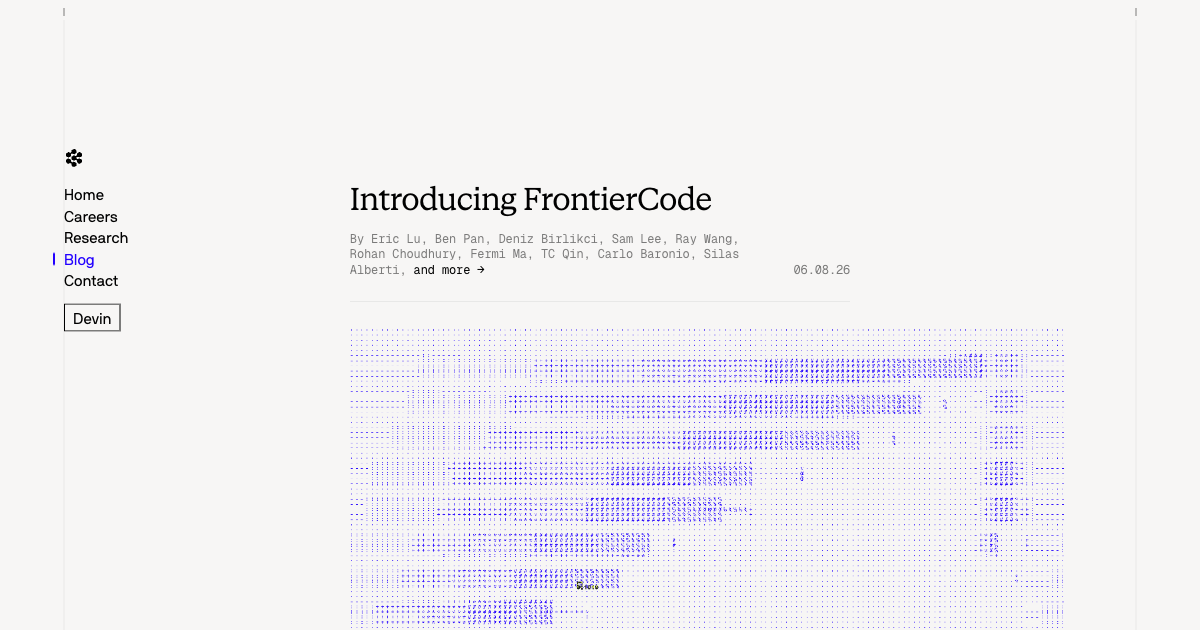
The leaderboard results are sobering:
| Model | FrontierCode Diamond | FrontierCode Gold | Notes |
|---|---|---|---|
| Claude Opus 4.8 | 13.4% | — | Best overall, still fails 86.6% of hard tasks |
| GPT-5.5 | 6.3% | — | Less than half of leading score |
| Other frontier models | 2-5% | — | Rapidly diminishing returns |
Even the best model in the world produces output that a human maintainer would actually merge only 13.4% of the time on the hardest tasks. The green checkmark was always an insufficient gate.
Latent Space’s coverage validated the significance: “FrontierCode shifts focus from whether AI code merely runs to whether human maintainers would actually accept it into production repositories.” For teams evaluating AI coding agents, this benchmark matters more than SWE-bench ever did — because it measures what your reviewers care about.
Enterprise Playbooks: How the Leaders Are Building the Gate
The organizations getting this right aren’t buying a review tool and calling it done. They’re building review infrastructure with evaluator-agent handoff patterns.
Meta’s RADAR: Risk-Calibrated Auto-Approve
Meta’s RADAR system (Risk-Aware Diff Auto Review) is the most sophisticated implementation we’ve seen. It reduces median time-to-close by over 330% and median diff review wall time by 35% — not by skipping review, but by calibrating it. RADAR applies distinct criteria to different automation source types: deterministic codemods, AI-generated codemods, and RACER runbooks each get evaluated against a risk model trained on Meta’s internal data.
The key insight: not all AI-generated changes carry the same risk. A bot that renames a CSS class across 400 files doesn’t need the same scrutiny as a bot that refactors authentication logic. RADAR scores risk and auto-approves what’s safe, freeing human reviewers for what actually needs judgment.
PyTorch’s team has already begun open-sourcing their implementation, noting candidly: “Many PRs to PyTorch are AI-authored, and there have been obvious growing pains.” Their playbook, assembled after the May 2026 compiler offsite, includes an open-source reimplementation of RADAR. If your codebase is large enough to feel the pain, this is the pattern to study.
Cloudflare’s Multi-Agent Review Orchestra
Cloudflare’s approach scales differently. Rather than a single reviewer, they deploy up to seven specialized review agents — focused on security, performance, code quality, documentation, release management, and compliance. A coordinator agent deduplicates findings, gauges severity, and posts one clean comment.
The numbers from one month of production use: 131,246 runs across 48,095 merge requests in 5,169 repos. 159,103 findings including 6,460 flagged as critical. 93% R&D adoption. This isn’t a pilot. It’s infrastructure.
The pattern — specialized agents reporting to a coordinator, which synthesizes into a single actionable review — is what we’d call the “review sandwich.” AI does the first pass (breadth), a coordinator compresses the signal (synthesis), and human reviewers focus on architecture and business logic decisions (judgment). If you’re building agent architectures for your team, this is the reference implementation.
The Tooling Landscape: What $15-25 Per Review Buys You
The market has responded to the bottleneck, and the pricing tells you something about the value.
Anthropic launched Claude Code Review in March 2026, using multiple agents working in parallel — each examining the codebase from a different perspective, with a final agent aggregating and ranking findings. Price: $15 to $25 per review. That’s not a commodity price. That’s the price of work that matters.
But the pricing also creates a math problem at 10x volume. If your team was reviewing 50 PRs/week and now reviews 500, even at $15/review you’re looking at $7,500/week in AI review costs — on top of the AI generation costs that created the PRs in the first place.
Greptile’s benchmarks with NVIDIA Nemotron show one path to cost reduction: Nemotron 3 Ultra delivered roughly 4.5x cheaper per classification with a 78% cost saving while maintaining frontier-quality accuracy. For teams running cost-conscious agent stacks, the model choice for review agents matters as much as the model choice for generation.
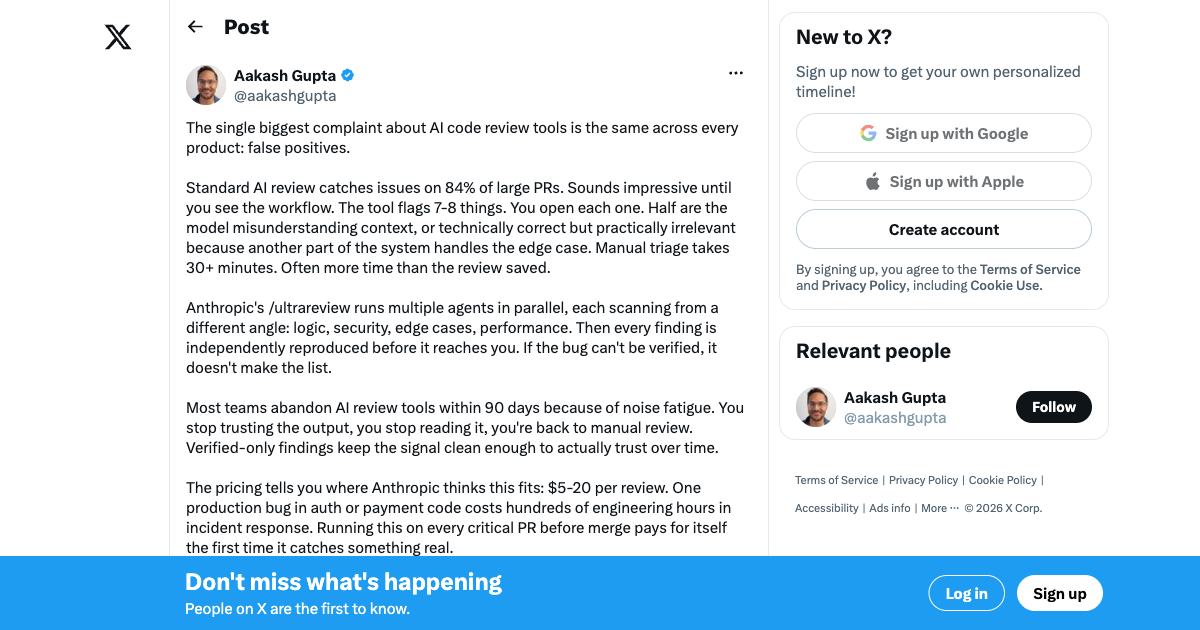
But the tool market has its own quality problem. Aakash Gupta nailed the core complaint: “Standard AI review catches issues on 84% of large PRs. Sounds impressive until you see the workflow. The tool flags 7-8 things. You open each one. Half are the model hallucinating.” False positives erode the trust that review tools need to actually reduce cognitive load.
And then there’s the dark side. Aiden Bai called out unsolicited AI review bots spamming open-source PRs: “Please don’t do this — some random AI code review company (I didn’t sign up for!) is spamming my PRs with slop. This is a huge time waste and should be banned.”
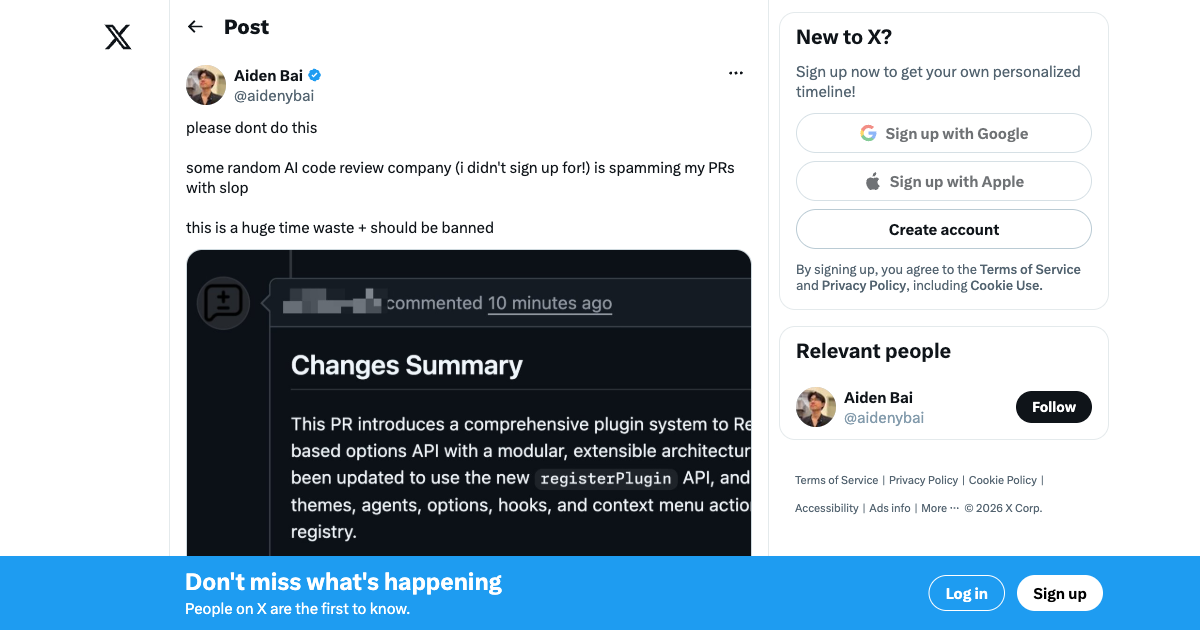
Bad AI review tooling doesn’t solve the bottleneck. It adds another layer to it.
Prevention Over Detection: AGENTS.md and Upstream Quality
The smartest pattern isn’t better review tooling. It’s reducing what needs to be reviewed.
AGENTS.md is an emerging open standard — a simple format for guiding coding agents that’s already read natively by Claude Code, Codex CLI, Cursor, Aider, Devin, Copilot, Gemini CLI, Windsurf, and Amazon Q. The premise: “Without proper guidance, code review cycles balloon as humans catch the same drift over and over. With AGENTS.md, agents produce mergeable PRs faster and behavior stays consistent across teammates using different tools.”
This is preventive quality control. Instead of catching problems in review, you specify constraints upstream — naming conventions, file structure rules, testing requirements, forbidden patterns — so agents produce mergeable output the first time. GitHub’s review heuristics point in the same direction: “Any change that weakens CI is a blocker. For every new helper or utility in an agent PR, do a quick search — if you find an equivalent, don’t leave a comment. Require consolidation before merge.”
For teams already running structured harnesses, the AGENTS.md standard is a natural extension — it’s the configuration file that tells your harness what “good” looks like before the agent writes a single line.
What to Actually Build: The Review Gate Pattern
If you’re an engineering leader reading this, here’s the operational playbook distilled from the organizations that have solved it:
1. Triage by risk, not by source. Meta’s RADAR proves the pattern: auto-approve low-risk mechanical changes (renames, dependency bumps, test backfills). Route medium-risk changes through AI review agents. Reserve human review for architecture decisions, security-critical paths, and business logic. The cost of reviewing everything equally is higher than the cost of building a risk classifier.
2. Deploy specialized reviewers, not general ones. Cloudflare’s seven-agent architecture works because each agent has a narrow focus. A security reviewer that only looks for injection vectors produces fewer false positives than a general reviewer that looks at everything. Build or buy reviewers with clear, narrow mandates.
3. Measure mergeability, not just test-passing. If your CI gate is “tests pass and lint is clean,” you’re measuring the wrong thing. FrontierCode’s rubrics — correctness, tests, scope, style, and maintainability — are what human reviewers actually evaluate. Build these into your automated gates.
4. Invest in upstream specification. AGENTS.md, codebase conventions documents, PR templates with required sections — the cheapest review is the one you don’t need to do because the agent got it right the first time. Teams using operator playbooks for their coding agents already know this: the quality of the output is determined by the quality of the input.
5. Budget for the review layer explicitly. If you’re budgeting for AI coding tools, you need to budget for AI review tools at 1.5-2x the generation cost. The $15-25/review price point from Anthropic, the infrastructure cost of running Cloudflare’s multi-agent system, the engineering time to build RADAR-style risk classifiers — none of this is free, and none of it is optional at scale.
The Uncomfortable Truth
Most teams are buying AI code review tools to solve a problem created by AI code generation tools — often from the same vendors. The circularity isn’t lost on anyone. Rohan Varma’s comparison of Anthropic’s $25/review versus Codex Review at ~$1/run captures the market’s confusion about what review is even worth.
The real gate isn’t another AI reviewer. It’s the organizational willingness to say “slower is fine” when the alternative is shipping slop. The teams that build the review infrastructure — risk classifiers, specialized agents, upstream specifications, mergeability benchmarks — will ship better software at scale. The teams that just crank up agent throughput and hope review sorts itself out will end up with their own Sloppenheimer channels.
The agents are shipping. The question is whether anyone is checking.
For more on building production-grade agent architectures, see our guides on agent observability, the agent judge layer, and coding agent security.