Field report · · AgentConn Team
The Fable 5 Receipts: What AI Coding Shipped
A ported game, 50M lines of Ruby, and a $149 invoice. Here's what Claude Fable 5 actually delivered this week.
The conversation about AI coding shifted this week. Not because of a benchmark. Not because of a demo. Because three practitioners showed their receipts.
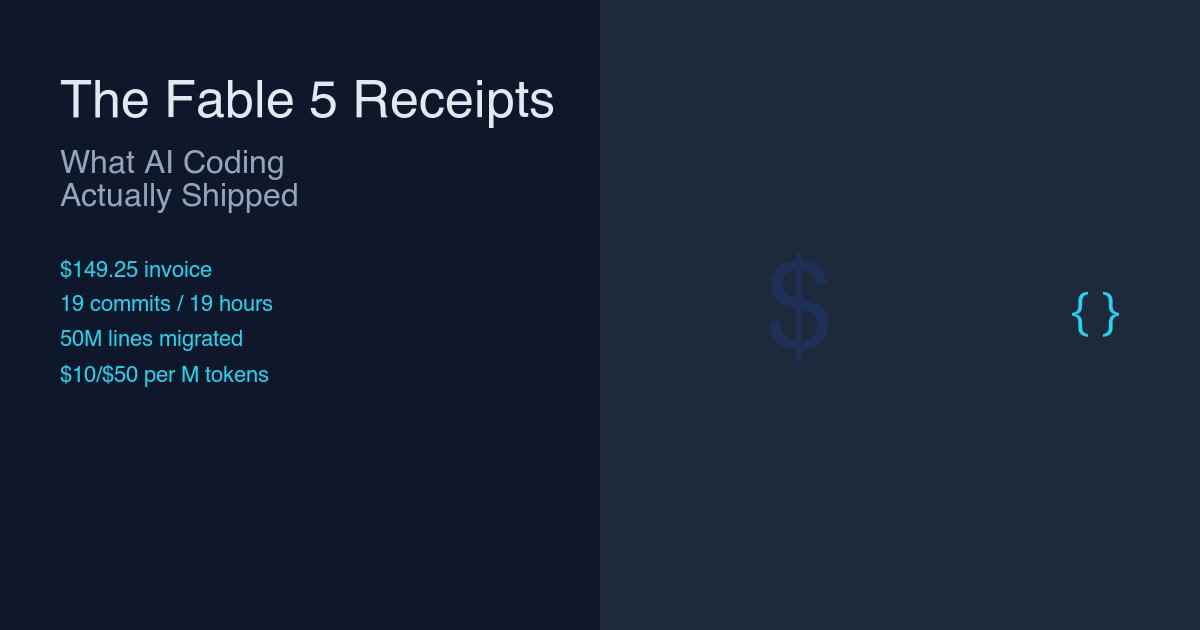
Simon Willison published the exact cost of shipping an open-source release mostly written by Claude Fable 5: $149.25. A developer ported a 23-year-old game engine to the iPhone in under 19 hours. And Stripe reportedly ran a 50-million-line Ruby migration with Fable 5 in a single day — work their team estimated would take two months.
These aren’t toy demos or benchmark scores. They’re production artifacts with costs, commit histories, and deployment logs. Together, they map both the real capability of AI coding agents in mid-2026 and the caveats that matter.
Receipt #1: The $149.25 Invoice
On July 5, Simon Willison — one of the most meticulous practitioners in the AI tools space — published a blog post with a title that reads like a line item: “sqlite-utils 4.0rc2, mostly written by Claude Fable (for about $149.25).”
sqlite-utils is a widely-used Python library for manipulating SQLite databases. The 4.0 release candidate isn’t a weekend project — it’s a significant refactor with migrations, nested transactions, and breaking changes that Willison wanted to land while Fable 5 was still available on Max subscriptions.
What makes this receipt unusual isn’t the amount. It’s the specificity. Willison published the exact token costs, documented each session, and noted where Fable excelled and where it needed correction. During a final review, Fable identified five significant problems categorized as release blockers — issues Willison hadn’t caught in his own passes.
The $149.25 figure represents the total API spend across the entire development cycle. For context, at Fable 5’s pricing of $10 per million input tokens and $50 per million output tokens, that’s roughly the cost of three hours of a mid-level developer’s time in a major tech hub.

The Hacker News discussion generated hundreds of comments, splitting between developers who saw this as validation of AI-assisted coding and those who argued that Willison’s deep expertise in the project was doing the heavy lifting — that Fable was a force multiplier, not a replacement.
Both are right. The receipt proves Fable can produce shippable code at a fraction of traditional development costs. But it also proves that the human operator’s domain knowledge is what makes the output production-grade rather than plausible-looking.
Receipt #2: The 19-Hour Port
On the same weekend, developer Ammaar Reshi posted a video on X showing Command & Conquer: Generals Zero Hour — a 2003 real-time strategy game — running natively on an iPhone. Not through an emulator. The actual C++ engine, compiled for ARM64, with touch controls, drag-select boxes, and pinch-to-zoom camera support.
The project was only possible because Electronic Arts released the Generals source code under the GPL v3 license. The GeneralsX community had already spent months getting the engine compiling on macOS. Reshi used Fable 5 via Claude Code to handle the final leap: adapting the engine for iOS, building touch input handlers, and wiring up MoltenVK for the rendering pipeline.

The first build took 40 minutes. The debugging phase — fixing input handling, camera controls, and platform-specific edge cases — took a few additional hours. The entire project landed in 19 commits over 19 hours.
One detail that matters for evaluating the claim: Opus 4.8 couldn’t complete the same task even at its highest “ultra” effort setting. This isn’t a case of “any good model could do it.” The Fable 5 capability jump — the 1-million-token context window, the sustained focus across long agentic sessions — was load-bearing.
ℹ️ The C&C port is a sweet spot for AI coding: a well-structured legacy codebase with clear compilation targets, existing community infrastructure, and a developer who understood the architecture. It’s impressive. It’s also not the same as greenfield systems design.

The Hacker News thread hit 633 points. The response pattern was telling — more game developers asking “what else could we port?” than skeptics arguing it doesn’t count.
Receipt #3: The 50-Million-Line Migration
The largest claim is also the hardest to verify independently. On June 9, Anthropic published a customer signal from Stripe: Fable 5 performed a codebase-wide migration on their 50-million-line Ruby codebase in a day, where the manual path would have taken a team over two months.
The migration involved a core internal API pattern used throughout the codebase — thousands of files, each requiring individual inspection and transformation. This is exactly the kind of work that enterprise engineering teams dread: mechanically repetitive, error-prone, and impossible to parallelize with humans because every file has its own edge cases.
⚠️ The “50 million lines in a day” framing deserves scrutiny. Stripe’s team still had to validate every change against live environments, review the output, and decide what to ship. The implementation time compressed. The review time didn’t. As one engineer put it: “The ratio of implementation time to review time inverts.” That’s a real and important shift — but it’s not the same as “an AI wrote 50 million lines of code.”
What the Stripe case actually demonstrates is that Fable 5 excels at a specific class of work: large-scale, pattern-based transformations across codebases too big for any individual to hold in their head. The 1-million-token context window and Fable 5’s persistent file-based memory mean it can track patterns across thousands of files without losing coherence.
For enterprise teams evaluating AI coding tools, the Stripe case is the most practically relevant receipt of the three — not because of the headline number, but because it maps directly to the kind of engineering work that consumes months of team bandwidth every quarter.
The Bottleneck Shift
These three receipts, taken together, map a pattern that a Fable 5 engineer articulated this week: “You, not the model, are now the limit.”
That’s provocative, but the receipts support a more nuanced version of it:
Where AI coding works right now:
- Legacy code transformations with clear structure (C&C port)
- Pattern-based migrations across large codebases (Stripe)
- Well-scoped library work with a knowledgeable operator (sqlite-utils)
- Reverse engineering with tool integration (Claude + Ghidra MCP workflows)
Where it doesn’t — yet:
- Greenfield architecture decisions that require product judgment
- Anything where the operator can’t evaluate the output
- Novel algorithm design (as opposed to applying known patterns)
- Systems where correctness matters more than coverage

The honest read is that AI coding agents have crossed the threshold from “interesting demo” to “production tool” — but only for operators who can direct them with precision. The $149 invoice produced a release candidate because Willison knew exactly what sqlite-utils 4.0 needed to be. The game port worked because Reshi understood the architecture and the community had already done the macOS groundwork. The Stripe migration worked because the pattern was well-defined.
What This Means for Coding Agent Stacks
The pricing math matters. At $10/$50 per million tokens, a day of heavy Fable 5 coding agent usage costs roughly $200–$400. Anthropic’s own enterprise figures put median daily spend at $13 per developer, with 90% under $30.
For comparison, a mid-level software engineer in San Francisco costs roughly $600–$800 per day fully loaded. The ROI case for pattern-based work — migrations, refactors, test generation, code review — is straightforward. The ROI case for creative engineering work is murkier.
After July 7, Fable 5 moves to usage-based credits rather than being bundled with subscriptions. Teams that built workflows around uncapped Fable 5 access will face real cost discipline for the first time. This is likely to sharpen the distinction between “Fable for everything” and “Fable for the specific tasks where it demonstrably outperforms humans.”
The coding agent ecosystem is already pricing in this distinction. Multi-model routers that dispatch to the cheapest model capable of each subtask are gaining traction. Agent harness builders that survived the Fable 5 export ban proved that orchestration — not any single model — is the durable investment.
The receipts this week don’t change that picture. They sharpen it. The model is genuinely better. The operator still matters more.
For more on building resilient coding agent stacks, see our complete guide to AI coding agents and the DeepClaude vs Claude Code cost comparison.