Field report · · AgentConn Team
The Escalation Pattern
Let a cheap agent call Opus only when stuck. Near-Opus accuracy at 3-4x lower cost-per-task.
The Escalation Pattern
Every team running agents in production has the same complaint: the bill. Not the model price per token — that drops every quarter. The cost per completed task. A coding agent that burns through forty Opus turns to fix a bug nobody asked it to fix. A research agent that escalates every query to the frontier tier because its routing classifier was trained on the wrong distribution. An orchestrator that inherits the parent session’s model by default and quietly racks up a four-figure daily spend.
The GitHub trending page tells the story: OmniRoute hit 11,190 stars in a single week. Orca, a parallel coding-agent manager, followed with 7,205. Twelve of the top fifteen repos on any given week in Q3 2026 were agent infrastructure — and the pattern that unifies them is not “better models.” It is better routing.
But routing has a blind spot. A router picks a model before the task starts. It classifies the prompt, assigns a tier, and hopes it guessed right. The escalation pattern fixes that blind spot: a cheap model runs the task, and calls a stronger model only when it gets stuck. Not before. Not after. Mid-task, at the moment uncertainty peaks.
Anthropic shipped this as the advisor tool in April 2026. The research community formalized it in three papers over the summer. And the economics are clear: near-Opus accuracy at three to four times lower cost per task.
This article breaks down how the escalation pattern works, when it fails, and how to implement it today.
Routing vs. Escalation: The Core Distinction
The agent cost stack has two primitives, and most teams only use one.
Routing classifies a request before generation. A small classifier model — or even a rule-based heuristic — examines the prompt and sends it to Haiku, Sonnet, or Opus. RouteLLM, the open-source routing framework from LMSYS and UC Berkeley, is the canonical implementation. Its matrix factorization router achieves 95% of GPT-4 performance while sending only 26% of requests to the expensive model — roughly 2x cost savings on standard benchmarks.
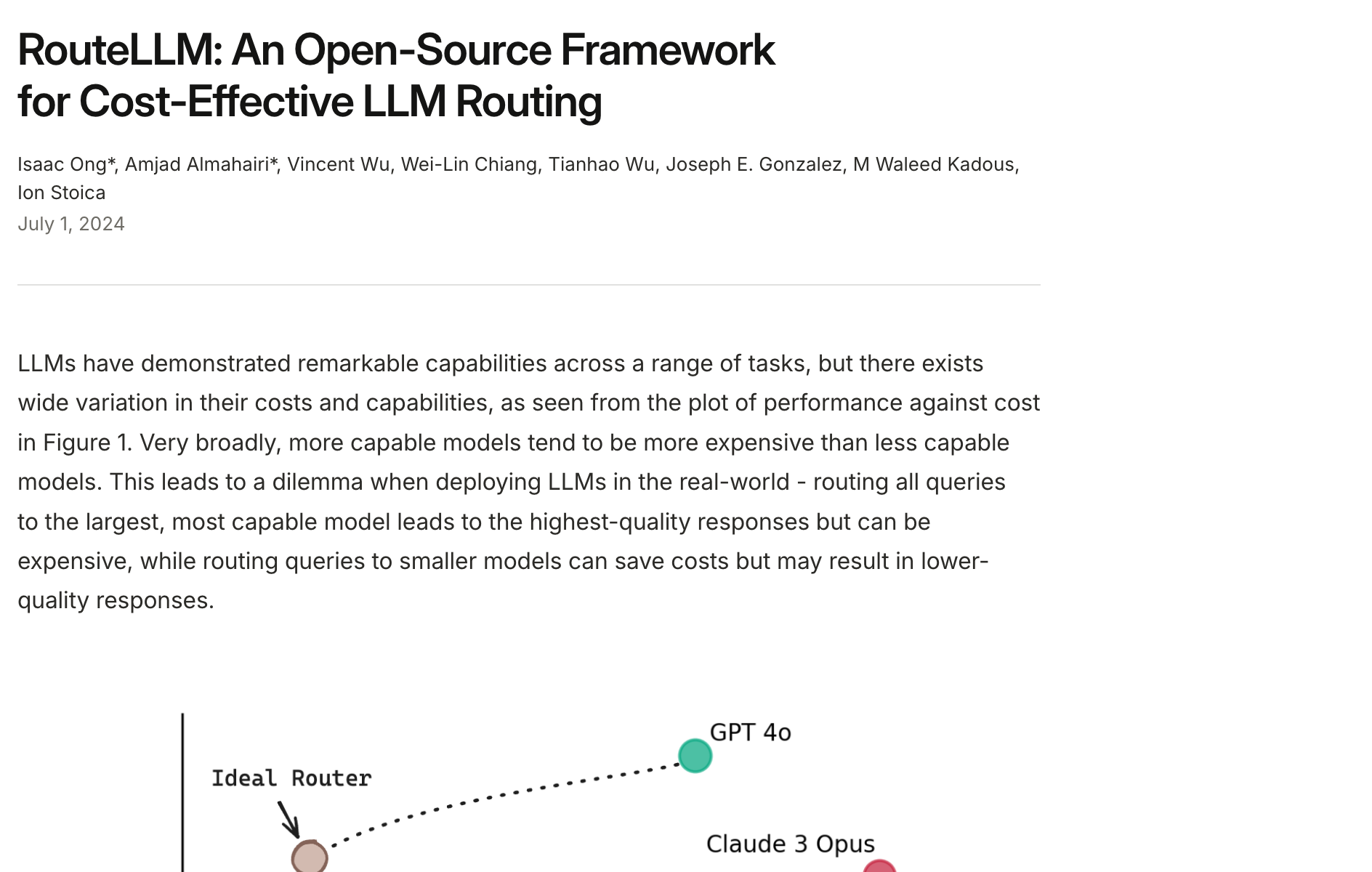
View original post on LMSYS blog →
The problem: routing commits to a model before seeing the task unfold. A prompt that looks simple (“refactor this function”) might require architectural reasoning three steps in. A prompt that looks hard (“design a distributed cache”) might decompose into straightforward subtasks. The router guesses based on surface features and locks in.
Escalation is different. The cheap model starts the task and keeps running until it hits a wall. Then — and only then — it calls the stronger model for guidance. The cheap model decides when to escalate, not a classifier. The stronger model advises, and the cheap model continues with that advice.
The distinction matters for cost. With routing, every hard task pays the full frontier price from token one. With escalation, the cheap model handles the easy prefix — often 70-90% of the tokens — and the frontier model only sees the hard decision point. The FrugalGPT paper from Stanford formalized this as the “LLM cascade” in 2023, reporting up to 98% cost reduction on its benchmarks while matching GPT-4 quality.
We covered the static version of this in Opus Plans, Haiku Executes. The escalation pattern is the dynamic upgrade: the cheap model is not just executing — it is also detecting when it needs help.
Anthropic’s Advisor Tool: Escalation as a Primitive
On April 9, 2026, Anthropic shipped the advisor tool as a beta feature on the Claude Platform API. It is the first provider-native implementation of the escalation pattern.
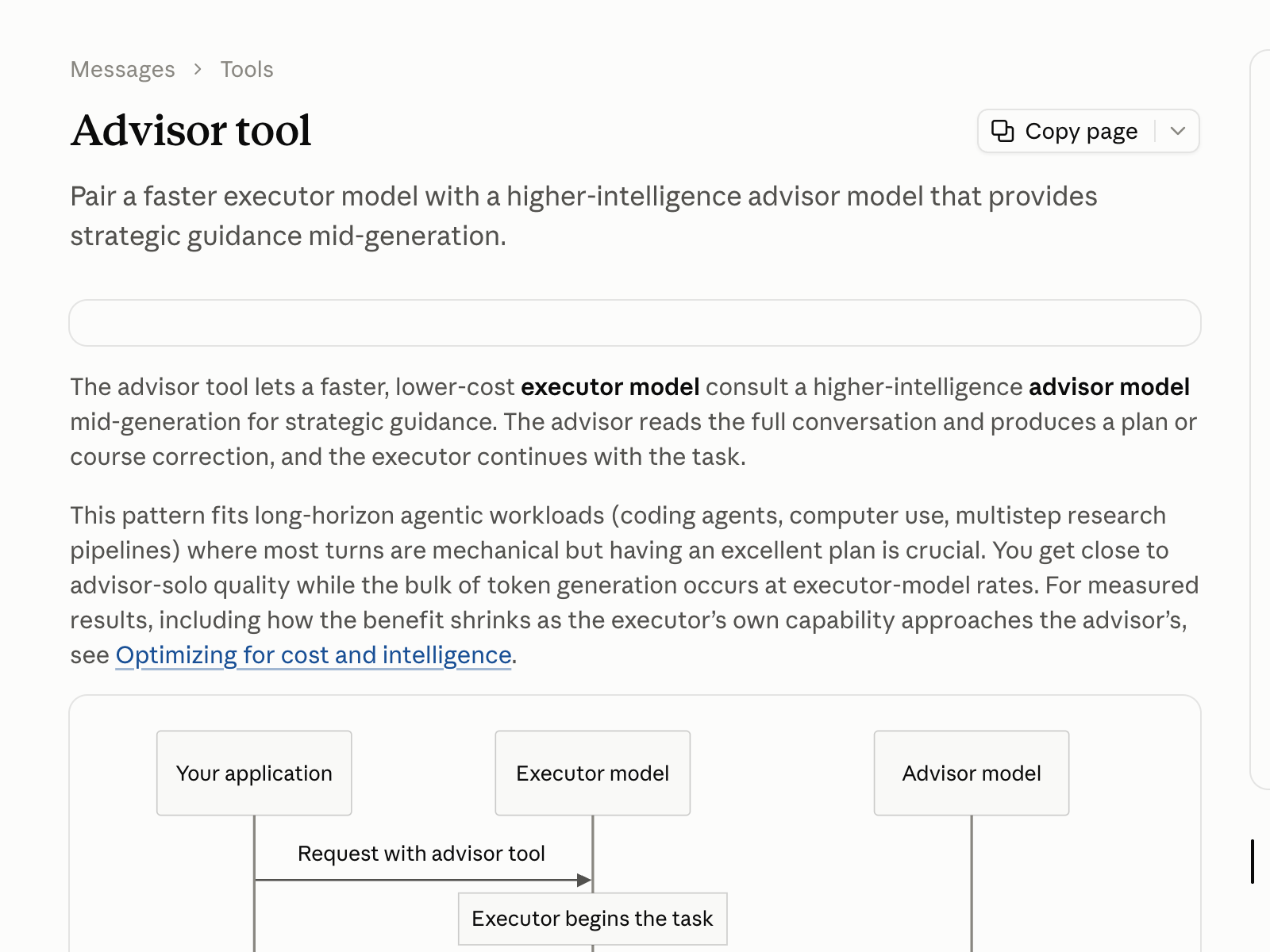
View original documentation on Claude Platform →
Here is how it works. You add one tool declaration to a standard Messages API request:
response = client.beta.messages.create(
    model="claude-sonnet-4-6",       # executor (cheap)
    max_tokens=16000,
    betas=["advisor-tool-2026-03-01"],
    tools=[{
        "type": "advisor_20260301",
        "name": "advisor",
        "model": "claude-opus-4-8",  # advisor (expensive)
        "max_tokens": 2048,          # cap advisor output
        "max_uses": 5,               # cap calls per turn
    }],
    messages=[{
        "role": "user",
        "content": "Build a concurrent worker pool in Go..."
    }],
)
The executor model (Sonnet) runs the task. When it decides it needs help — when it is stuck on a design decision, uncertain about an edge case, or facing a problem that exceeds its reasoning depth — it emits a tool call to the advisor. Anthropic runs a separate inference pass with Opus, passing the full transcript as context. The advisor’s response flows back as a tool result, and the executor continues.
The key design choice: the executor decides when to escalate. There is no external classifier, no confidence threshold, no separate routing layer. The cheap model’s own uncertainty signal triggers the call. Anthropic’s documentation shows you can nudge this behavior with system prompt guidance — “consult the advisor before writing code” or “consult when changing approach” — but the decision is the executor’s.
What the benchmarks show
Anthropic’s internal results, published in the advisor tool documentation, report:
- Haiku 4.5 + nudge: roughly +7 percentage points on task pass rate compared to Haiku alone
- Haiku coding variant: +7.5 points on an internal coding benchmark
- Sonnet medium effort + Opus advisor: matches Sonnet at default effort for coding, at lower cost
- max_tokens: 2048 on advisor calls reduced mean advisor output about 7x (roughly 630-840 tokens vs 4,200-5,900 uncapped) with approximately 0% truncation
The cost structure: most output tokens come from the cheap executor. The advisor typically generates 400-700 text tokens per call. A Sonnet executor with an Opus advisor costs similar to or less than running Opus alone, with quality closer to the advisor’s level.
/v1/messages request. No extra round trips from your application. No separate service to deploy. No routing classifier to train. Add the tool declaration, and the executor model handles the rest.
The Community Signal
The escalation pattern is not just Anthropic’s bet. The broader developer community has converged on model routing and escalation as the critical cost lever for 2026.
View original article on BuildFastWithAI →
Practitioners on Reddit report real savings. One builder split an agent into a cheap router and a premium synthesis model and reported roughly 78% cost reduction on about 1,400 companies. Another moved routine LangGraph sub-tasks off the top-tier model, taking daily spend from $300 to $63. The most useful pushback: “The escalation layer is effectively a risk system. The expensive mistake is routing the wrong thing as safe and letting the agent continue.”
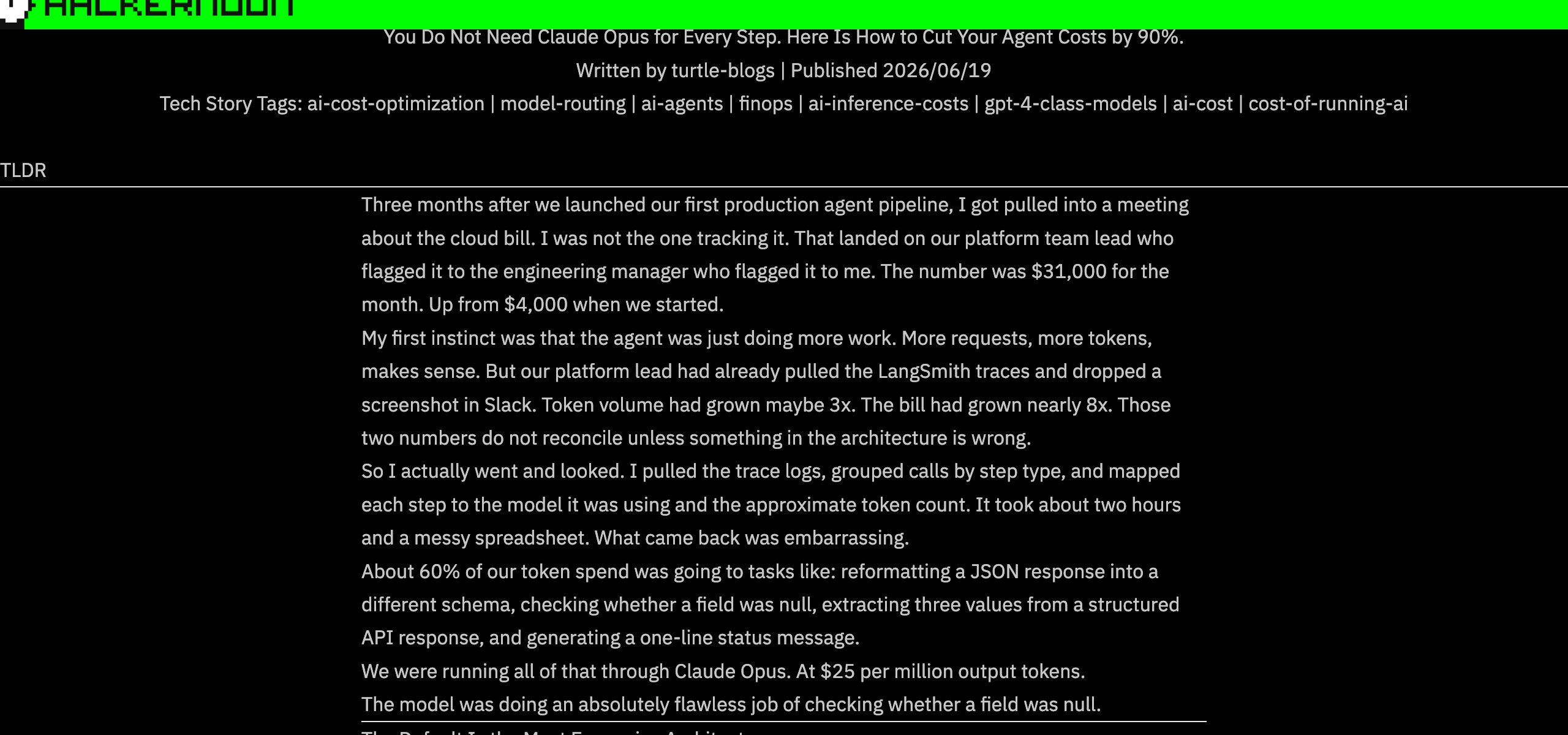
View original article on HackerNoon →
Splunk’s engineering blog frames model routing as the primary cost optimization for agent infrastructure, recommending that teams “keep a frontier model in charge of planning and high-consequence decisions, then send well-scoped execution work to smaller models.”
View original article on Splunk →
The Research Stack: When Escalation Works (and When It Doesn’t)
Three papers from summer 2026 formalize the escalation pattern and expose its failure modes.
TACIT-Switch: Learning When to Hand Off
TACIT-Switch (Lei and Huang, August 2026) is the first paper to treat escalation as a learned policy rather than a fixed threshold. The core idea: train a model to recognize when accumulated trajectory evidence suggests the cheap model is going to fail, and switch to the expensive model at that point.
The results: 7.4 to 11.1 percentage points improvement over task-level, step-level, and fixed-prefix routing baselines at comparable cost. On a 274-instance software engineering benchmark, TACIT-Switch achieved 55.1% success at a cost of 176.87, compared to 48.9% for SWE-Router at 192.75. The pure large model reached 59.5% at 208.02 — better, but 18% more expensive.
The practical takeaway: escalation timing matters more than most teams realize. A fixed “escalate after N turns” policy leaves money on the table. A learned policy that watches for specific failure signals — repeated corrections, circular reasoning, or confidence drops — escalates earlier on hard tasks and never escalates on easy ones.
The Handoff Tax: What Escalation Costs
The Handoff Tax (August 2026) is the skeptic’s paper. It studies what happens when an agent switches models mid-task and finds that the handoff itself carries a quality penalty.
The headline finding: full-trajectory escalation recovers less than half of the low-cost-to-high-cost quality gap while incurring a substantial cost premium. When you switch from Haiku to Opus mid-task, Opus has to pick up where Haiku left off — and Haiku’s trajectory may have already committed to a suboptimal approach.
The interesting nuance: downshift offers a favorable cost-quality point. Starting with Opus for the hard planning phase and then handing off to Haiku for execution works better than the reverse. This aligns with the Opus Plans, Haiku Executes pattern we covered previously, and it explains why the advisor tool works: Opus advises but does not take over. The executor keeps its own trajectory.
RouteLLM’s Distribution Shift Problem
A Stanford review from October 2026 found that RouteLLM’s Arena-trained routers fall to the level of a random router on MMLU — a benchmark with a very different task distribution from the Chatbot Arena preference data the routers were trained on. The router works great on conversational tasks and fails on standardized benchmarks.
This is the fundamental problem with pre-routing: the classifier’s accuracy depends on how well its training distribution matches your production traffic. The escalation pattern sidesteps this entirely. The executor does not need to classify the task’s difficulty up front — it discovers the difficulty as it works.
The GitHub Signal: Agent Orchestration Dominates
The demand signal is not subtle. GitHub’s trending page in Q3-Q4 2026 is dominated by agent orchestration and routing infrastructure:
- OmniRoute — 11,190 new stars in a single week (July 2026). Routes coding tools across multiple model providers from a single endpoint.
- Orca — 7,205 stars. Parallel coding-agent management with cost-aware model selection.
- CascadeFlow — LLM cascade routing framework claiming 60-70% of queries handled by small models without escalation.
- awslabs/cli-agent-orchestrator — Multi-agent orchestration for coding CLIs, coordinating Claude Code, Kiro, and Codex in isolated sessions.
- mattpocock/skills — 311,000+ stars. Skills for agent configuration, including model routing patterns.
The pattern: teams are not building better models. They are building better systems around models. The orchestration layer — routing, escalation, cost controls, observability — is where the engineering effort is going. As we wrote in Stop Chasing Models, Fix Your Harness: the harness is the moat.
The Implementation Checklist
If you are running agents in production and paying more than you should, here is the escalation pattern implementation path, ordered by effort and impact.
Step 1: Instrument what you have (Day 1)
Before changing anything, measure:
- Cost per completed task — not cost per token, not cost per request. The full cost of a task from start to successful completion, including retries.
- Escalation rate — what percentage of tasks require human intervention or fail outright. This is your current implicit escalation rate.
- Turn distribution — how many turns does each task type take? The variance tells you where routing or escalation would help most.
Step 2: Add the advisor tool (Day 2)
If you are on the Claude API, the advisor tool is the lowest-effort escalation implementation. One tool declaration. No routing classifier. No infrastructure changes.
Start with Sonnet as executor and Opus as advisor. Set max_uses: 5 to cap advisor calls per turn, and max_tokens: 2048 to keep advisor responses concise (Anthropic’s benchmarks show no quality loss at this cap). Add a system prompt nudge: “Consult the advisor before writing code and when you are stuck.”
Step 3: Monitor and tune (Week 1-2)
Watch the escalation rate. Anthropic reports that a turn-2 nudge on workloads where the baseline first advisor call came at turn 7+ actually hurt performance by 3-4 points — premature escalation wastes the advisor’s budget on easy problems.
The target: an escalation rate between 15-25%. Below 15%, the advisor is under-utilized and you could be capturing more quality. Above 25%, the cheap tier is not strong enough for your workload and you should consider Sonnet as your base instead of Haiku.
Step 4: Track cost per completed task (Ongoing)
The only metric that matters is cost per completed task at your quality bar. Token cost alone is misleading — a cheap model that fails 30% of the time costs more per successful task than an expensive model that succeeds 95% of the time.
Build a dashboard that shows: tasks attempted, tasks completed, average cost per completion, advisor call rate, and advisor call distribution by task type. This tells you exactly where your escalation budget is going and whether it is paying off.
max_tokens: 2048 on the advisor tool — it reduces advisor output 7x with no quality loss. (2) Enable advisor prompt caching ("caching": {"type": "ephemeral", "ttl": "5m"}) if your agent makes 3+ advisor calls per conversation. (3) Use the usage.iterations[] field to track advisor costs separately from executor costs.
What This Means for You
The escalation pattern is not a hack or a workaround. It is becoming the default architecture for cost-efficient agent systems. Anthropic built it into the API. The research validates the economics. GitHub trending confirms the demand.
The practitioners who will pay the least per completed task in 2026 are the ones who stop thinking about model selection as a one-time decision and start thinking about it as a runtime control loop. The cheap model runs. When it gets stuck, it asks for help. When the help arrives, it keeps going.
That is the escalation pattern. It is the harness primitive that connects model routing to production economics.
The API call is one line. The hard part is measuring whether it is working. Start there.
The escalation pattern fills a gap in the agent harness corpus. For the static version of model-tier routing, see Opus Plans, Haiku Executes. For observability and budget controls, see Agent Observability and Budget.