Field report · · AgentConn Team
Security Skills Hit the Compliance Layer
817 cybersecurity skills mapped to MITRE ATT&CK and NIST. Agent prompt engineering just became an auditable, governed discipline.
Security Skills Hit the Compliance Layer
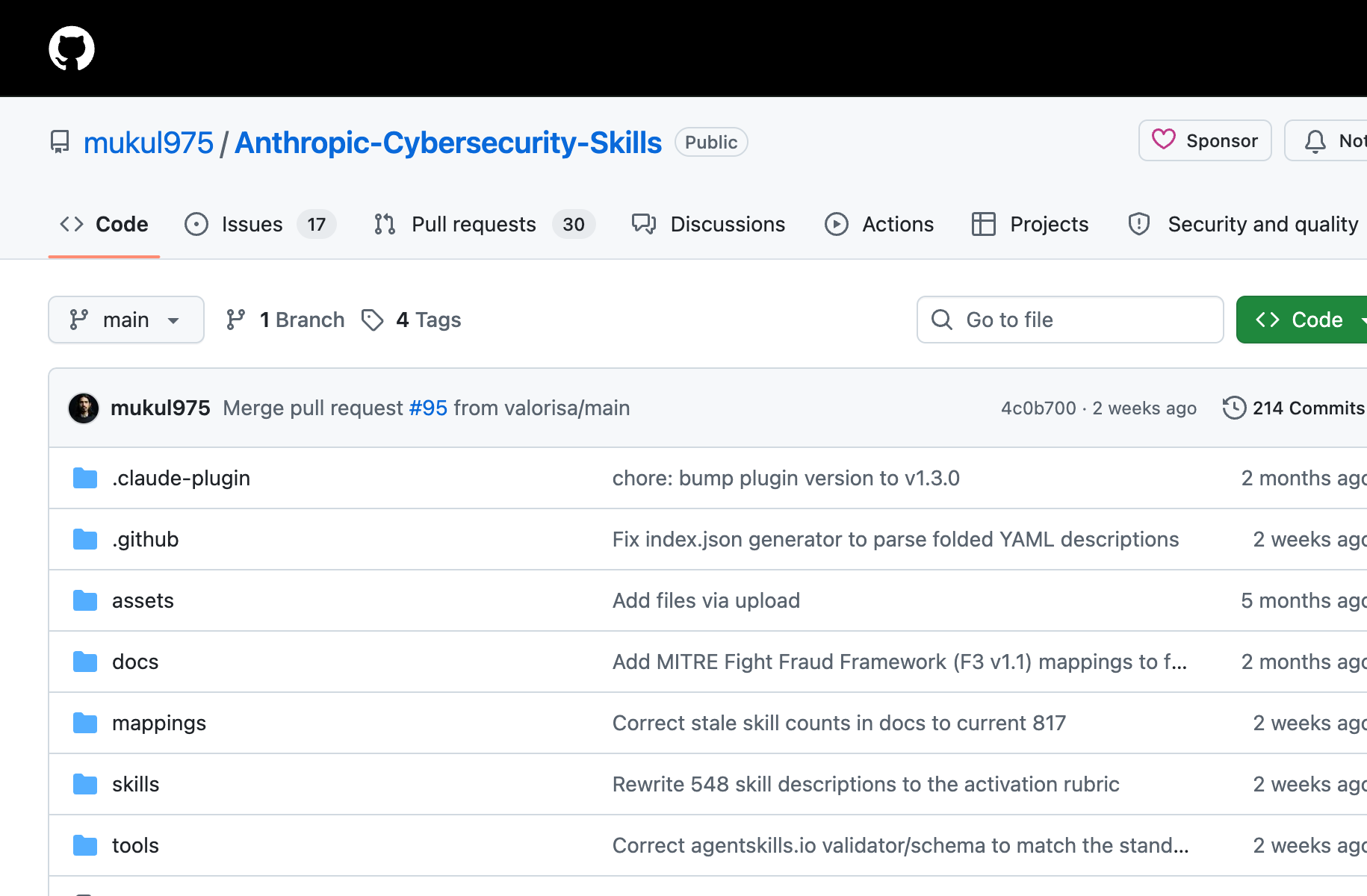
A community-built GitHub repo just crossed 29,000 stars by doing something nobody else bothered to do: map 817 cybersecurity skills to six formal compliance frameworks — MITRE ATT&CK, NIST CSF 2.0, MITRE ATLAS, D3FEND, NIST AI RMF, and MITRE F3 (Fight Fraud). Built by Mahipal Jangra and eight contributors, the Anthropic-Cybersecurity-Skills repository follows the agentskills.io open standard and works with Claude Code, GitHub Copilot, Codex CLI, Cursor, Gemini CLI, and over 20 other platforms.
The name is misleading — this is not an official Anthropic project. It is an independent, Apache 2.0-licensed library that uses Anthropic’s skill format specification. But the substance is real: 817 structured YAML-plus-markdown files spanning 29 security domains, each with explicit framework cross-references, prerequisites, step-by-step workflows, and verification criteria.
Here is the thesis: ad-hoc prompt engineering for security tasks is the new shadow IT. Every security team using coding agents today is shipping unaudited, unversioned, untracked instructions into production workflows. The Anthropic-Cybersecurity-Skills library matters not because of its scale — though 817 skills across 29 domains is substantial — but because it demonstrates what the compliance-ready version of agent security looks like. Framework mappings turn “we use AI for security” from a hand-wave into an auditable claim.
What the Library Actually Contains
The 817 skills cover 29 security domains with coverage weighted toward the areas where agents do the most practical work:
| Domain | Skills | Domain | Skills |
|---|---|---|---|
| Cloud Security | 66 | SOC Operations | 35 |
| Threat Hunting | 58 | Red Teaming | 33 |
| Threat Intelligence | 52 | Container Security | 33 |
| Network Security | 43 | Incident Response | 30 |
| Web Application Security | 42 | Vulnerability Management | 28 |
| Digital Forensics | 41 | Compliance & Audit | 25 |
| Malware Analysis | 39 | Cryptography | 22 |
| Identity & Access Management | 37 | AI/ML Security | 20 |
Each skill follows a precise structure. YAML frontmatter handles discoverability — name, description, domain, subdomain, tags, and framework mapping IDs. The markdown body provides four sections: When to Use (trigger conditions), Prerequisites (required tools, access, knowledge), Workflow (step-by-step execution), and Verification (how to confirm success).
The framework mapping density is what makes this genuinely useful for compliance teams:
- MITRE ATT&CK v19.1: 805 of 817 skills mapped to adversary tactics and techniques
- NIST CSF 2.0: 804 skills mapped to risk management functions
- MITRE D3FEND v1.4: 139 skills mapped to defensive countermeasures
- NIST AI RMF 1.0: 97 skills mapped to AI risk lifecycle
- MITRE ATLAS 2026.07: 93 skills mapped to AI/ML threat techniques
- MITRE F3 v1.1: 94 skills mapped to fraud-specific techniques
The Progressive Disclosure Architecture
The design solves a real token-budget problem. As Mahipal explained on Dev.to: scanning a skill’s YAML frontmatter costs approximately 30 tokens. Loading the full skill — workflow, references, verification — runs 500 to 2,000 tokens. This means an agent can scan all 817 frontmatters for roughly 25,000 tokens (about $0.08 at Claude Sonnet pricing) and only load the 5-10 skills that match the current task.
This is not a minor optimization. Without it, feeding 817 full skills into a context window would consume 400,000 to 1.6 million tokens — burning the entire context budget before the agent does any actual work. Progressive disclosure turns a library into a practical tool.
The installation is trivial:
# Via the skills CLI
npx skills add mukul975/Anthropic-Cybersecurity-Skills

# Or manual clone
git clone https://github.com/mukul975/Anthropic-Cybersecurity-Skills.git
Once installed, the agent’s workflow for a security task looks like this: scan 817 frontmatters, identify matching skills by domain and technique ID, load the full skill files for the matches, execute the structured workflow, map findings to the relevant framework IDs, and output results with embedded compliance citations. The agent stops improvising and starts following auditable procedures.
Why Framework Mappings Change the Game
Here is a question every CISO will eventually face: “Show me which MITRE ATT&CK techniques your AI security agents can detect and respond to.”
Without structured skill mappings, the answer is a shrug. Your agents can probably detect… some things. They ran some commands. The LLM decided what to do based on its training data and whatever prompt your security engineer wrote last Tuesday.
With the Anthropic-Cybersecurity-Skills approach, the answer is a matrix. 805 skills mapped to specific ATT&CK technique IDs. You can generate an ATT&CK Navigator layer showing exact coverage. You can identify gaps — tactics where you have zero or minimal skill coverage. You can track which skills actually executed and whether they reported findings, creating an audit trail that maps to the same frameworks your compliance team already uses.
This is the difference between “we use AI for security” and “we have documented, framework-mapped coverage across these specific threat categories with verifiable execution logs.”
The Broader Ecosystem Context
The Anthropic-Cybersecurity-Skills repo does not exist in isolation. It sits within a rapidly maturing agent skills ecosystem that has exploded throughout 2026.
The agentskills.io open standard, published by Anthropic in December 2025, defines the SKILL.md format: YAML frontmatter plus structured markdown, discoverable by any compliant agent. As of August 2026, roughly 40 platforms have adopted the standard — from OpenAI Codex and GitHub Copilot to Cursor, Gemini CLI, and enterprise platforms like Databricks Genie and Snowflake Cortex. The ecosystem has indexed 1.9 million skills, though quality varies wildly: the average public skill scores only 6.2 out of 12 on quality benchmarks.
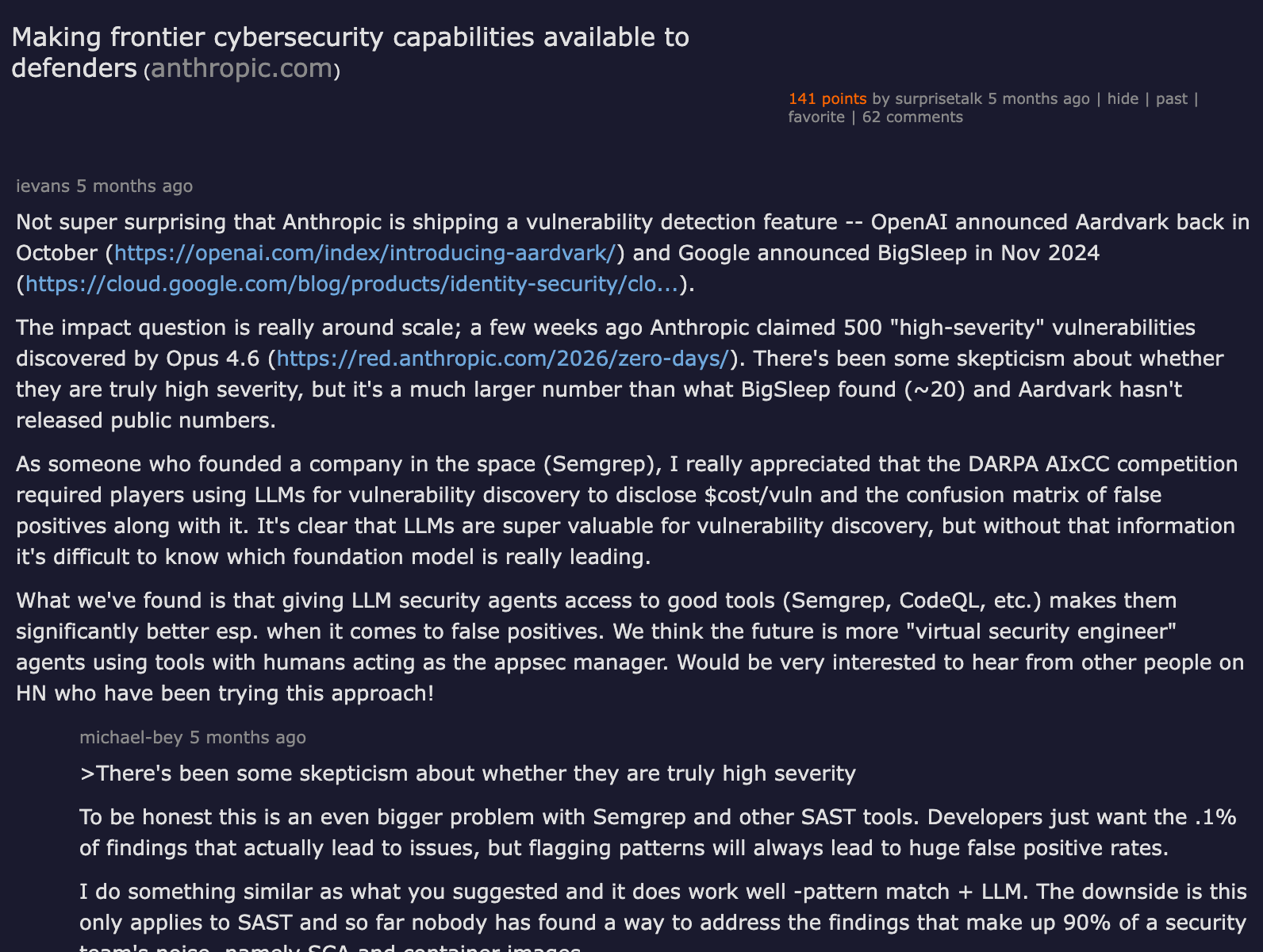
The security angle is not academic. Anthropic’s own Claude Code Security initiative, announced in February 2026, used Opus 4.6 to find over 500 high-severity vulnerabilities in production open-source codebases — bugs that had gone undetected for decades. The HN discussion (141 points, 62 comments) debated false positive rates, dual-use risks, and whether LLMs should be paired with deterministic tools like Semgrep and CodeQL for best results. The consensus from practitioners like the Semgrep founder: AI-powered security scanning works best when grounded with structured tooling — exactly the pattern the skills library provides.
We covered the supply chain implications in June: config files that run code, CLAUDE.md and .cursorrules files that execute on load, and the Snyk ToxicSkills findings that put hard numbers on the risk. The Anthropic-Cybersecurity-Skills library is, in part, a response to that exact problem — structured, auditable skills instead of unvetted third-party prompts.
What the Community Is Saying
The repo’s growth trajectory tells one story — from 4,100 stars at its Dev.to launch in April to 29,300 today, gaining roughly 726 stars per day on its latest trending run. But the community reaction is more nuanced than raw velocity suggests.
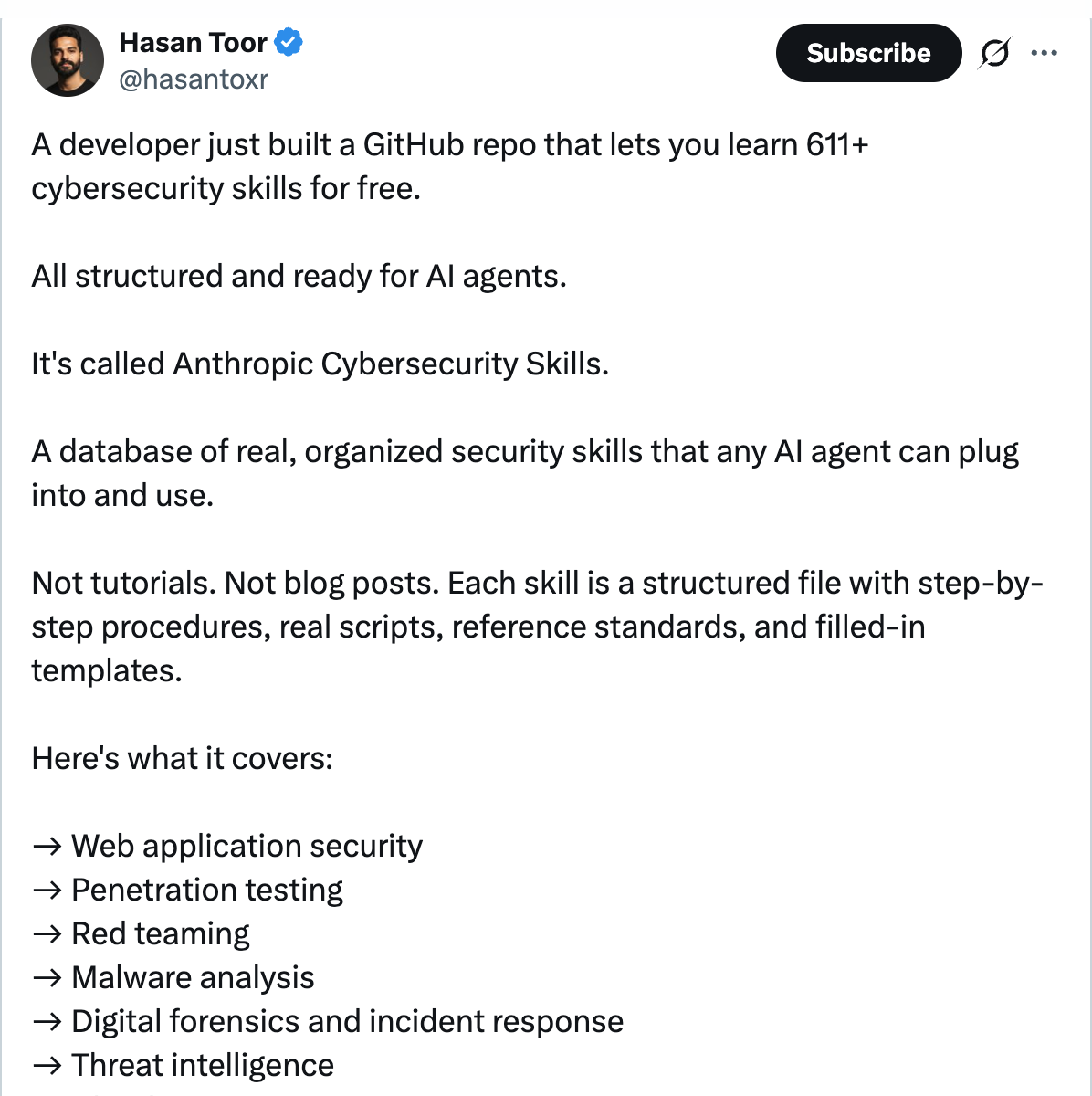
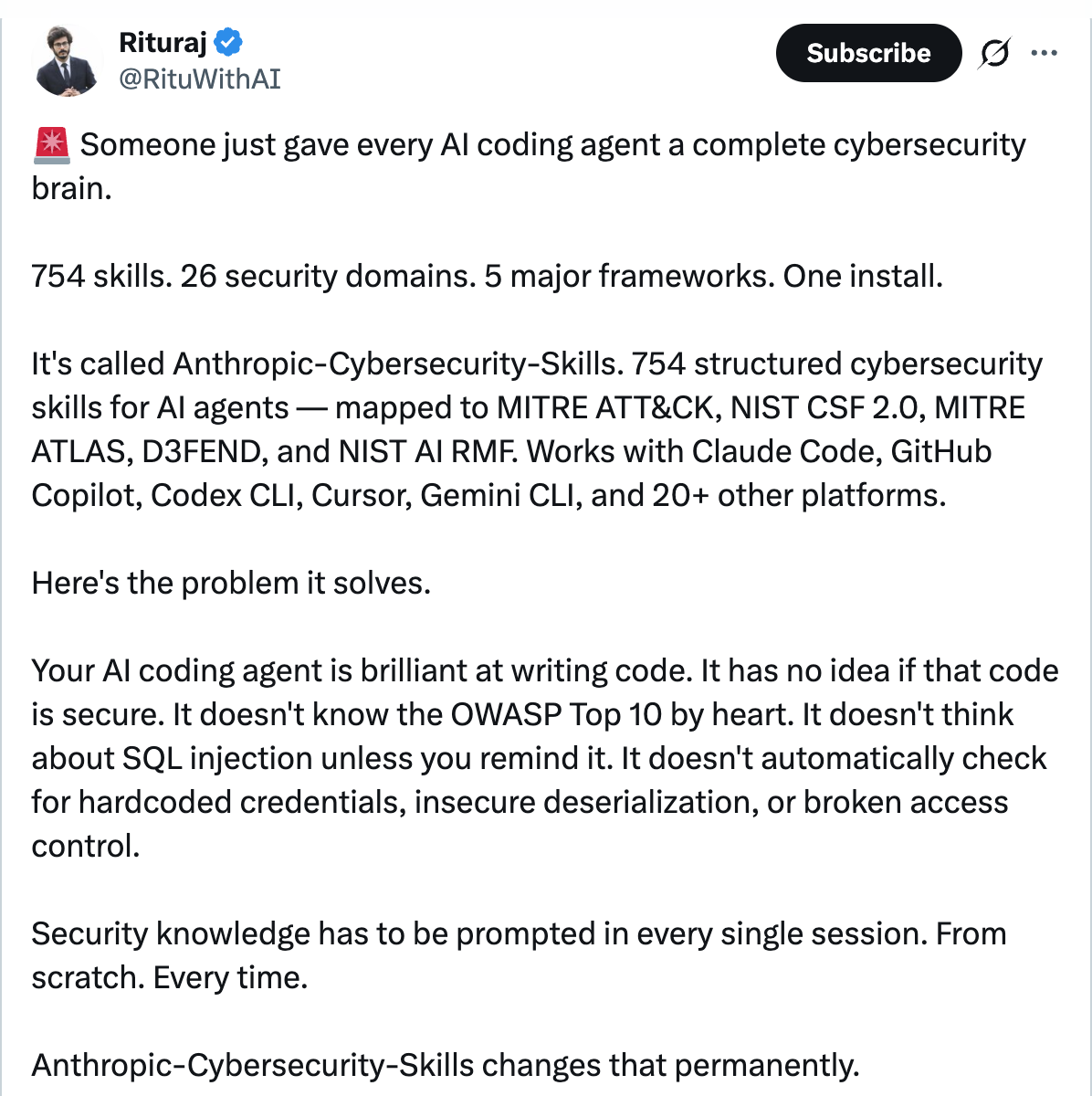
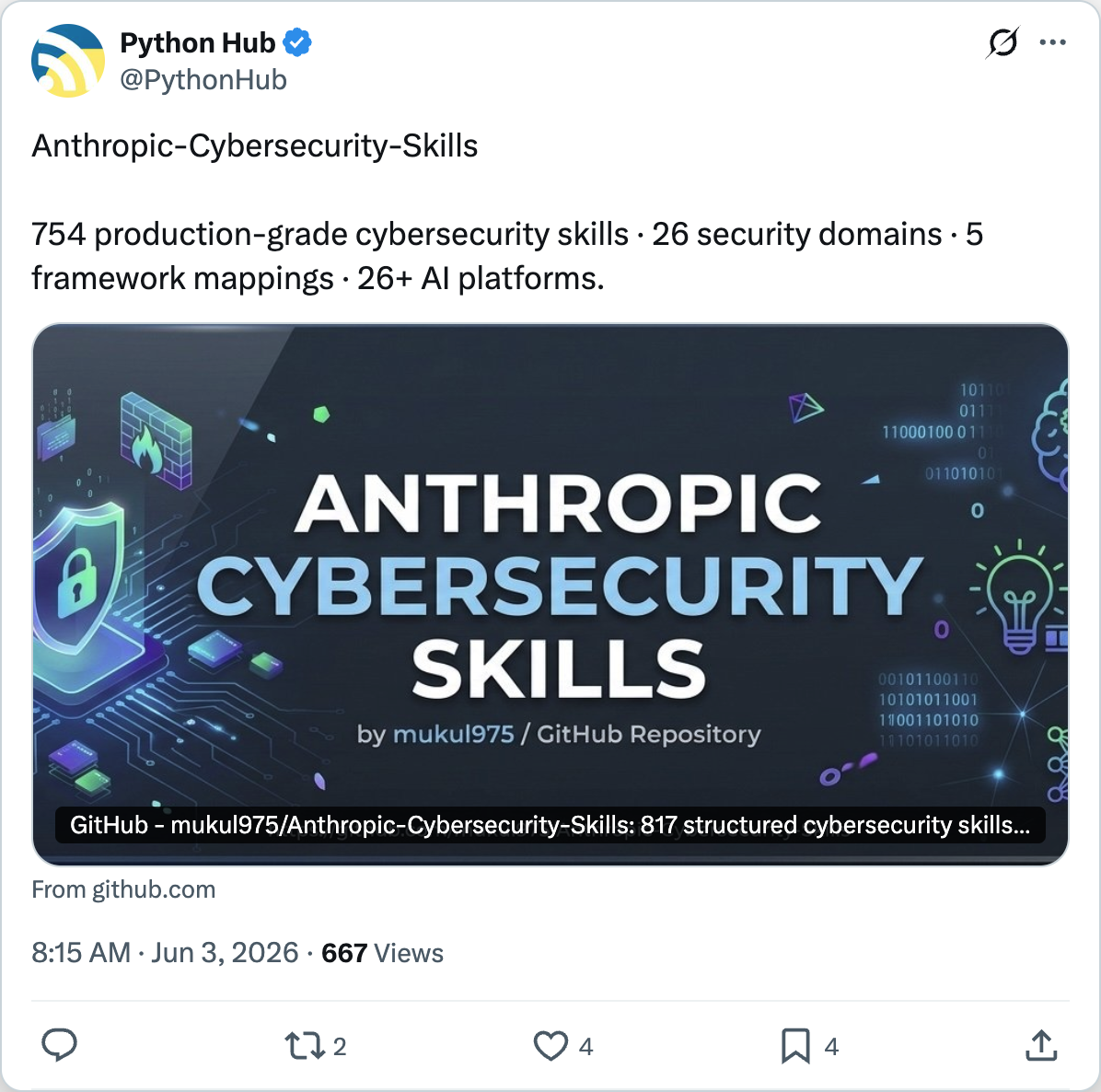
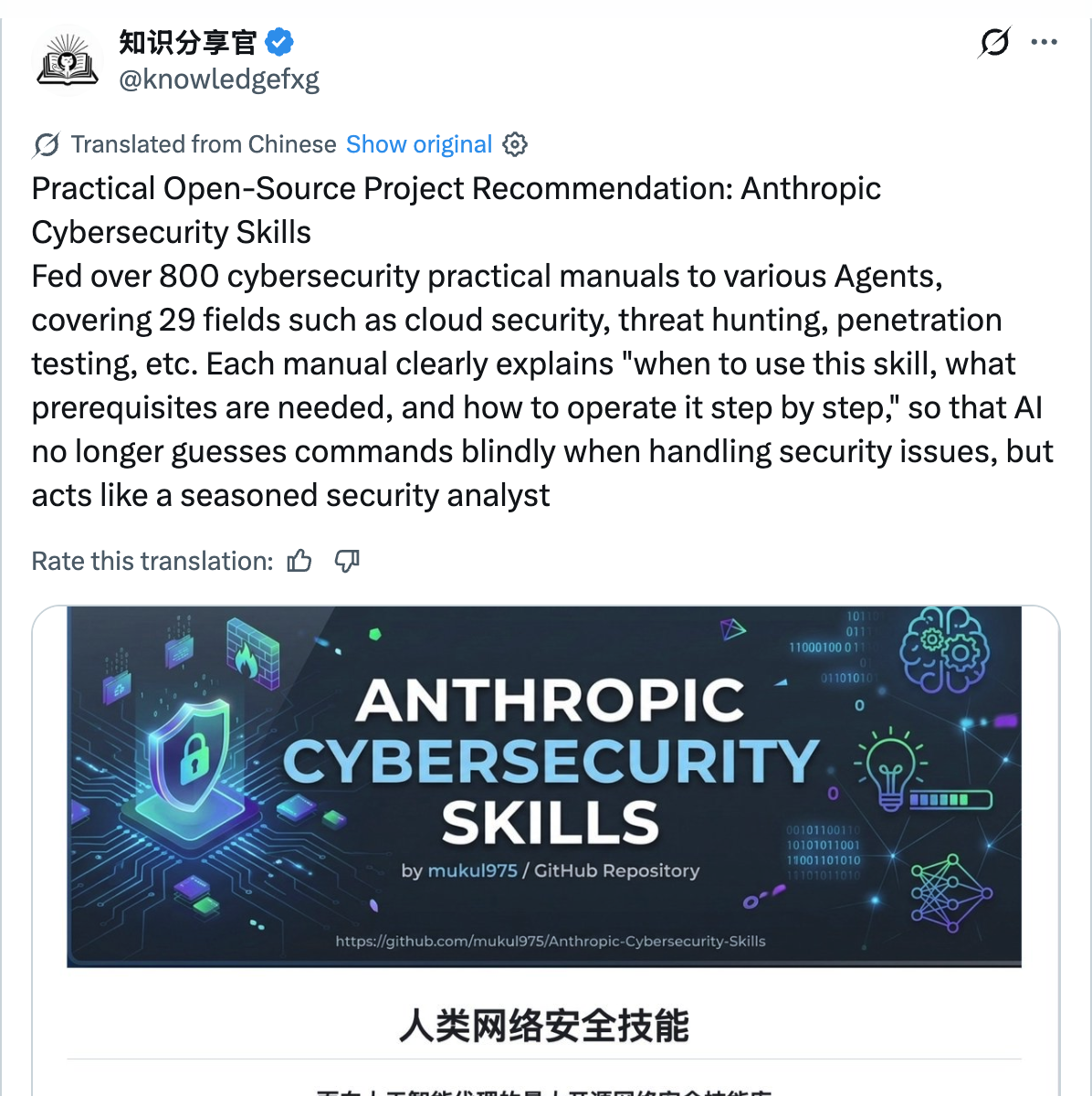
On X, the coverage has been enthusiastic. @RituWithAI called it “a complete cybersecurity brain” for coding agents. @PythonHub amplified the production-grade positioning. @hasantoxr framed it as “a database of real, organized security skills that any AI agent can plug into and use.” International coverage has followed — Chinese-language tech accounts are highlighting the 800+ skill count and the 29-domain coverage.
The more interesting signal is in the gap between the hype and the hard questions nobody is asking publicly:
-
Execution validation is missing. The skills define workflows, but there is no built-in mechanism to verify that the agent actually executed each step correctly. A skill that maps to ATT&CK T1003 (Credential Dumping) and tells the agent to run Volatility3 only works if Volatility3 is installed, the memory dump is accessible, and the agent interprets the output correctly. The skill file cannot guarantee any of that.
-
Version drift is unmanaged. The repo tracks MITRE ATT&CK v19.1 and NIST CSF 2.0. When v20 drops, every mapping needs review. The current maintenance model — 8 contributors, 48-hour PR review commitment — will be tested when framework updates affect 800+ skills simultaneously.
-
The “Anthropic” branding creates confusion. Multiple X posts and coverage sites treat this as an official Anthropic project. It is not. The README says so explicitly. But the name ensures ongoing misattribution, which could become a liability if skill quality issues surface.
The Compliance Bridge Pattern
Here is the pattern worth extracting from this project, independent of whether you adopt these specific 817 skills:
Step 1: Standardize the format. Use the agentskills.io specification or an equivalent structured format. Every security skill gets YAML frontmatter with discovery metadata, framework mapping IDs, and versioning.
Step 2: Map to established frameworks. Every skill explicitly references the MITRE ATT&CK techniques it addresses, the NIST CSF functions it supports, and any domain-specific frameworks (ATLAS for AI threats, D3FEND for defensive techniques). This creates the compliance bridge — your agent’s capabilities are now expressed in the same language your auditors already speak.
Step 3: Implement progressive disclosure. Structure skills so agents can scan cheaply and load selectively. The 30-token frontmatter / 2,000-token full-skill ratio is the design target.
Step 4: Validate the supply chain. Run skills through security scanning (Snyk’s mcp-scan or equivalent) before deployment. The ToxicSkills data proved that unvetted skills are a material attack surface — 76 confirmed malicious payloads in a single marketplace audit.
Step 5: Build the audit trail. Log which skills executed, when, by which agent, with what inputs and outputs, mapped back to framework technique IDs. This is the piece the Anthropic-Cybersecurity-Skills library does not yet provide — and it is the piece that turns the library from a knowledge base into a compliance tool.
What This Means for You
If you run a SOC: The Anthropic-Cybersecurity-Skills library is worth evaluating as a starting point for structuring your agents’ security workflows. Clone it, review the skills in your top-priority domains (Cloud Security, Threat Hunting, Incident Response), and test whether your agents can actually execute the workflows. The framework mappings give you an immediate artifact for compliance conversations.
If you build agent tooling: The compliance bridge pattern — structured skills mapped to established frameworks — is the template for any vertical skills library. Security got there first because the compliance requirements are most explicit. Expect healthcare (HIPAA), finance (SOX, PCI-DSS), and infrastructure (FedRAMP) to follow the same pattern.
If you audit agent deployments: Ask to see the skills manifest. If the team cannot produce a list of what their agents are trained to do, mapped to industry frameworks, that is a finding. The existence of projects like this means the “we didn’t know structured skills were possible” defense has expired.
The deeper signal from 29,000 stars and 6 framework mappings: prompt engineering is growing up. The ad-hoc era — where security capabilities lived in ephemeral chat threads and undocumented system prompts — is ending. What replaces it looks a lot like traditional software governance: versioned, mapped, audited, and governed. The teams that get there first will have the compliance story. The teams that don’t will have the audit finding.
Explore related: Config Files That Run Code: The Agent Skill Supply Chain | Agent Skills Are the New Dotfiles | Shannon AI Pentester Review