Field report · · AgentConn Team
Shannon AI Review: Autonomous Web Pentesting Agent
Shannon autonomously pentests web apps at 96% XBOW success for ~$50 a run. We review how it works, what it misses, and who should use it.
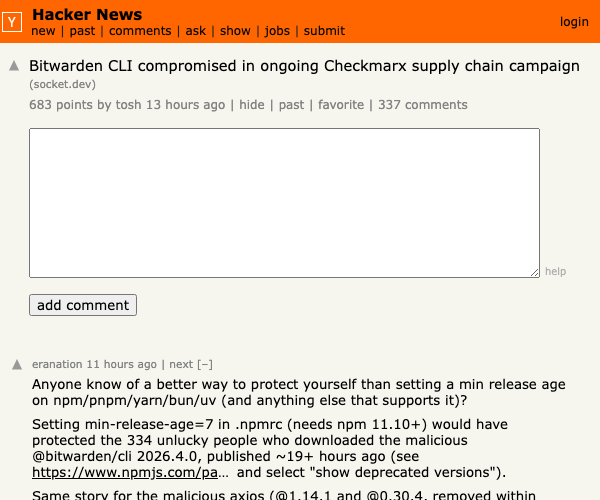
On April 22, 2026, the Bitwarden CLI package was compromised and pushed to npm as version 2026.4.0. The malicious release was live for 19 hours. 334 users downloaded it before detection. Bitwarden is one of the most-audited, most-trusted password managers on the planet — and the attack was caught by community monitoring, not by the organization’s own tooling.
The Hacker News thread that followed scored 679 points and 337 comments. Buried in the discussion was a pattern that keeps repeating in every major supply chain incident: the vulnerability wasn’t the novel part. The novel part was how long it took anyone to notice.
This is the context in which Shannon needs to be evaluated — not as an academic security toy, but as a response to an increasingly hostile environment where the traditional model of “annual pentest, quarterly audit” is already obsolete before the PDF is delivered.
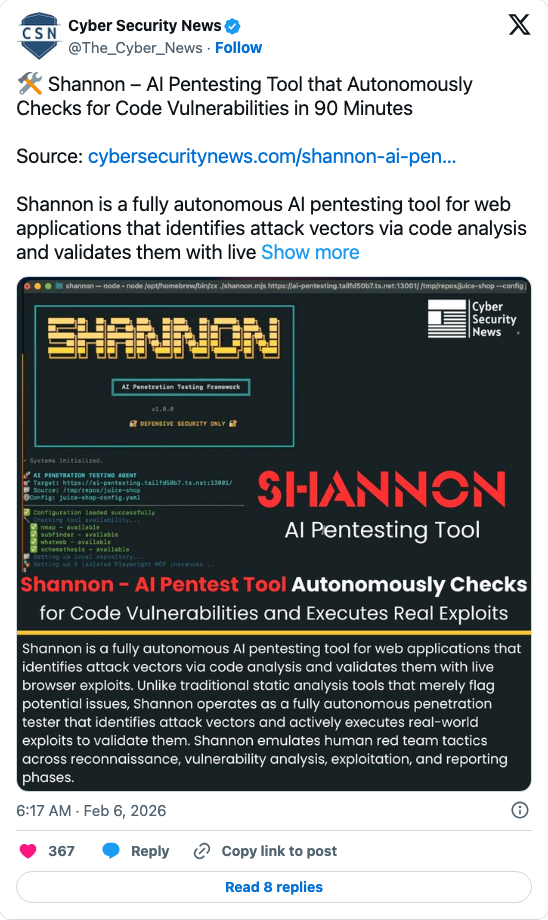
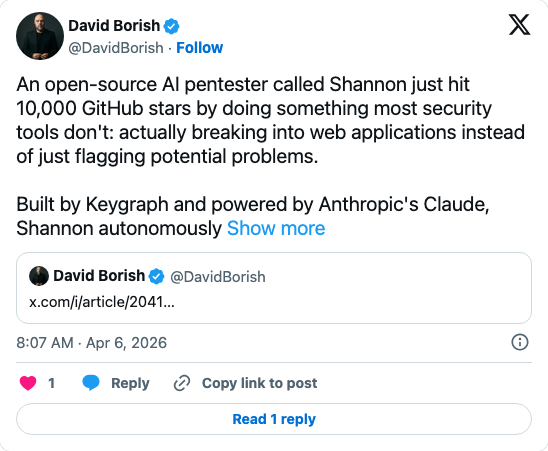
Shannon is an open-source autonomous AI pentesting agent built by Keygraph. It reads your source code, maps your attack surface, and then attempts to break in — producing a report with zero false positives, because it only files findings it can actively prove with a working exploit. It has 40.1K GitHub stars as of April 2026. It was trending on GitHub today. And it is powered by Anthropic’s Claude.
What Shannon Actually Does
The traditional security audit has a rhythm that hasn’t changed much in a decade: scope definition, scheduling, a human (or team) spending several days prodding an application, a final PDF report, and then silence until next year. By the time that PDF arrives, the application has received dozens of commits, three new API endpoints, and a dependency update that introduced a new vulnerable package. The report is already stale.
Shannon’s design premise is that this model is fundamentally broken, and the fix is to make continuous security testing as cheap and automatic as running a test suite.
When you run Shannon, it executes a five-phase workflow:
-
Pre-reconnaissance — Static code analysis. Shannon reads your source repository, identifies architecture patterns, entry points, authentication mechanisms, and likely attack vectors before touching the live application.
-
Reconnaissance — Dynamic analysis via Playwright browser automation. Shannon explores your running application, mapping the live attack surface: forms, API endpoints, authentication flows, file upload handlers.
-
Vulnerability & Exploitation — The distinctive phase. Five parallel Claude agents simultaneously test for SQL injection, XSS, authorization bypasses, SSRF, and IDOR. When an agent suspects a vulnerability, it doesn’t flag it as “potential” — it attempts live exploitation. If it cannot produce a working proof-of-concept, the finding is discarded.
-
Confirmation — A dedicated confirmation pass verifies that each exploit is reproducible. Only confirmed, reproducible exploits advance to the report.
-
Reporting — A structured markdown report containing only proven vulnerabilities, with exact
curlcommands to reproduce each finding.
The entire process takes 1–1.5 hours and costs approximately $50 in Anthropic API credits (Claude 3.5 Sonnet recommended). For comparison, traditional penetration testing runs $10,000–$50,000 for a comprehensive assessment that takes weeks to schedule and deliver.
The XBOW Benchmark: 96.15%
Shannon’s headline benchmark is 96.15% on the XBOW security benchmark — a structured evaluation suite of 104 intentionally vulnerable web applications, run in hint-free, source-aware mode (Shannon has access to source code but no hints about which vulnerabilities exist). Shannon solved 100 of 104 exploit challenges.
For context: most commercial DAST tools score 30–40% on comparable evaluations. Shannon’s 96.15% places it among the strongest performers on this benchmark for white-box, source-aware evaluation.
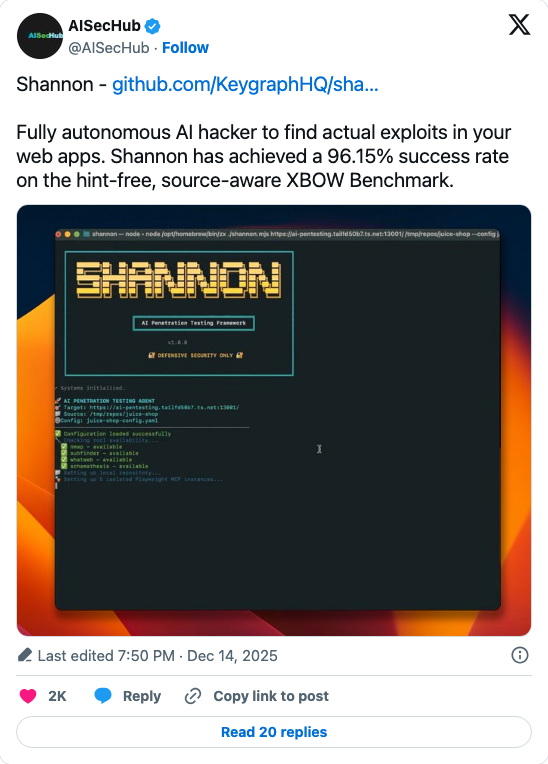
The four challenges Shannon failed are not publicly documented, but its scope is currently limited to four vulnerability categories: Broken Authentication/Authorization, Injection attacks (SQL, command, LDAP), Cross-Site Scripting, and SSRF. Anything outside this domain is outside Shannon’s current detection capability.
Hands-On Test Results
Multiple independent testers have published results from running Shannon against intentionally vulnerable applications.
DVNA (Node.js) — Shannon was run against DVNA (Damn Vulnerable NodeJS Application). It detected SQL injection, command injection, XSS, and XXE with working exploits for each. The tester observed: “What stood out was how Shannon organized the analysis — it structured the findings into clear sections.”
OWASP Juice Shop — Better Stack’s documented test against Juice Shop consumed approximately $60 in Claude API credits. The key finding: Shannon “didn’t say ‘this login looks weak’ — it bypassed the login, dumped data, and handed me the screenshots and logs to prove it.” Zero false positives.
Limitation noted by testers — Shannon is excellent within its defined categories. One reviewer noted: “If the bug isn’t in its specific ‘hit list,’ it’ll ignore it.” Business logic flaws and issues outside the four-category scope are missed.
The Economics of Continuous Security Testing
| Approach | Cost | Time | Frequency |
|---|---|---|---|
| Traditional pentest | $10,000–$50,000 | Weeks to schedule + deliver | Annual (if well-funded) |
| Shannon per scan | ~$50 API credits | 1–1.5 hours | Daily in CI/CD |
This math changes what “continuous security” means. A $50 scan that runs on every PR to main is operationally different from a $25,000 audit that runs once a year. Shannon’s AGPL-3.0 license means the tooling itself costs nothing — you only pay for Claude API calls.
Shannon Pro (Keygraph’s commercial offering) extends this with CI/CD integration, multi-user RBAC, compliance reporting (OWASP, PCI-DSS, SOC2), and self-hosted deployment. The open-source Lite version is sufficient for local development security testing.
What Shannon Misses
White-box only. Shannon requires source code access. It cannot perform black-box testing against third-party services, closed-source applications, or deployed third-party APIs. The supply chain attack on the Bitwarden CLI that opened this article? Shannon would not have caught it — it has no visibility into the npm package itself.
Four vulnerability categories. SQL injection, XSS, SSRF, and broken authentication cover a large portion of OWASP Top 10, but not all of it. Business logic vulnerabilities — the kind that require understanding what your application is supposed to do — are beyond Shannon’s current capability.
Not for production. Shannon explicitly performs mutative actions: it creates users, modifies data, and tests side effects. Running it against a live production application without explicit written authorization from the system owner is a legal issue, not just a technical risk.
LLM residual risk. The underlying Claude model can hallucinate. Shannon’s confirmation phase mitigates this significantly, but human review of the final report before treating findings as ground truth remains essential.
API cost accumulation. At $50 per run, daily CI/CD integration across multiple services adds up. Teams with many microservices will need to be selective about what gets scanned and how frequently.
The Dual-Use Concern
Shannon’s open-source availability provoked a pointed Hacker News discussion. One commenter observed: “Since this is open source, it’s a white-hat tool, but it also democratizes script kiddos being able to do some serious damage.” The developer’s response: “I guess who owns the most hardware wins the arms race?”
This is the honest position. Shannon meaningfully lowers the skill threshold for web application exploitation. The counterargument — the one Keygraph implicitly makes — is that defenders need this asymmetric advantage more than attackers do. Attackers have automation and time. Defenders, historically, have had one annual audit and a prayer.
For context on the broader threat landscape, see our analysis of AI agent supply chain attacks and what the LiteLLM breach means for your stack.
Shannon vs. Frontier Security AI
Shannon’s open-source autonomous pentesting occupies a different position from closed-access frontier security AI. Claude Mythos Preview — Anthropic’s restricted security AI under Project Glasswing — found 271 Firefox vulnerabilities in a single evaluation pass at a capability ceiling Shannon does not approach.
The comparison is instructive rather than competitive: Mythos is for critical infrastructure vendors who need zero-day discovery at frontier scale. Shannon is for development teams who need continuous security assurance at dev-cycle scale. For the vast majority of teams — startups, scale-ups, and engineering teams who run zero or one professional pentests per year — Shannon is the more relevant tool.
Setup and Requirements
Shannon requires three things:
- Docker and Docker Compose — Shannon’s multi-agent testing infrastructure runs in containers
- Node.js 18+ — Required for the Shannon CLI
- Anthropic API key — Pay-per-use API account at roughly $50 per scan using Claude 3.5 Sonnet
# Quickstart
npx @keygraph/shannon setup
npx @keygraph/shannon start -u https://your-dev-app.com -r /path/to/repo
Run Shannon only on sandboxed, non-production environments with a clean database snapshot. The scan will create users, fire SQL injection probes, and modify application state.
The Verdict
Shannon is the most practically capable open-source security tool in this category. The 96.15% XBOW score reflects what happens when white-box code analysis is combined with live exploitation confirmation at scale.
Use Shannon if:
- You want to shift security testing left, running it at dev time instead of pre-release
- Your application is web-based with source code you control
- Your primary security risk is within Shannon’s four-category scope (auth bypass, injection, XSS, SSRF)
- You need something between “no security testing” and a full professional pentest
Don’t rely on Shannon if:
- You need black-box testing of third-party services or APIs
- Business logic vulnerabilities are your primary risk
- You need compliance-ready reports without human review
- You’re assessing a production system
For development teams running zero or one professional pentests per year, Shannon provides a material security improvement at a cost that is easy to justify. The gap Shannon doesn’t close is the gap between your application’s known vulnerability surface and the supply chain, third-party dependencies, and infrastructure your application runs on. For that, you still need traditional tooling, and you still need a human.
Shannon is available at github.com/KeygraphHQ/shannon under the AGPL-3.0 license.
Sources: GitHub/KeygraphHQ/shannon · Keygraph.io · Help Net Security · Better Stack · AIToolly · ByteIota · HN Bitwarden · HN Shannon · @DavidBorish · @AISecHub · @TheCyberNews