Field report · · AgentConn Team
One Demo, Durable Memory: Record-a-Skill
Anthropic's Record-a-Skill captures screen demos as reusable skills. Two creators converged on the same idea. Here's what it means for agent harnesses.
One Demo, Durable Memory: Record-a-Skill
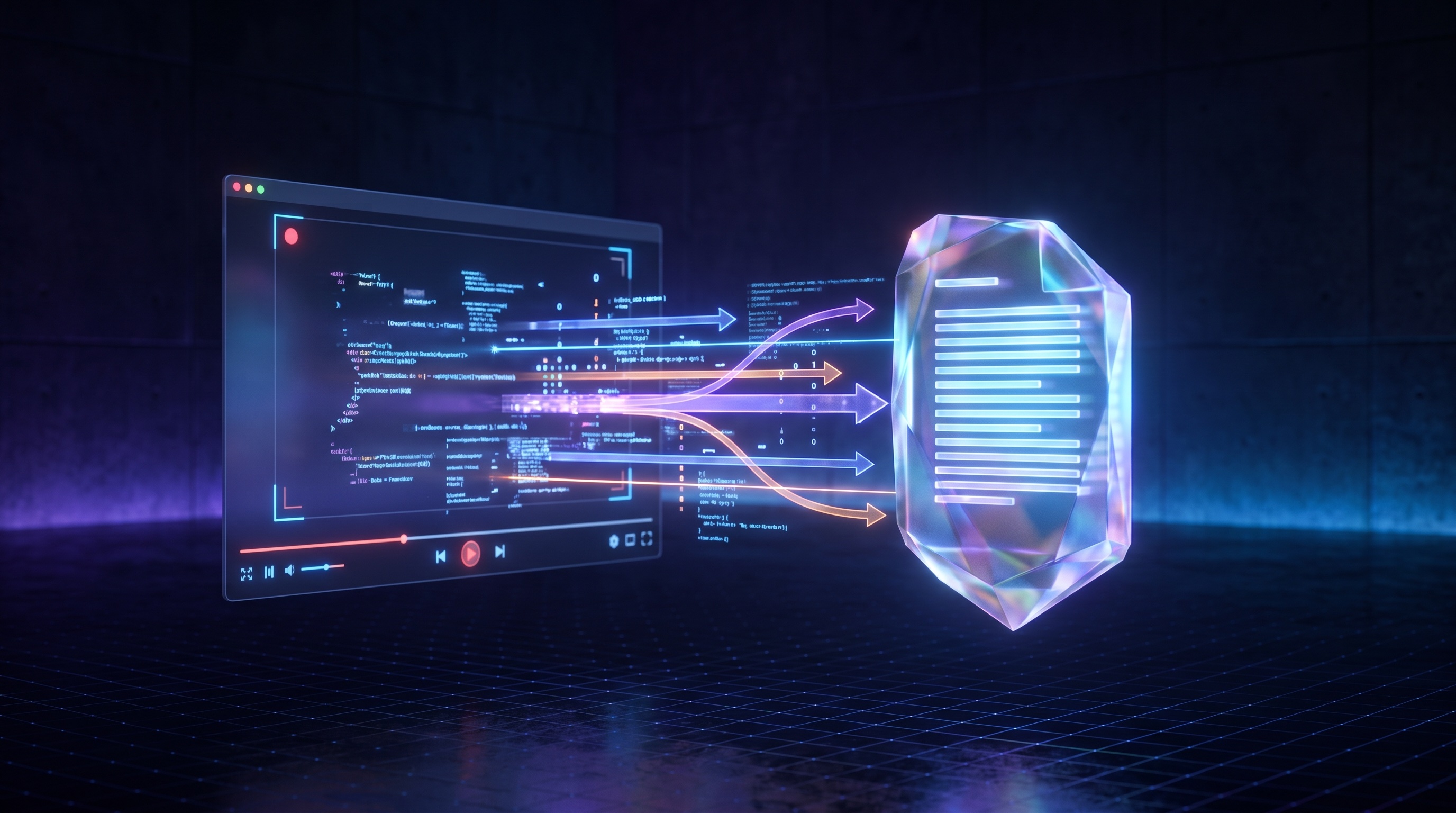
On July 21, 2026, Anthropic shipped a feature inside Claude Cowork called Record a Skill. You open the desktop app, hit the plus button, choose “Record a Skill,” and then you just do your task — screen recording running, narrating as you go. Claude captures the screen activity, your mouse clicks, your keystrokes, and your voice. When you stop, it distills the entire demonstration into a SKILL.md file: a structured, reusable instruction set that Claude can load and execute on demand via a slash command.
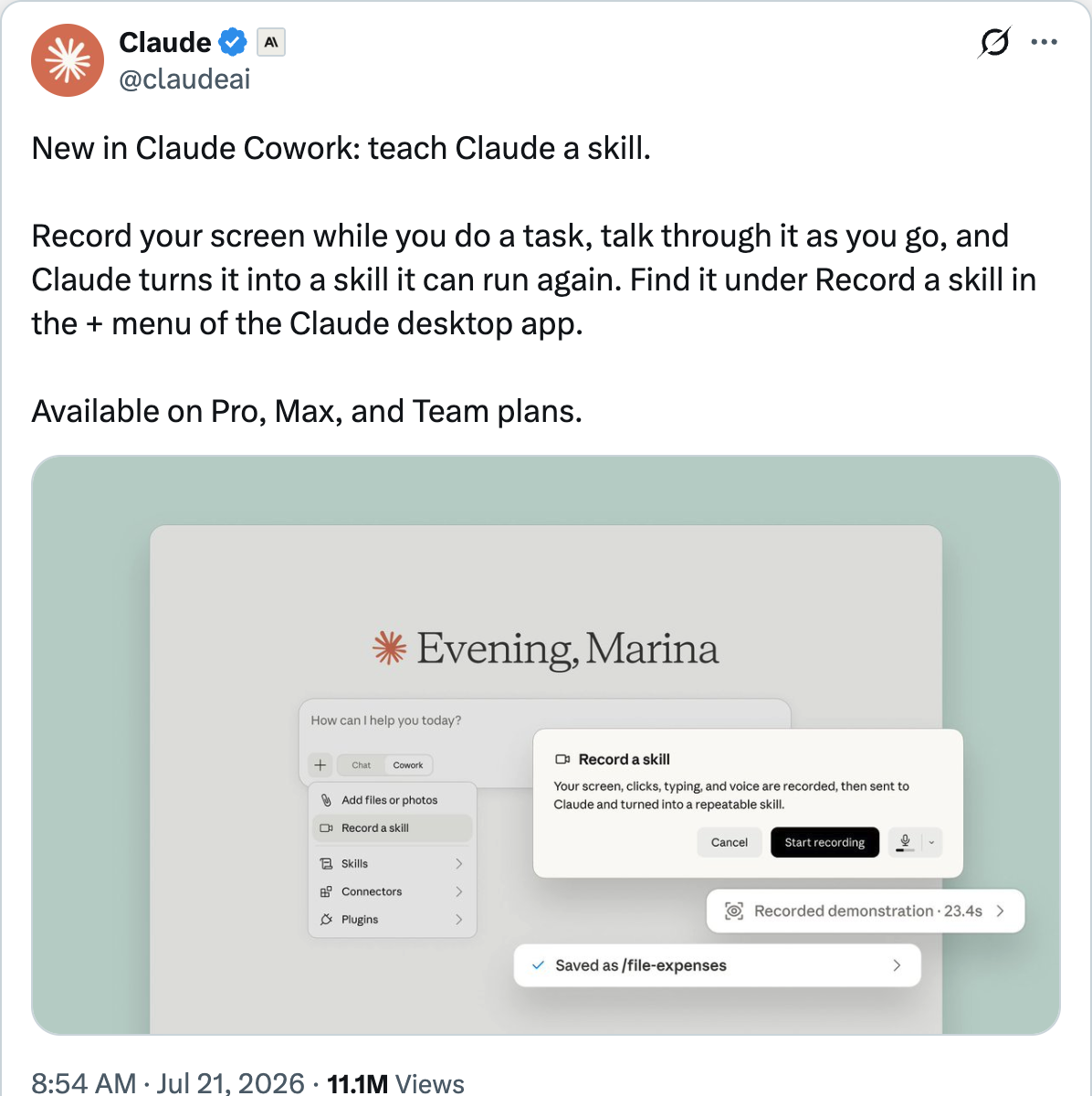
The feature landed quietly, but the signal is loud. Two independent creators — one inside Anthropic’s product team, one in the open-source community — converged on the same architectural insight within weeks of each other: hand-writing skill documents does not scale. The value in agent systems has permanently migrated from the one-shot prompt to the durable, transferable skill. And that migration reshapes how teams build, share, and compound their AI workflows.
The Problem Record-a-Skill Solves
Before Record-a-Skill, teaching Claude a repeatable workflow meant writing a SKILL.md file by hand. You would define YAML frontmatter with metadata, write out step-by-step instructions in markdown, optionally attach helper scripts, and place the whole package in .claude/skills/<name>/. It worked — Claude’s skill loader is elegant — but it had a fundamental friction problem.
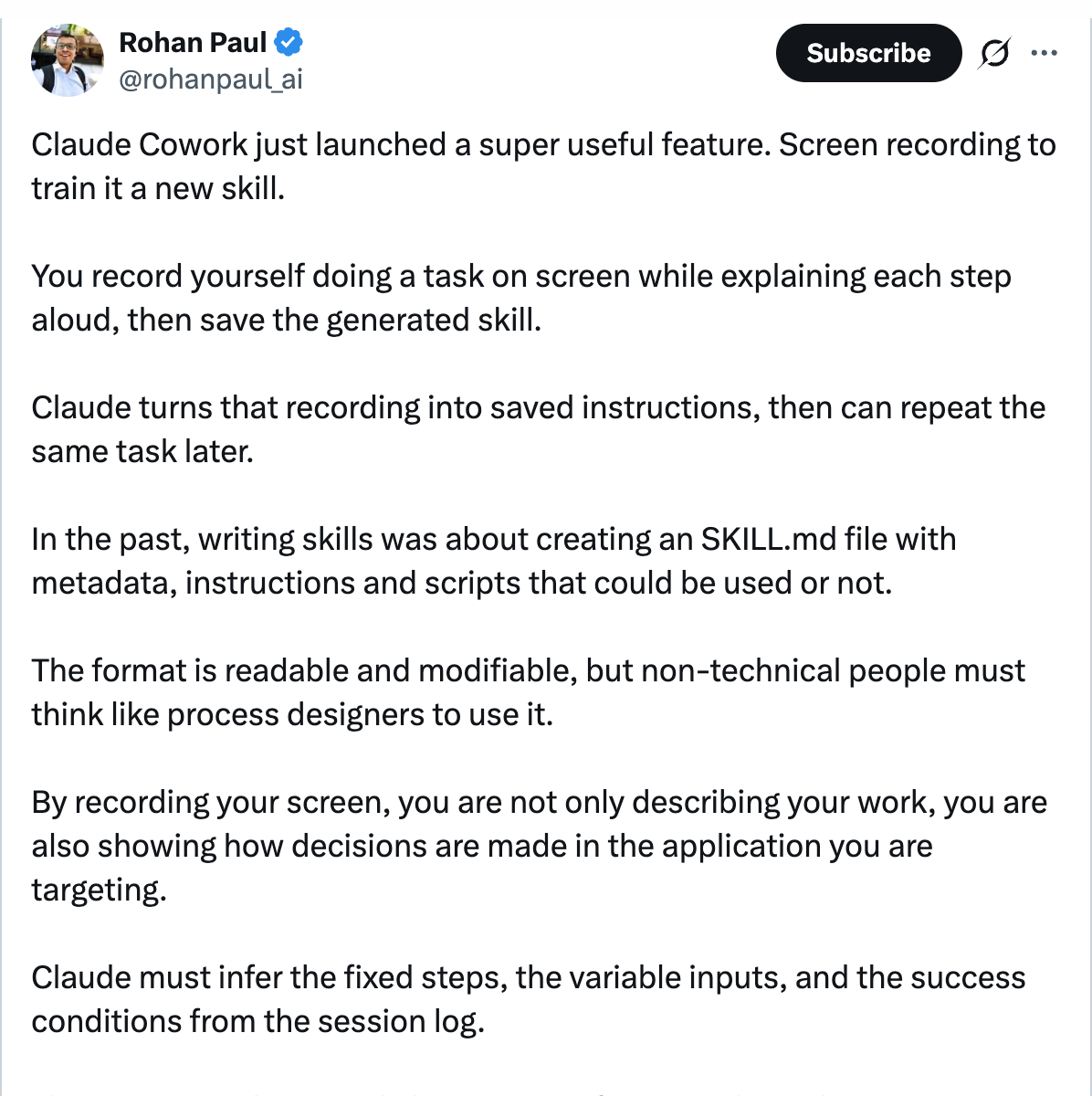
As Rohan Paul noted on X: “In the past, writing skills was about creating a SKILL.md file with metadata, instructions and scripts… non-technical people must think differently now.” The gap between knowing how to do a task and writing instructions an AI can follow was wider than most teams realized. Domain experts who knew their workflows cold could not externalize that knowledge into markdown. Engineers who could write the markdown often did not know the workflows well enough to capture the edge cases.
Record-a-Skill closes that gap by changing the input modality. Instead of writing instructions, you demonstrate. As Charlie Hills put it in MarTech AI: “Show it and you get your process. Type it and you get Claude’s best guess.” The distinction matters. A written skill captures what you think the steps are. A demonstrated skill captures what you actually do — including the contextual decisions, the order-of-operations nuances, and the implicit checks you perform without thinking about them.
View original post on Substack →
How It Actually Works Under the Hood
Record-a-Skill captures three parallel data streams: screen video, microphone audio, and user interactions (clicks, keystrokes, scrolling). But it is not a macro recorder. The system does not replay your mouse movements pixel by pixel. Instead, Claude analyzes the demonstration across multiple sub-agents working in parallel — one drafts the skill file, another creates platform-specific reference guides, and a third packages the result into the standardized SKILL.md format.
The narration is the critical input. Claude uses your voice-over to understand the reasoning behind each action, not just the sequence. Why did you check that field before proceeding? Why did you skip that menu option? The “why” gets encoded into the skill’s decision logic. Without narration, you get a brittle click sequence. With narration, you get a transferable workflow.
Three streams, one skill. Record-a-Skill captures screen, voice, and clicks — then distills them into a SKILL.md that Claude loads on matching slash commands. Skills execute through Claude’s browser extension powered by Opus 4.5, independent of the chat model.
Skills execute through Claude’s browser extension (powered by Claude Opus 4.5) rather than replaying recorded inputs. This means a recorded skill generalizes across different screen sizes, page layouts, and even different instances of the same application. It is closer to teaching than to scripting.
Two key constraints exist today. First, there is a 10-megabyte file size cap on assets the skill can reference. Second, the feature requires the Claude desktop app — the web version cannot access screen recording or microphone permissions. Both are V1 limitations, not architectural walls.
The Open-Source Parallel: Chase AI and the Skills Ecosystem
While Anthropic built Record-a-Skill into Cowork, the open-source community independently attacked the same problem from the opposite direction. Chase AI’s YouTube channel has been documenting open-source repos that solve Claude Code’s biggest weaknesses — and the recurring theme across every video is the same: Claude’s number one problem is not intelligence. It is memory.
The repos Chase covers — skills for research, design, video comprehension, memory persistence — all follow the same pattern. They are SKILL.md files (or small directories containing one) that encode a workflow Claude could not otherwise perform reliably. The community discovered through trial and error what Anthropic formalized with Record-a-Skill: the right unit of agent knowledge is not a prompt, not a fine-tune, not a RAG chunk — it is a skill.
This convergence is not coincidental. It reflects a structural truth about how LLM-based agents work. The model provides raw reasoning capability. The harness — the execution environment, tool integrations, memory systems, and skill definitions wrapping around that model — determines whether the agent actually does useful work. As Faros.ai documented across 211 engineering tasks: “Open-weight models with optimized harnesses matched or outperformed expensive frontier models on real-world coding tasks.” LangChain’s engineering team moved their coding agent from 30th to 5th place on Terminal Bench 2.0 without changing the underlying model — purely through harness optimization.
The Karpathy Effect: 220,000 Stars for Four Rules
No discussion of the skills shift is complete without the Karpathy-inspired CLAUDE.md repository. Created by developer Forrest Chang on January 27, 2026, it contains a single 70-line markdown file derived from Andrej Karpathy’s observations on LLM coding pitfalls. Four rules. No dependencies. Copy it into any repo’s root directory and Claude Code immediately writes more disciplined code.
The repo passed 220,000 combined GitHub stars across its two mirrors — one of the fastest-growing repositories in GitHub history. It held number one on GitHub Weekly Trending for 28 consecutive days. The explosion was not about the specific rules (though they are good). It was about the format. Developers realized that a single markdown configuration file could reshape an AI agent’s behavior more reliably than months of prompt iteration.
This is what Simon Willison meant when he wrote that skills are “maybe a bigger deal than MCP”. MCP (Model Context Protocol) gives agents access to external tools. Skills give agents knowledge of how to use those tools well. MCP is the hands. Skills are the muscle memory.
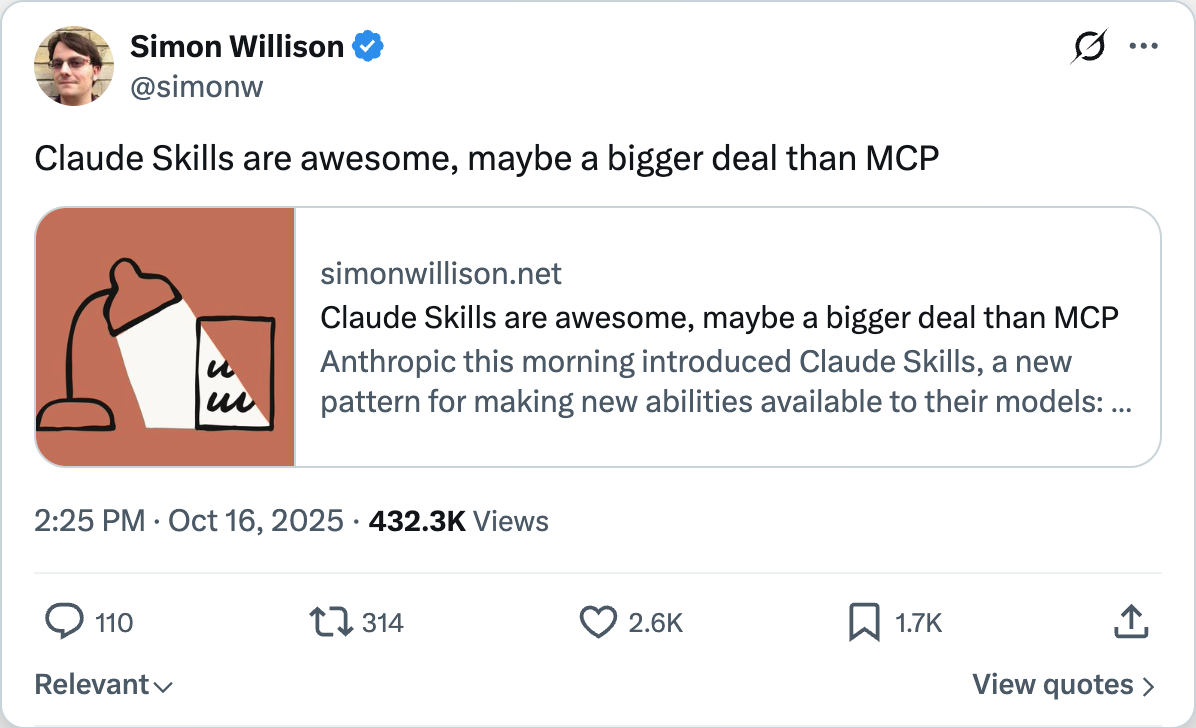
The broader ecosystem confirms the pattern. The skills-as-dotfiles trend has produced registries, curated directories, and even security auditing newsletters. Vercel launched skills.sh as a discovery platform. Every major cloud provider — from Anthropic to Google to Stripe to Cloudflare — now ships official skill definitions for their products. The “Cambrian explosion” Willison predicted is here.
Andrew Ng’s Data: The Job Market Already Moved
If skills are the new product surface, the labor market is pricing it in. On August 14, 2026, Andrew Ng published the AI Engineering Skills Map — four essential competencies derived from analysis of more than 10,000 job postings, dozens of structured interviews with hiring managers, and survey data.
The four skills: building AI applications, software engineering fundamentals, using coding agents, and shaping the build. The last two are the ones that matter here. “Using coding agents” means managing agent context, planning, and execution — the operational knowledge that skills encode. “Shaping the build” means deciding what should be in the spec rather than implementing it yourself.
Notably absent from Ng’s list: prompt engineering. The standalone skill that dominated 2023-2024 hiring conversations has been absorbed into a broader discipline. As harness engineering replaced prompt engineering in the stack, the job market followed. The standalone “Prompt Engineer” title declined roughly 30% between 2024 and 2026, even as roles requiring prompt-adjacent skills grew 3x. The value did not disappear — it migrated into the harness layer.
Your takeaway: Start treating your .claude/skills/ directory like your dotfiles repo. Every workflow you repeat more than twice should be a recorded skill. The teams that build transferable skill libraries will have a compounding advantage over teams that rely on tribal knowledge and one-shot prompting.
What the Community Is Saying
The 451-point Hacker News thread on “Claude Code as a Daily Driver” captures both the excitement and the friction. User mil22 raised the central concern: skills, commands, subagents, and plugins are “all just variations of insert a canned prompt” with unclear best practices. superfrank called skills “the junk drawer” where various prompt types get mixed without clear taxonomy.
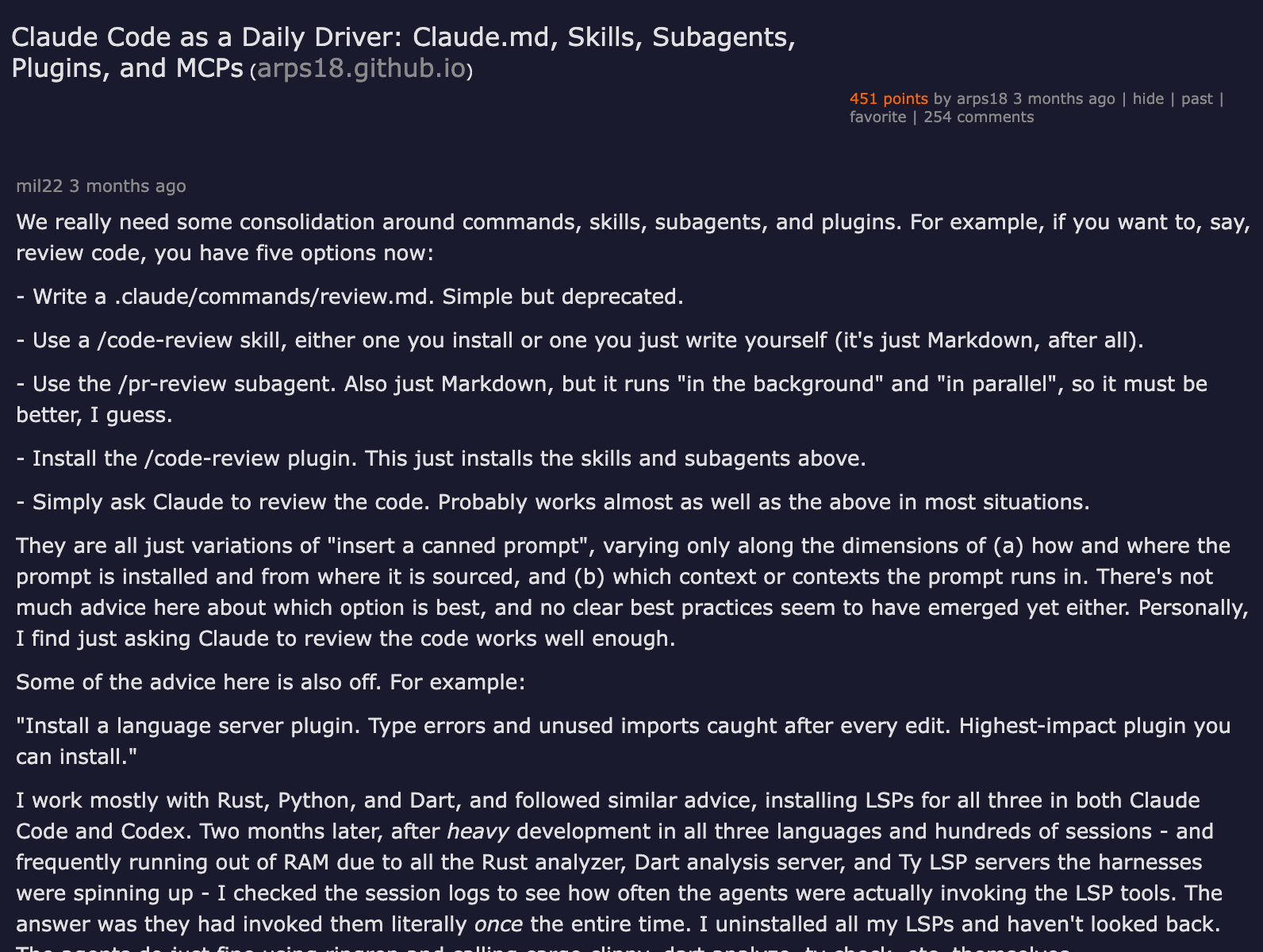
These are legitimate engineering criticisms, not resistance to the concept. The skills abstraction is young. Discovery is hard (you have to know the slash command exists). Composition is harder (chaining skills requires glue code). And the security surface is real — untrusted SKILL.md files can execute arbitrary shell commands, making skill registries a new attack vector that most teams have not yet audited.
But the trajectory is clear. bcherny from Anthropic confirmed in the same thread that consolidation is underway, with /code-review becoming a unified skill with multiple effort levels. The tool surface is converging, not fragmenting. Record-a-Skill accelerates that convergence by making skill creation accessible to people who would never write a SKILL.md file manually.
MTS connected Record-a-Skill to Leopold Aschenbrenner’s “drop-in remote worker” thesis: if an AI agent can learn any workflow by watching it once, the gap between “AI assistant” and “AI colleague” narrows to the quality of the demonstration. The bottleneck is no longer the model’s capability. It is the human’s ability to articulate their workflow clearly enough to record.
Contrarian corner. Skills are still just prompts with better packaging. A SKILL.md file is a text document the model reads at inference — no actual learning happens. The Karpathy repo’s 220k stars prove people want a quick fix, not deep understanding. Record-a-Skill trades one problem (writing instructions) for another (recording good demos). And skills cannot compose: chaining three skills without glue code puts you back at square one. Fair points — but they describe the current limitation, not the trajectory. Composability and type safety will follow the same arc that MCP tool definitions followed: messy V1, standardized V2.
What This Means for You
The shift from prompt-writing to demonstration-capture is not a feature announcement. It is an architectural migration. Here is what it means for builders:
1. Skills are the new unit of team knowledge. Every SOC-2 compliance check, every deployment runbook, every QA workflow that lives in someone’s head — these are all candidates for recorded skills. The cost of externalization just dropped from “write careful documentation” to “do the task once while talking.”
2. Skill libraries compound. A team that records 50 skills in Q3 has 50 reusable automations in Q4. A team that relies on one-shot prompting starts from zero every session. The compounding effect is the real moat, not any single skill.
3. The hiring filter shifted. Ng’s data shows that “using coding agents” and “shaping the build” are now top-four hiring criteria. Developers who treat skills as infrastructure — versioned, tested, shared — will outcompete developers who treat AI as a chat box.
4. Security is the unresolved problem. The skills supply chain is the new npm. Untrusted skills execute in your agent’s context with your permissions. Until skill signing and sandboxing mature, treat third-party skills like third-party code: audit before you install.
5. Record-a-Skill is V1. It requires the desktop app, Pro/Max/Team plans, and cannot yet handle workflows spanning multiple applications or long-running processes. The demonstration-capture paradigm will expand to multi-session recordings, team-shared demonstration libraries, and eventually skills that learn from watching production usage — not just one-off demos.
The tutorial economy has shifted. The valuable artifact is no longer the clever prompt. It is the durable skill — demonstrated once, reused indefinitely, transferred across teams, and composable into larger workflows. Record-a-Skill is the clearest signal yet that Anthropic agrees.
Your harness is your moat. Start recording.