Field report · · AgentConn Team
DeepSeek Open-Sourced a Harness to Rival Claude Code
DeepSeek Harness hit 135K stars in four days. Musk admitted Grok needs its harness. The moat just moved from models to scaffolding.
DeepSeek Open-Sourced a Harness to Rival Claude Code
On August 13, 2026, DeepSeek published deepseek-harness on GitHub under the MIT license. Within four days, the repository crossed 135,000 stars and 8,800 forks — one of the fastest adoption curves GitHub has ever recorded for a developer tool. The terminal command is dsh. The architecture is radical: everything is a plugin, including the model adapter, the tool registry, the session log, the sandbox, and the agent loop itself.
This is not just another open-source framework launch. It is a structural signal. When a Chinese AI lab open-sources an agent harness aimed directly at Anthropic’s Claude Code — and the developer community responds with 135K stars before most people have finished reading the README — the market is telling you something about where the moat lives now.
The Week That Made the Thesis Unavoidable
Three events landed within the same 72-hour window in mid-August, and together they crystallize a thesis that has been building all year: when model weights converge to commodity, the competitive moat migrates to the execution harness.
Event 1: DeepSeek Harness launches. The New Stack covered it on day one. TechNode framed the positioning explicitly: “Against Claude Cowork, DeepSeek opens its open-source Harness to developers.” The framework is built on the Cordis plugin system, which adds hot-reload and dynamic enable/dispose capabilities — plugins can be added and removed at runtime with automatic effect reversal. One early tester on the HN thread reported a 99% cache hit rate inside dsh, potentially offsetting peak-rate pricing.
Event 2: Elon Musk concedes the harness dependency. Two days earlier, Musk posted what may be the most revealing admission in AI this year:
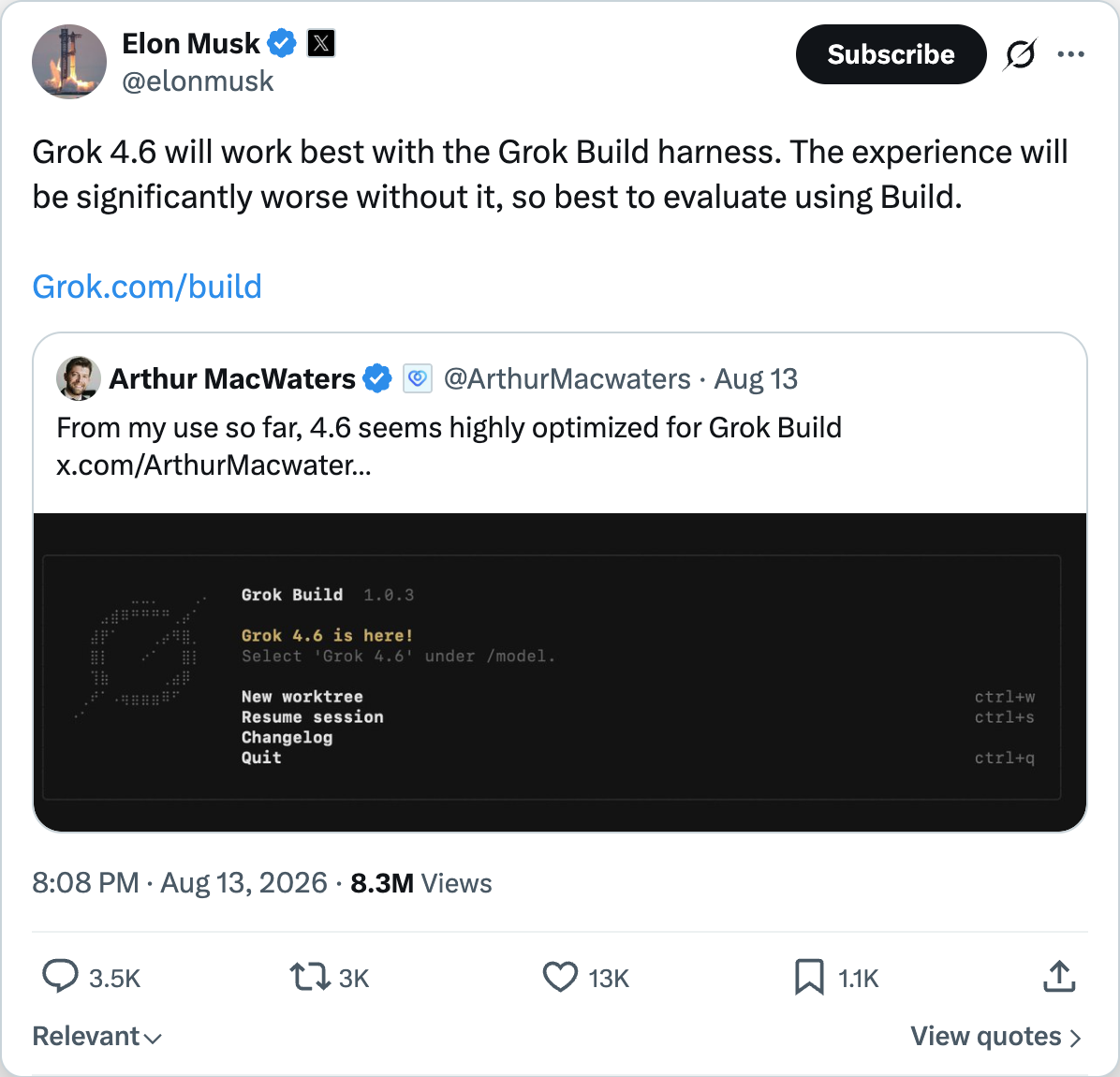
“Grok 4.6 will work best with the Grok Build harness. The experience will be significantly worse without it, so best to evaluate using Build.” Read that carefully. The CEO of the company that shipped the model is telling you the model is not enough. Grok 4.6 — which SpaceXAI positioned as matching GPT-5.6 Sol for world’s third-best on Artificial Analysis — needs its harness to deliver the experience. The scaffolding is not optional. It is the product.
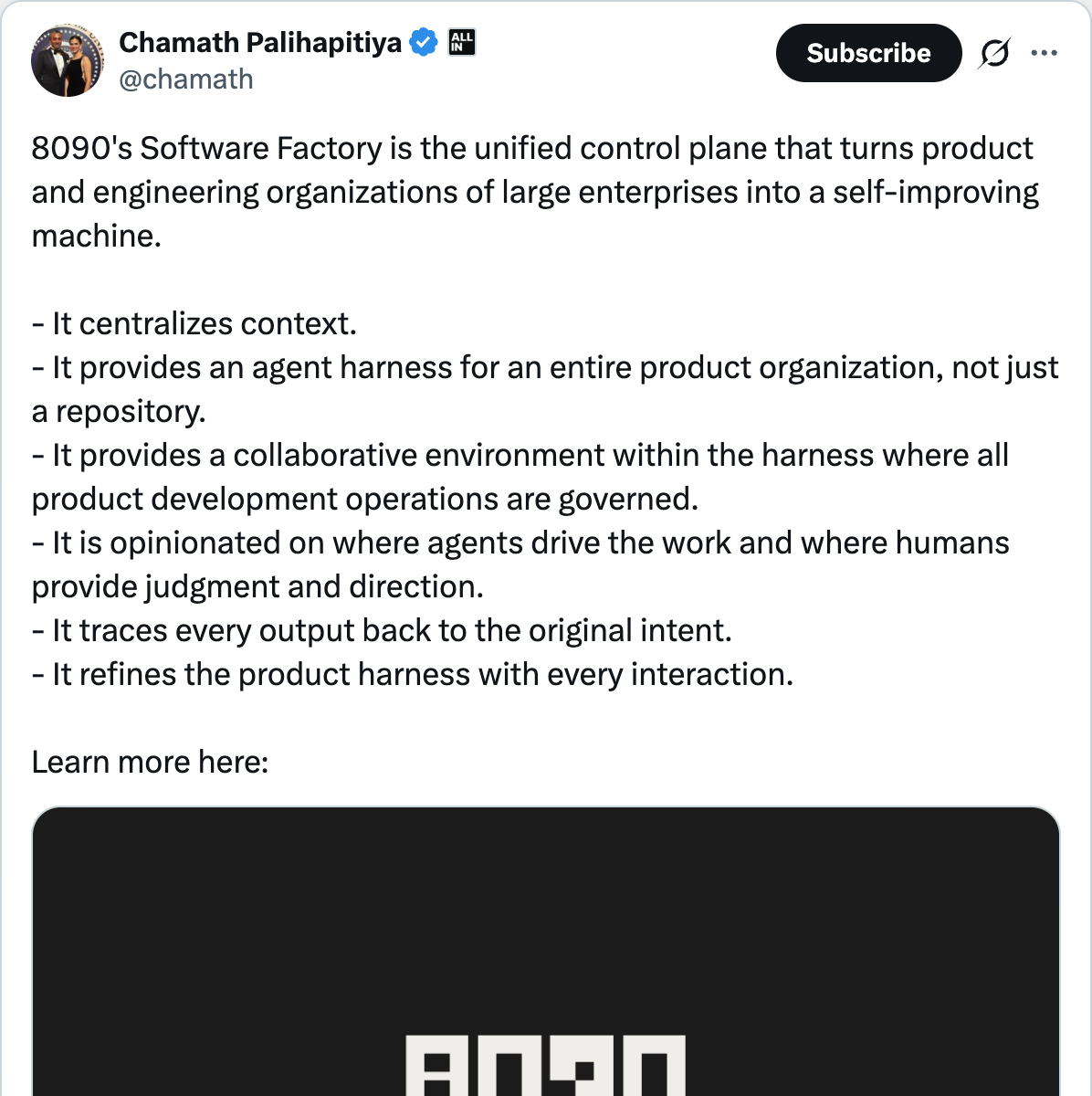
Event 3: Chamath calls the control plane the next battleground. Chamath Palihapitiya, investing through Social Capital, endorsed 8090’s Software Factory as “the unified control plane that turns product and engineering organizations of large enterprises into a self-improving machine.” The key phrase: “It provides an agent harness for an entire product organization, not just a repository.”
Three signals from three different corners of the industry — open-source, closed-source, and venture capital — all pointing at the same structural shift. The model is the engine. The harness is the car. Nobody buys an engine.
What DeepSeek Harness Actually Is
DeepSeek Harness (dsh) is a TypeScript-based, MIT-licensed agent runtime. Its defining architectural decision is that every layer is a replaceable plugin:
- Model adapters — swap between DeepSeek V4-Pro, Claude, OpenAI, or any custom endpoint
- Tool registry — file editing, shell commands, web search, custom tools
- Session state — an append-only event log as the single source of truth
- Sandbox — configurable isolation levels
- Agent loop — the reasoning-action-observation cycle itself is pluggable
- UI — terminal, web (port 3080 via
npx @deepseek-ai/dsh web), or headless
The Cordis framework underneath provides what the project calls “spatiotemporal composability” — plugins can be hot-swapped without restarting the agent, and removing a plugin automatically reverses its effects. If that sounds like React’s useEffect cleanup for agent infrastructure, the HN discussion confirms the analogy.
This is a fundamentally different trade-off from Claude Code. Anthropic’s harness is polished, deeply integrated with their model family, and closed. DeepSeek’s is raw, model-agnostic, and MIT-licensed. You get less out of the box but you own everything. For teams building production agent systems that need to survive model disruptions — and we wrote about why that matters during the Fable 5 ban — that ownership is the point.
The Benchmark Evidence: The Harness Changes the Score
The thesis is not just narrative — it is measurable. FutureAGI’s analysis of coding agent harness benchmarks found that scaffolding changes lifted a single model’s SWE-bench Verified score from 62.3% to 70.2% — a nearly 8-point swing from harness variation alone, with the same underlying weights.
The broader data is even more striking. The same Claude Opus 4.5 model, run through different standardized harnesses, produced scores ranging from 45.9% to 51.8% on SWE-bench Pro. Swap the model and keep the harness, and the scores barely move. Swap the harness and keep the model, and performance changes dramatically.
Paul Iusztin’s analysis drives the point home with a concrete example: “Changing only the harness moved DeepAgent from outside the top 30 to top 5 in TerminalBench 2.0.” That is not a model improvement. That is an engineering improvement — in the loops, the context management, the tool routing, the retry logic.
GitHub Trending: Wall-to-Wall Scaffolding
The GitHub trending page in August 2026 reads like a harness engineering conference program. Today’s digest alone shows:
- CLI-Anything (47,602 stars, +418/day) — “Making ALL Software Agent-Native”
- munder-difflin (1,189 stars, +200/day) — “local multi-agent harness”
- Cordis (4,604 stars, +719/day) — the plugin framework DeepSeek Harness is built on
- freebuff (9,668 stars, +145/day) — “the free coding agent”
And that is just one day’s snapshot. The awesome-harness-engineering list now tracks hundreds of projects across tools, patterns, evals, memory systems, MCP integrations, permissions, and observability. The agent-harness GitHub topic has become its own micro-ecosystem.
This is the same pattern we tracked in the harness wars: the engineering energy is flowing to the orchestration layer, not the model layer. Developers are not building better models — they are building better scaffolding around existing ones.
What the Community Is Saying
The Hacker News thread for DeepSeek Harness hit 734 points and 309 comments in less than a day. The sentiment clusters around a few themes:
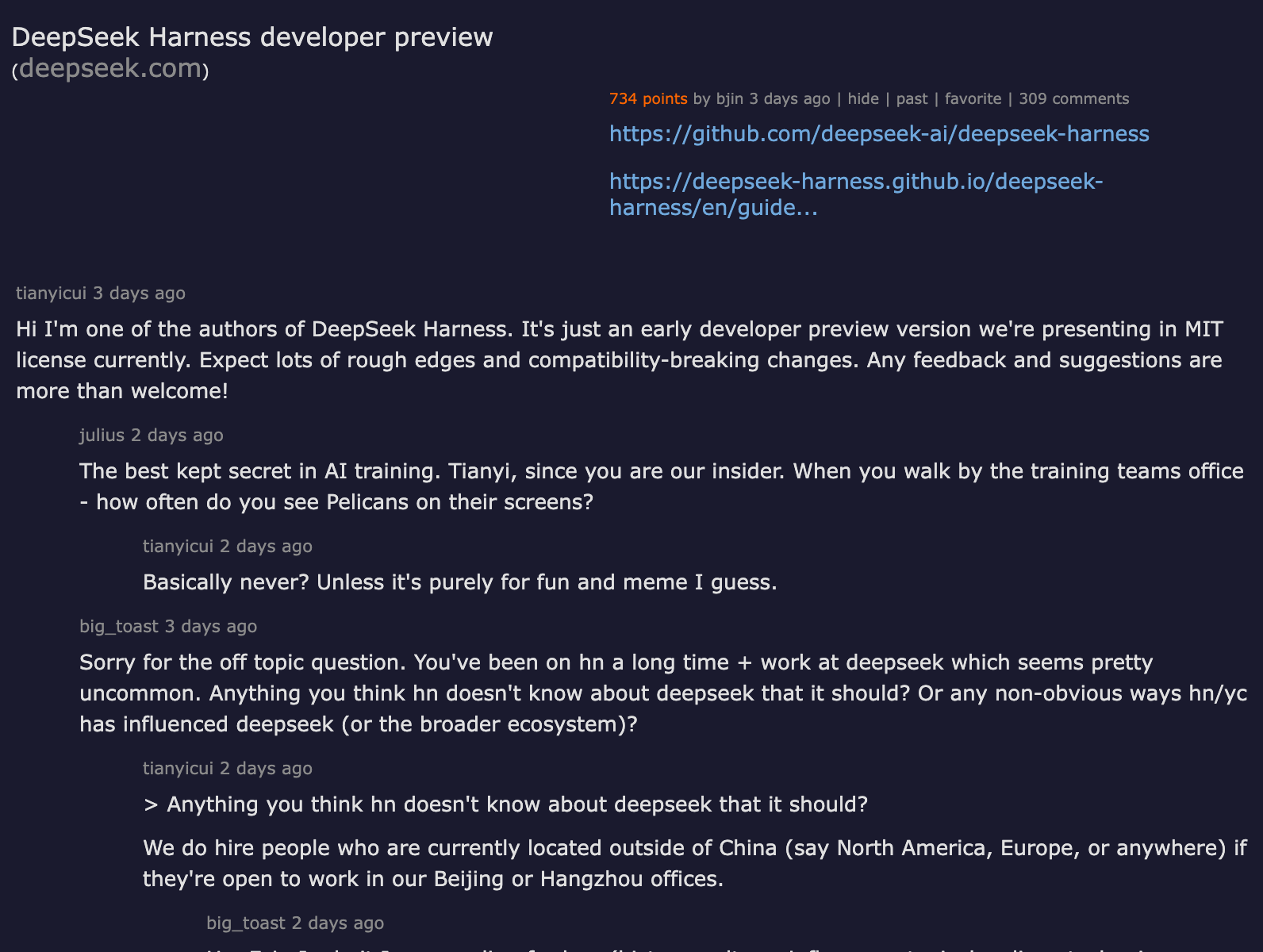
The transparency signal. Multiple commenters highlighted the traceable execution logs as a killer feature that closed-source harnesses do not offer. When your agent makes a mistake, you can walk the event log to understand exactly why — which tool was called, what context was available, what the model decided.
The plugin fatigue concern. Skeptics worried that plugin-dependent architectures become unmaintainable after the initial enthusiasm fades. One commenter drew the comparison to Eclipse’s plugin system — powerful in theory, dependency-hell in practice. This is a legitimate architectural risk, and the Cordis framework’s automatic-cleanup design is DeepSeek’s answer to it.
The TypeScript question. A recurring thread asked why most agent harnesses are built in Node.js/TypeScript rather than Python or Rust. The pragmatic answer: TypeScript has async-first semantics, a massive npm ecosystem for tool integrations, and LLMs generate it fluently — which matters when the harness itself might be modified by agents.
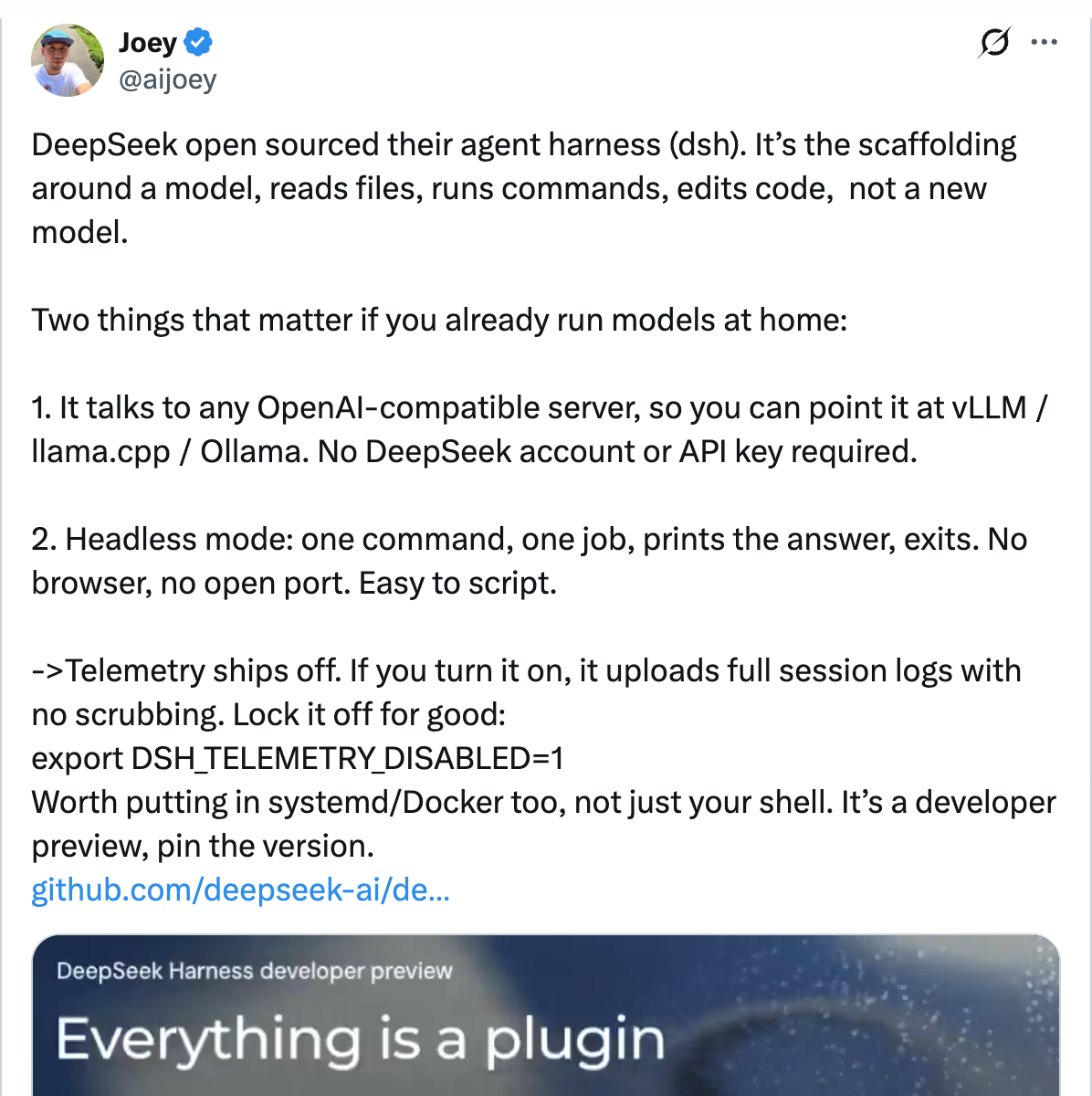
The local-first signal. Developers running self-hosted models immediately noticed the compatibility story. As one developer summarized on X: “It talks to any OpenAI-compatible server, so you can point it at vLLM / llama.cpp / Ollama with no DeepSeek account or API key required.”
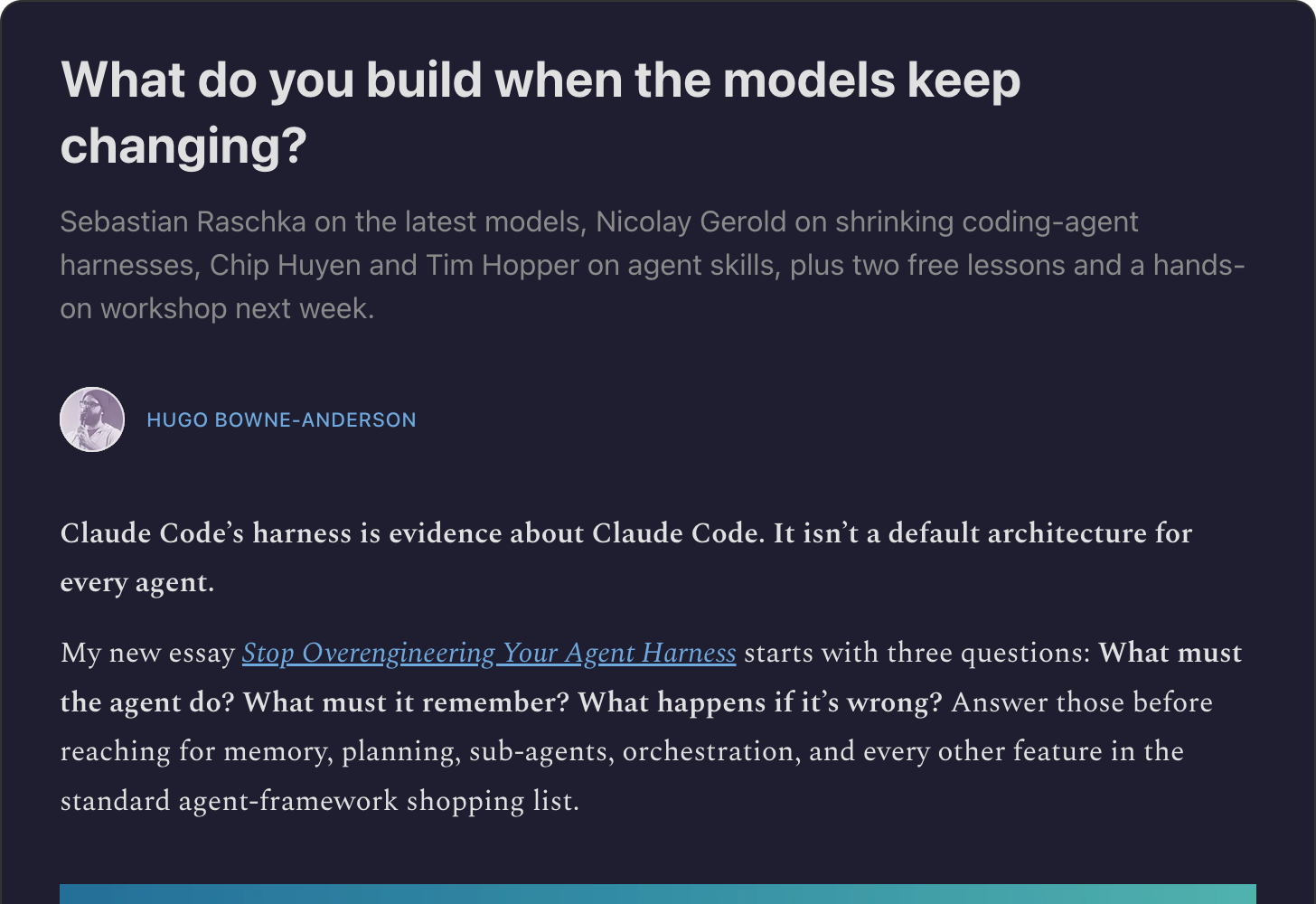
Hugo Bowne-Anderson’s Substack analysis frames the community sentiment precisely: better models do not eliminate harness engineering — they shift its complexity. As models absorb planning capabilities, the architectural burden moves to verification, human review loops, and the question that matters most: “What happens if the agent is wrong?”
The Landscape: Who Is Building What
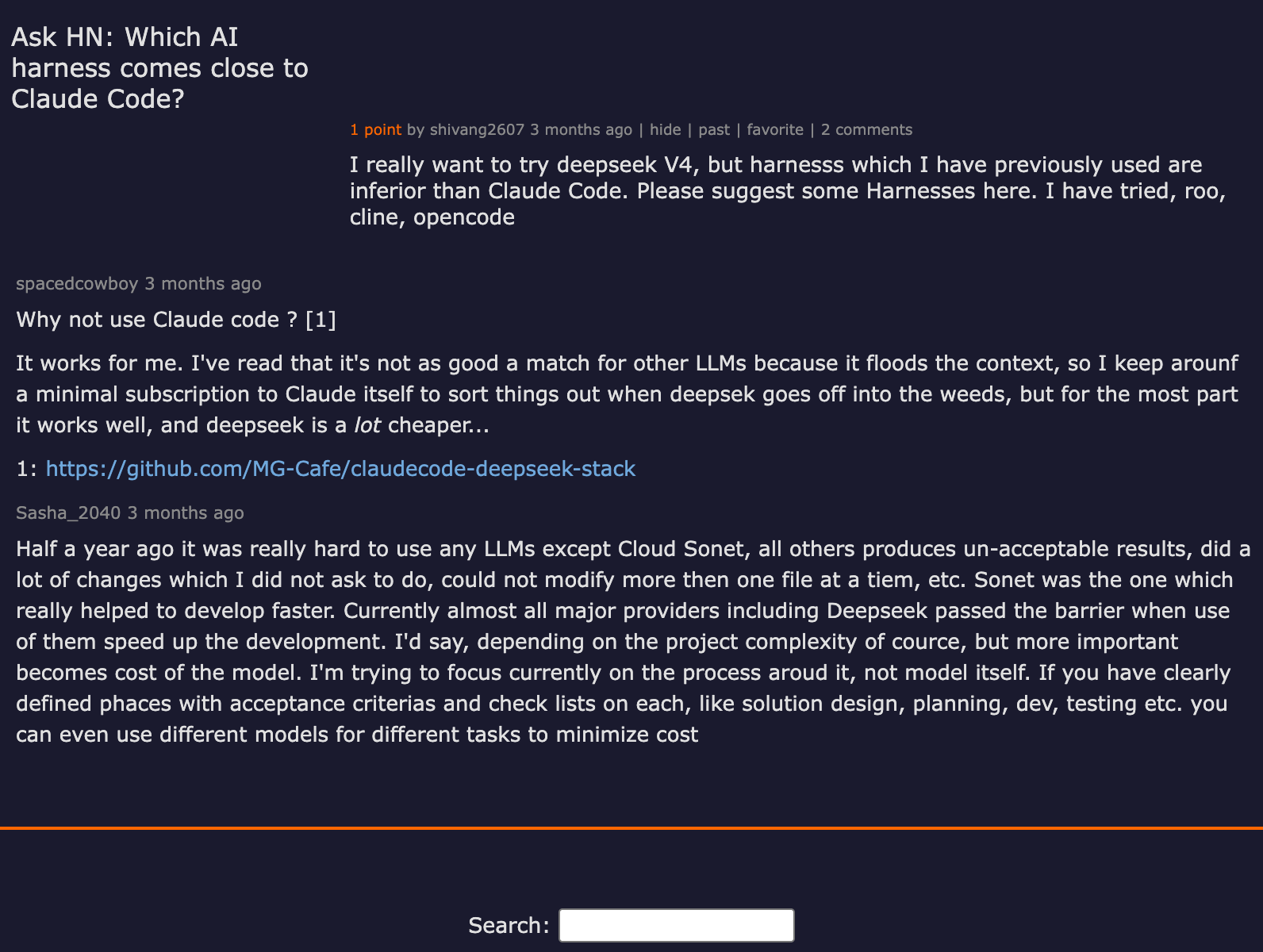
Even before DeepSeek Harness launched, the community was already asking the right question. The Ask HN: “Which AI harness comes close to Claude Code?” thread from earlier this summer catalogued every alternative — and the consensus was that no single open-source harness matched Claude Code’s polish. DSH changes that calculus.
The agent harness landscape in August 2026 breaks into two tiers:
Closed-source harnesses optimize for polish and integration:
- Claude Code (Anthropic) — terminal-first, 171K+ stars, deeply integrated with Claude models
- Codex CLI / ChatGPT Work (OpenAI) — spans chat, code, and background work modes
- Cursor (Anysphere/SpaceX) — IDE-native, acquired for $60B
- Google Antigravity — sandboxed execution with a plugin system
- Grok Build (SpaceXAI) — the harness Musk says Grok 4.6 needs
Open-source harnesses optimize for ownership and flexibility:
- DeepSeek Harness — 135K+ stars, everything-is-a-plugin, MIT license
- OpenCode — 75+ LLM integrations, TUI/desktop/IDE
- Pi — minimal reference implementation, 54K+ stars, runs on a <1K token system prompt
- Aider — git-native, every change auto-committed
- Cline — VS Code extension with permission-gated approvals
The split is clean: closed harnesses trade customization for polish; open harnesses trade polish for ownership. DeepSeek Harness is the most aggressive bet on the open side — not just open-source code, but an open architecture where the loop itself is a swappable component.
What This Means for Builders
The harness-as-moat thesis is no longer speculative. It is measurable in benchmarks, visible on GitHub trending, and explicitly acknowledged by the CEO of a model-producing company. Here is what to do about it:
1. Abstract your model dependency today. If swapping claude-fable-5 for deepseek-v4-pro in your agent pipeline requires more than a config change, you have a structural vulnerability. DeepSeek Harness, OpenCode, and Pi all demonstrate that model-agnostic harnesses are production-viable now.
2. Invest in the agent loop, not the model call. The benchmarks are clear: harness variation produces larger score swings than model swaps. Your engineering time is better spent on retry logic, context windowing, tool routing, and verification than on chasing the next frontier model release.
3. Treat execution traces as first-class observability. DeepSeek Harness’s append-only event log is the right architectural pattern. If you cannot replay your agent’s decision chain after a failure, you cannot debug it — and if you cannot debug it, you cannot trust it in production. This matters more as agents run for hours on complex tasks.
4. Watch the plugin ecosystem, not just the framework. The real test for DeepSeek Harness will not be star count — it will be whether a healthy plugin ecosystem emerges around it. The Eclipse comparison from HN is instructive: plugin architectures need ecosystem gravity. Claude Code’s advantage is not technical — it is the thousands of CLAUDE.md files and skills that the community has already built.
The Bottom Line
We wrote “The Harness Is the Moat” in June, after the Fable 5 ban proved that model access is a political variable. Two months later, the thesis has hardened: DeepSeek shipped a 135K-star harness in four days, Musk admitted the model is not enough without it, benchmark data shows harness engineering outweighs model selection, and GitHub trending is wall-to-wall scaffolding projects.
The era of model worship is over. The era of harness engineering has begun. The question for every builder is simple: is your agent’s intelligence in the model, or in the system you built around it? If you cannot answer that question, DeepSeek just made it free to find out.