Field report · · AgentConn Team
Meta Muse Code Prices Your Repo at $1.15 per Mtok
Muse Code's contributor tier trades your code for a 20x discount. We unpack the pricing, the harness, and what it means for teams.

Meta Muse Code Prices Your Repo at $1.15 per Mtok
Meta Superintelligence Labs shipped Muse Code on August 5, 2026 — a terminal coding agent powered by the new Muse Spark 1.2 model. On the surface, it is another entrant in the coding-agent race that now includes Claude Code, Codex, Gemini CLI, and Grok Build. Beneath the surface, two things set it apart from everything that came before.
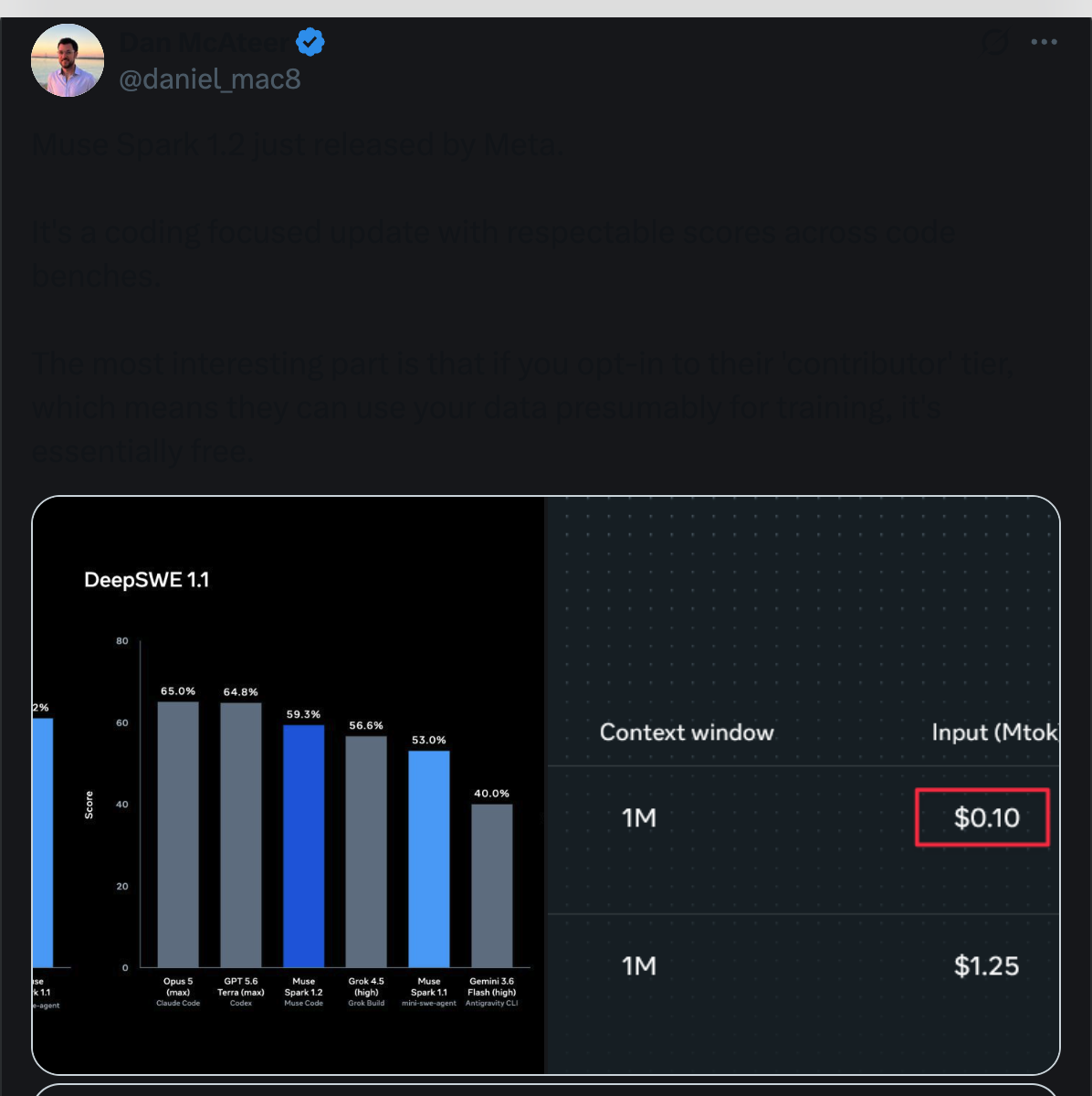
First, Meta is offering a 20x token discount if you let them train on your prompts and completions. The contributor tier prices input at $0.10/Mtok and output at $0.20/Mtok, versus $1.25/$4.25 on the standard tier. That delta — roughly $1.15 per million input tokens — is what Meta thinks your code is worth as training data. No other major lab has put an explicit dollar figure on developer output before.
Second, the benchmark gains from Spark 1.1 to 1.2 come largely from harness innovations, not raw model scaling. Persistent background sub-agents, a local event log for crash-safe resumability, and fan-out workers in isolated Git worktrees represent genuine engineering that the rest of the field will study regardless of whether Muse Code itself wins adoption.
The question for teams evaluating this today is not “is Muse Code better than Claude Code?” It is: should you pay for your coding agent with money, or with your code?
The Contributor Tier: Paying With Your Code
Every AI lab offers a data-retention toggle. OpenAI and Anthropic let enterprise customers opt out of training. Meta flipped the frame: instead of “pay to keep your data private,” it is “get paid (in discounts) if you share your data.”
The numbers are stark:
| Standard | Contributor | Discount | |
|---|---|---|---|
| Input | $1.25/Mtok | $0.10/Mtok | 12.5x |
| Output | $4.25/Mtok | $0.20/Mtok | 21.25x |
| Cached input | $0.15/Mtok | — | — |
| Rate limit | 3,000 req/min | 60 req/min | 50x lower |
The contributor tier runs on a rolling five-hour rate window and is available in select countries only. Your prompts and completions “may be used to improve Meta products.” At those rates, a heavy coding-agent workload that would cost $500/month on standard pricing drops to roughly $25.
As Kilo.ai’s analysis put it: “Meta didn’t discount the model. It put a price on your repository and paid in compute.” The piece estimates that developer code is worth approximately $1.15 per million input tokens to Meta, based on the pricing differential. That is not a rounding error. It is a market-clearing price for the most valuable training data left — code that grades itself through compilation, test results, and human acceptance signals.
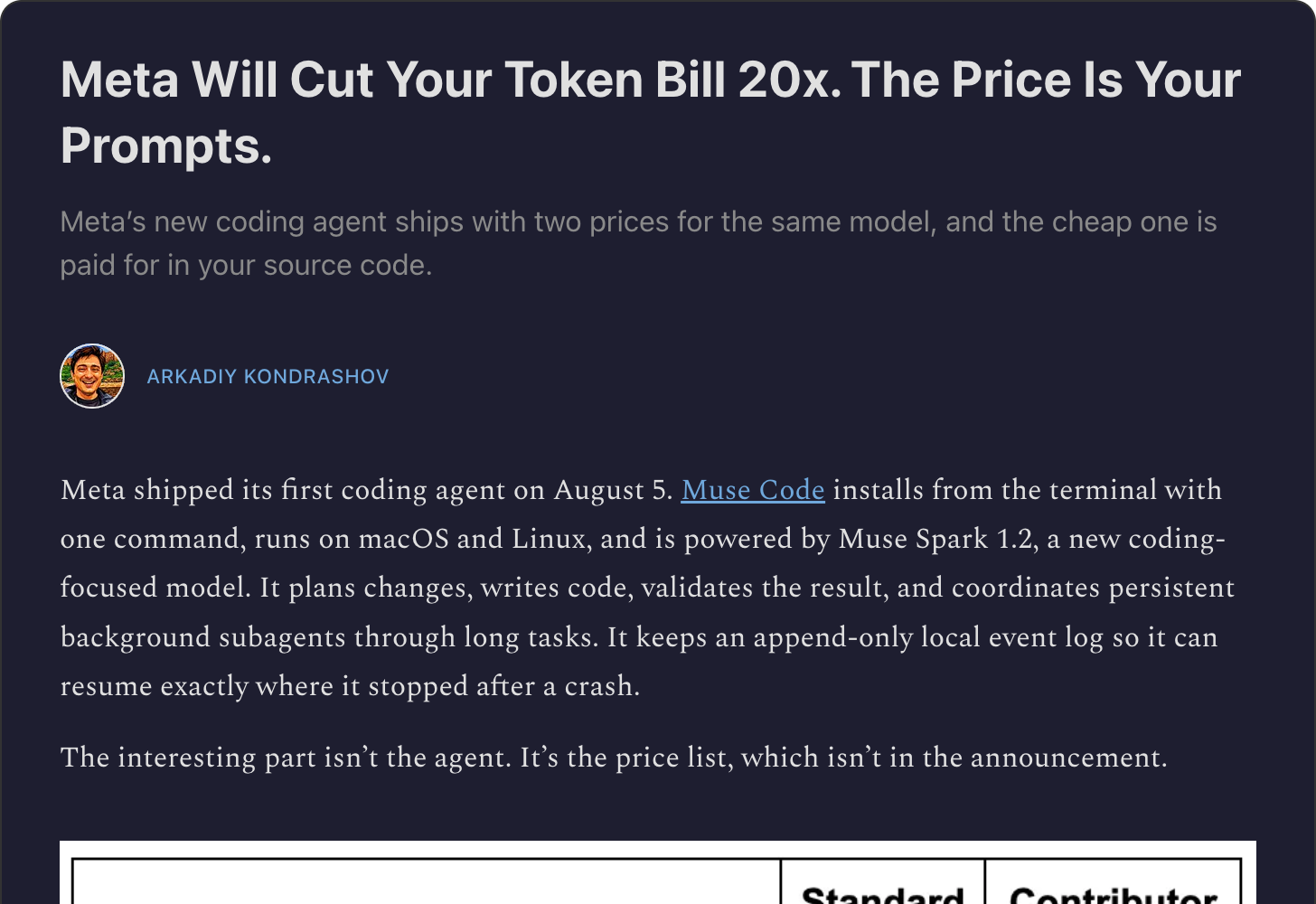
View original post on Kilo.ai ->
What exactly does “improve Meta products” mean? Meta’s contributor terms allow prompts and completions to be used for model training and product improvement. This is broader than just fine-tuning Spark — it could inform any Meta AI product. Simultaneously, Meta now accepts “zero-data-retention requests” through enterprise agreements, matching OpenAI and Anthropic. The ladder is: pay full price and Meta won’t train on you, request zero-retention through enterprise, or pay a tenth and hand over the transcript.
Why This Matters Beyond Meta
The contributor tier normalizes a new transaction type in the AI economy: paying for compute with intellectual output. Previous data-for-discount deals existed in consumer products (Facebook, Google — you are the product), but never as an explicit, quantified API rate card.
If this works, every lab will face pressure to offer the same deal. Why would a startup pay $4.25/Mtok for Claude output tokens when Meta offers equivalent-class tokens for $0.20? The answer is trust, quality, and governance — but for bootstrapped teams burning through tokens on prototype iteration, the economics are hard to ignore.
The Hacker News thread (323 points, 255 comments) captures the tension perfectly. One commenter noted: “there is no way meta is not training on your data regardless of your monthly invoice.” Simon Willison countered with the legal argument that such breach would invite litigation. Another commenter offered to bet $1,000 to charity that “within 18 months from now, there will be some story / whistleblower” about inadvertent data usage.
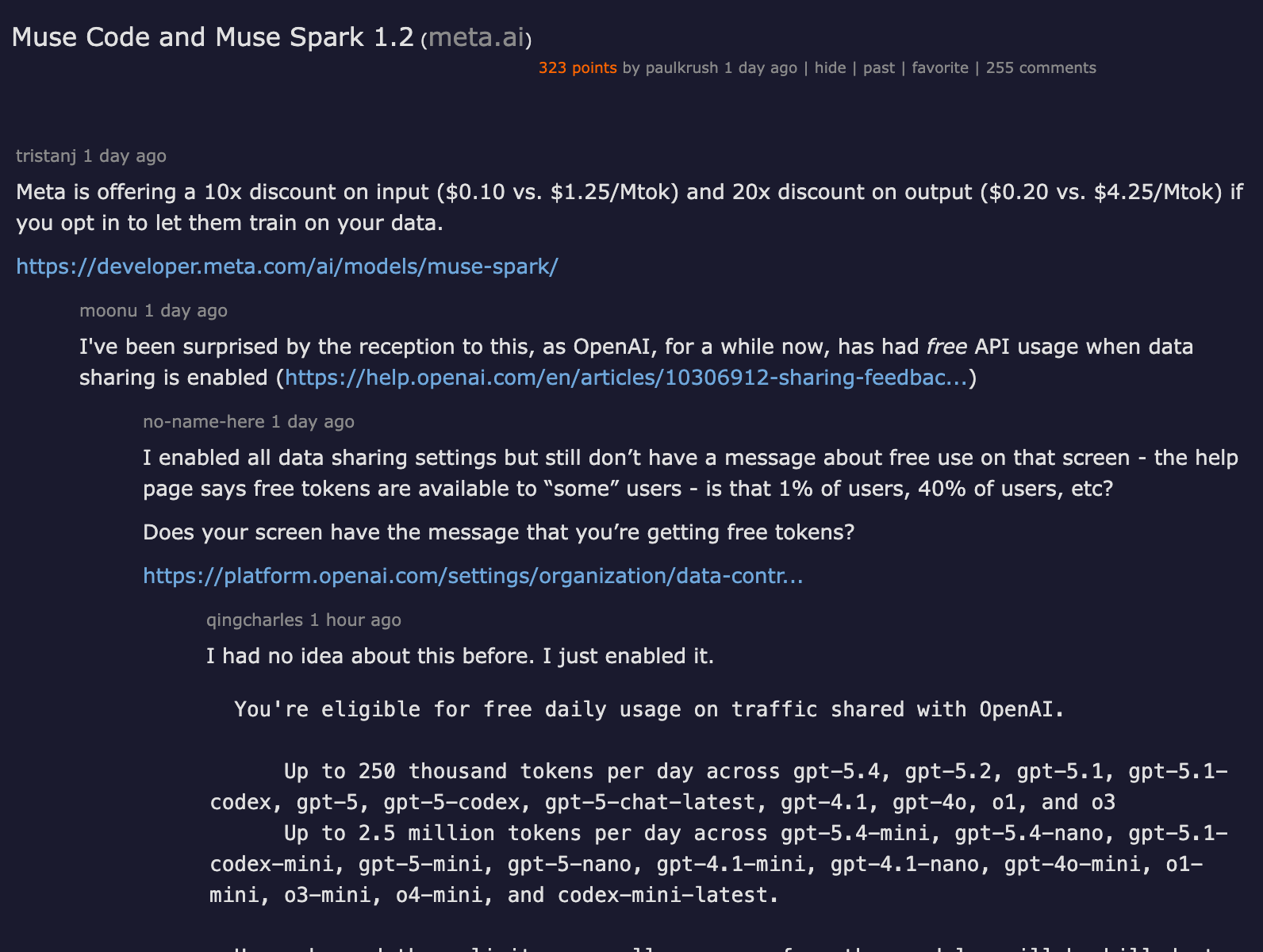
View original post on Hacker News ->
The trust deficit is real. But so is the price. And for teams working on non-proprietary code — open-source contributors, educational projects, internal tooling with no competitive sensitivity — the contributor tier is effectively free frontier-class compute.
The Harness Is the Story, Not the Benchmarks
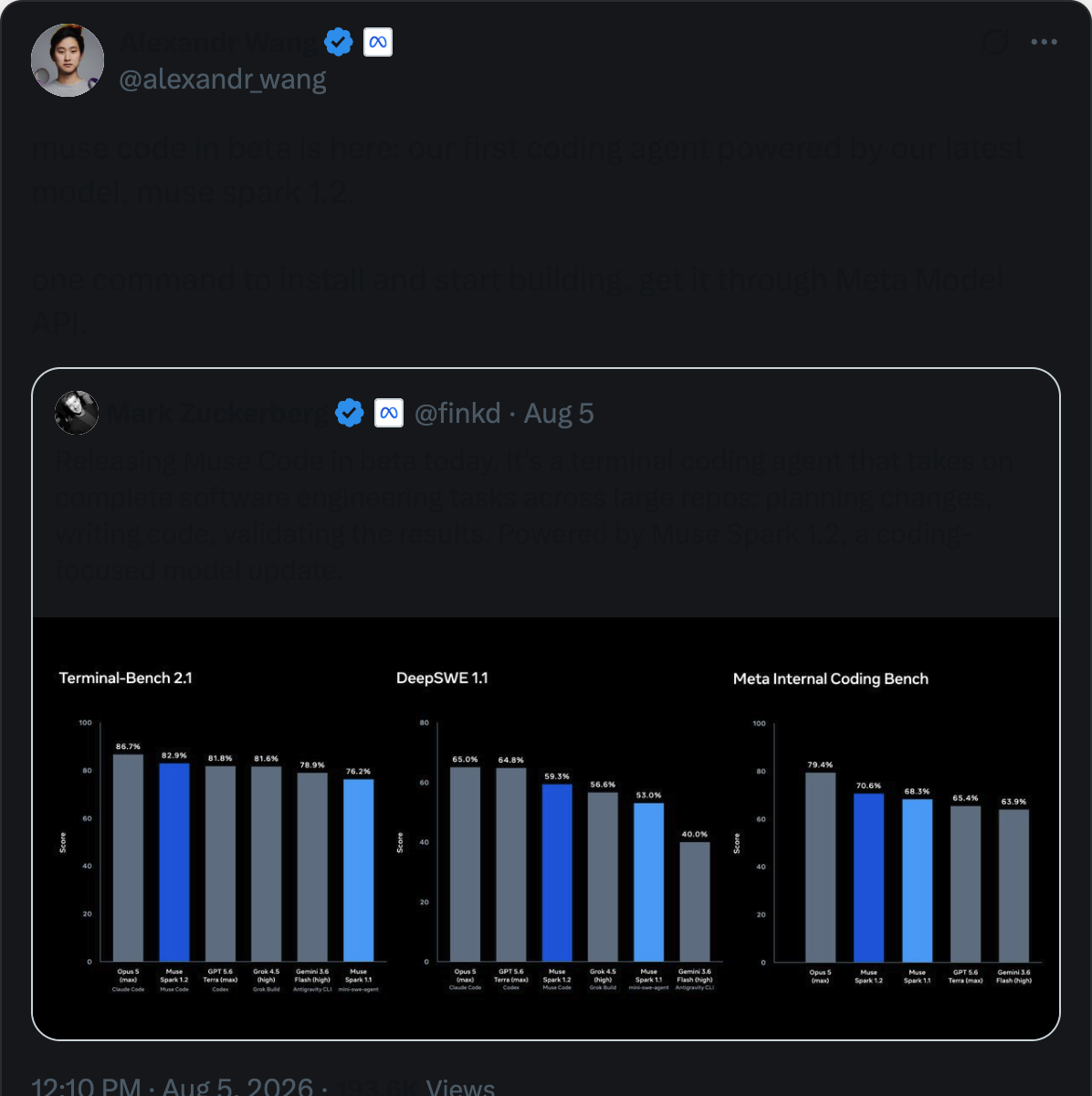
Meta claims Muse Spark 1.2 scores 82.9% on Terminal-Bench 2.1, behind Claude Code on Opus 5 (86.7%) but ahead of GPT-5.6 Terra on Codex (81.8%). These numbers deserve scrutiny.
Kingy.ai’s verified-score analysis found that neither Muse Spark 1.2 nor Opus 5 has an independently verified entry on the official Terminal-Bench leaderboard. The last verified Muse entry — Spark 1.1 — launched at 80.0% claimed but verified at 76.2%, a gap of 3.8 points. Meta also benchmarked against Opus 5 and GPT-5.6 Terra, not the actual verified leaders (Fable 5 at 83.8% and GPT-5.5 at 83.1%).
More importantly, the 1.1-to-1.2 improvement (+6.7 on Terminal-Bench, +6.3 on DeepSWE) is confounded by the harness switch. Spark 1.1 was benchmarked in a generic mini-SWE-agent harness; Spark 1.2 ran inside Muse Code itself. How much of the gain is model quality versus harness quality? Meta cannot separate them — and that is actually the point.
The benchmark tells you the wrong thing. If Muse Code’s harness contributes 3-4 points of the 6.7-point gain, the model itself improved modestly. But for practitioners, the harness gain is more valuable than the model gain — it ships with the product and you get it for free. The industry is converging on the view that long-horizon agentic tool-calling, not benchmark IQ, is the real frontier metric. Latent Space called out Meta’s “innovative harness design” as the story, not the scores.
What the Harness Actually Does
Muse Code introduces three architectural patterns worth studying even if you never use the product:
1. Persistent Background Sub-Agents
Most coding agents spawn sub-agents per task and tear them down when done. Muse Code keeps specialized background agents active for the entire session. They “choose when to communicate back to the main agent” and their persistence “reduces latency and the need for steering on difficult, multi-step tasks.” This is closer to how a human engineering team works — specialists stay in the room, accumulating context, rather than being briefed from scratch each time. We explored this pattern in our fleet orchestration deep-dive.
2. Local Event Log (Crash-Safe Resumability)
Every model call, tool run, approval, and edit is appended to a local event log. The runtime is “replay-exact and restart-safe: after a crash, the agent can resume precisely where it stopped.” For long-running jobs, this is transformative. Meta demonstrated a case study where Muse Code ran 1,000+ tool calls over 24 hours optimizing GPU kernels on NVIDIA Hopper hardware. If that job crashes at hour 20, you lose nothing.
3. Fan-Out Workers in Isolated Worktrees
Large tasks get broken into parallel sub-tasks, each running in its own Git worktree. No file conflicts. No lock contention. When sub-tasks complete, their changes merge back. This is how CI/CD systems handle concurrent builds, now applied to agent execution.
The Co-Training Loop
Meta co-trained Muse Spark 1.2 with Muse Code’s harness using “rejection-sampled harness trajectories and recipe optimizations for goals, compaction, and sub-agents.” In plainer English: they generated coding tasks, ran them through early versions of the harness, kept the trajectories where the agent succeeded, and trained the model on those successful runs. This creates a tight coupling — the model performs best inside this specific harness, and the harness is designed to extract the model’s best performance.

Cline tested this claim by extracting instructions from Muse Code’s system prompt and running Spark 1.2 inside their own harness. The results suggest the co-training matters — Spark 1.2 underperforms its benchmarks when separated from its native environment. This is a harness moat in the making.
How It Slots Against the Field
Here is where Muse Code sits as of launch day, based on available data:
| Agent | Model | Terminal-Bench 2.1 | Pricing (in/out per Mtok) | Maturity |
|---|---|---|---|---|
| Claude Code | Opus 5 | 86.7% (unverified) | ~$15/$75 (Max plan) | Production |
| Codex | GPT-5.6 Terra | 81.8% (unverified) | $2.50/$10 | Production |
| Muse Code | Spark 1.2 | 82.9% (unverified) | $1.25/$4.25 (std) | Beta |
| Muse Code | Spark 1.2 | 82.9% (unverified) | $0.10/$0.20 (contrib) | Beta |
| Gemini CLI | Gemini 3.6 | ~78% | Free tier available | Production |
On standard-to-standard economics, Muse Code is roughly 8-12x cheaper on tokens than Codex and dramatically cheaper than Claude Code’s subscription model. On contributor pricing, it is in a class by itself.
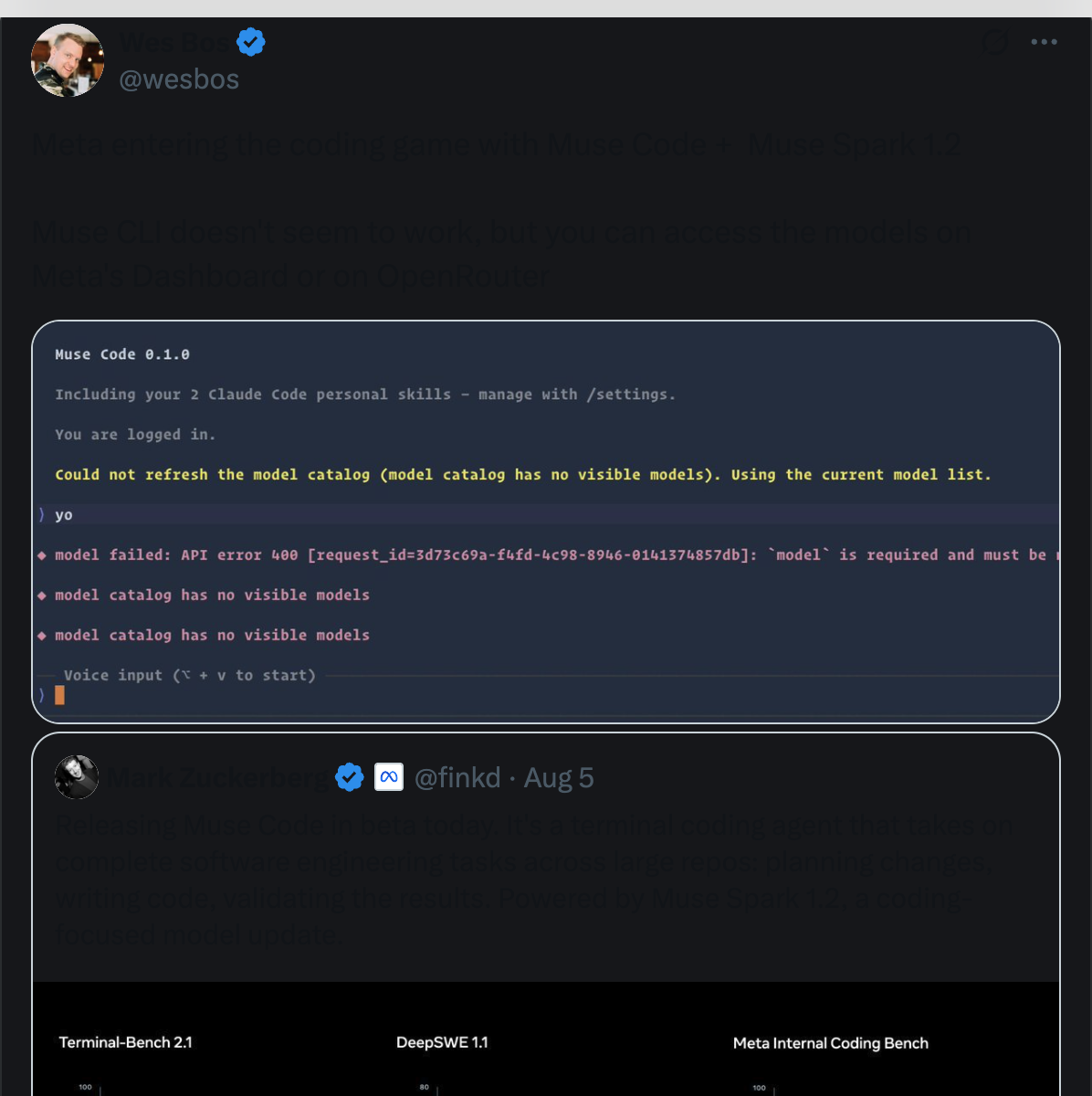
But maturity matters. Claude Code ships terminal, IDE, desktop, and web surfaces. Codex spans CLI, IDE extension, and cloud execution. Muse Code is terminal-only, macOS/Linux-only, beta-only. No Windows support. No IDE integration. No web interface. As multiple HN commenters noted, the CLI itself had login bugs on launch day, and one user reported the model “couldn’t complete a simple task — it stuck using grep/search tools.”
For teams already invested in Claude Code or Codex workflows, Muse Code is not a replacement today. It is a monitoring target — worth installing, testing on a side project, and benchmarking against your real workload. The harness architecture is the piece most likely to influence how you build with your current tools.
The Contrarian Case: Why the Discount Might Backfire
The bull case for the contributor tier assumes trust. Meta hasn’t earned it.
The contributor pricing is transparent — you know what you are giving up. But Meta’s history with user data (Cambridge Analytica, FTC consent decree, repeated privacy settlements) means every enterprise compliance team will flag this. As one HN commenter put it: “It doesn’t matter how good it is, no one will use it because no one trusts them.”
The counterargument: Meta’s legal exposure from training on standard-tier data without consent would be enormous. The explicit opt-in structure is designed precisely to create legal defensibility. And for non-proprietary workloads, the trust question is moot — there is nothing to protect.
The real risk is selection bias. If only non-proprietary, educational, and open-source code flows through the contributor tier, Meta gets a training set that underrepresents production patterns, enterprise architecture, and proprietary frameworks. The model trains on the code people do not care about protecting — which may not be the code that makes it better at the work people care about.
Geographic and Regulatory Wrinkles
Multiple users reported the contributor tier is unavailable outside the US. EU developers — subject to GDPR and the AI Act — cannot opt in even if they want to. This creates a two-tier global market: US developers get frontier-class tokens at commodity prices, while everyone else pays 10-20x more for the same model.
For teams building cross-vendor agent queues, this geographic restriction matters. If your orchestration layer routes to the cheapest available model, contributor-tier Spark 1.2 would win every cost comparison — but only for US-based execution. International teams need routing logic that accounts for tier availability, not just price.
What This Means for You
If you run a coding agent at scale and your code is not proprietary: Test the contributor tier immediately. At $0.10/$0.20 per Mtok, you can run Muse Code for extended sessions — including those 1,000+ tool-call long-horizon tasks — at a cost that would be noise in your cloud bill. Open-source maintainers, educational institutions, and internal-tooling teams should evaluate this seriously.
If you have proprietary code: The standard tier at $1.25/$4.25 is competitive but not exceptional. Evaluate Muse Code’s harness features (persistent agents, event logs) against your current setup. If you are running Claude Code or Codex, the switching cost likely exceeds the savings unless Muse Code’s specific architecture solves a pain point you have today — like crash recovery on long-running tasks.
If you build agent harnesses: Study the event-log pattern and persistent sub-agent architecture. These are transferable ideas. The event log in particular — append-only, replay-exact, restart-safe — is a pattern that belongs in every long-running agent system, regardless of the underlying model. We covered why the harness, not the model, is the moat in our earlier analysis, and Muse Code reinforces that thesis.
If you are watching the market: The contributor tier is a leading indicator. If Meta’s training flywheel works — cheap tokens attract developers, developer code improves the model, better model attracts more developers — expect Claude and OpenAI to respond with their own data-for-discount programs within 12 months. The 7M-user race just got a new pricing dimension.
The Bottom Line
Meta shipped a beta coding agent with genuine architectural innovations and a pricing model that forces every team to answer a question they have been avoiding: what is your code worth as training data?
The harness is interesting. The benchmarks are unverified but plausible. The model is competitive but not leading. None of that is what makes Muse Code significant.
What makes it significant is that for the first time, a major lab has published a rate card that explicitly prices developer code as a commodity — $1.15 per million tokens, payable in compute discounts. Whether you take the deal or not, the price has been set. The rest of the industry will have to decide whether to match it, beat it, or argue that their code is worth more.
Muse Code is not the best coding agent today. It might be the most honest one about what it wants from you.