Field report · · AgentConn Team
Nadella Said It: VS Code Faded in Six Months
Satya Nadella admitted VS Code lost its decade of dominance in six months to Claude Code. The agent harness, not the editor, is the product surface now.

Nadella Said It: VS Code Faded in Six Months
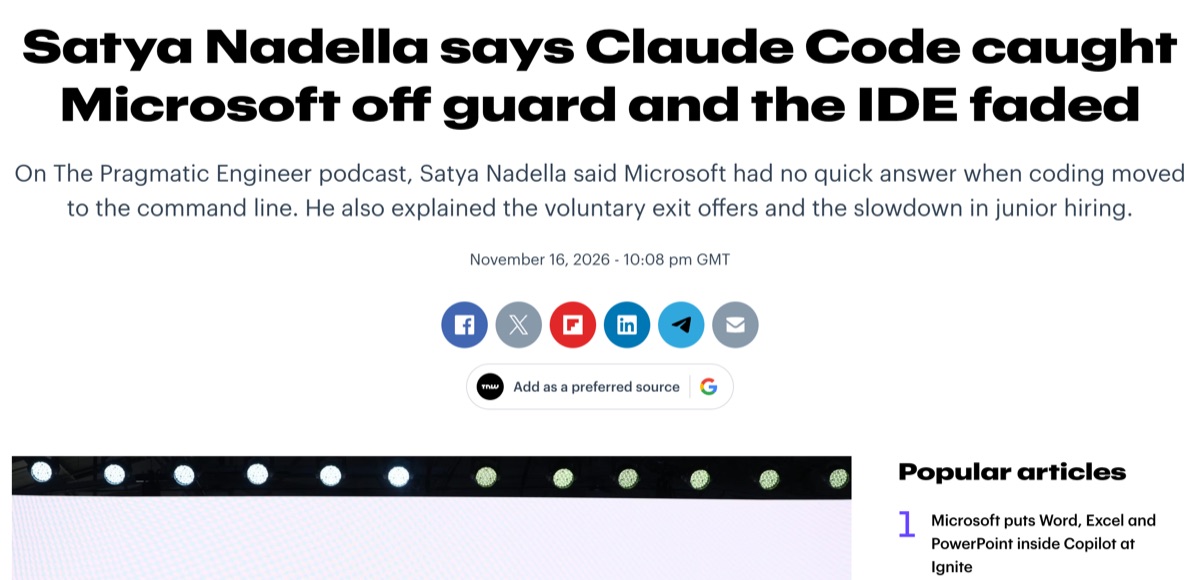
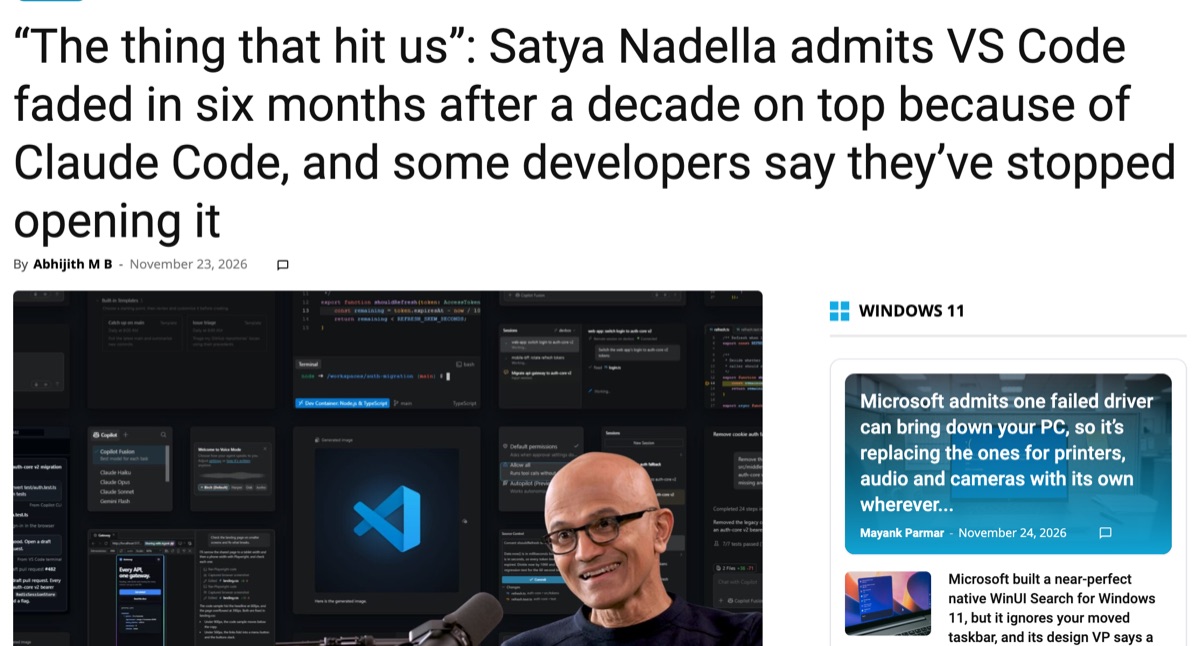
The most dominant code editor of the last decade did not die in a competitive shootout. It faded — quietly, in about six months — because the product surface moved somewhere else entirely. In an hour-long interview with Gergely Orosz on The Pragmatic Engineer podcast, Microsoft CEO Satya Nadella said it plainly: “The thing that hit us was obviously the great work that Anthropic did with their model, which then truly made the CLI the form factor.” The IDE — VS Code, the editor that had commanded 75.9% of daily developer usage in the 2025 Stack Overflow survey — kind of faded away.
This is not a story about one tool beating another. It is a story about what happens when the product surface migrates from the editor to the agent harness. The agent loop, the tool registry, the permission model, the skill library — that is what developers interact with now. VS Code became a viewport for Claude Code’s terminal session. The harness won.
View original article on The Next Web →
What Nadella Actually Said
The interview, published November 16, 2026 and recorded in Redmond hours before a Microsoft Outlook outage, contained several admissions that would have been unthinkable a year earlier.
Nadella walked through the sequence: VS Code dominated for a decade by “building in the open,” where product managers read community feedback every day. Then GitHub Copilot arrived in 2021, and its early code completions were “magical.” Then Cursor forked VS Code and built an agent mode. Microsoft caught up on agent mode. And then Claude Code moved coding from the editor to the command line entirely — and Microsoft had no quick answer.
“Code went from input to output,” Nadella told Orosz. “In six months or so… IDEs kind of faded away.”
The key insight is Nadella’s framing of why it happened: “When model jumps happen nonlinearly, the form factor has to change quickly. AI-first product building in that sense is unforgiving.” This is not a complaint about losing market share. It is a structural observation about how platform shifts work. The model improvement was so rapid that the IDE — built around human editing of text files — could not adapt fast enough.
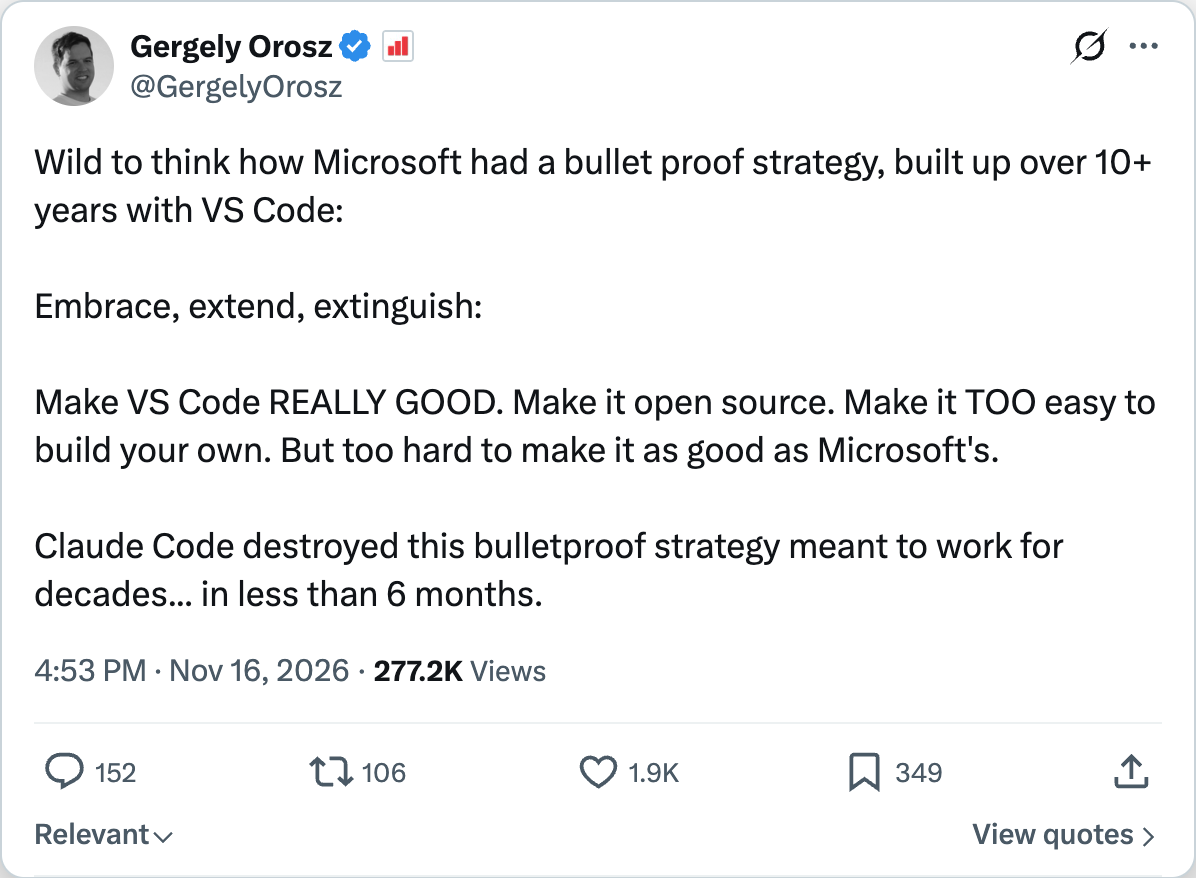
Orosz himself amplified the thesis on X, noting that Claude Code “destroyed this bulletproof strategy” that VS Code had built over a decade. The sentiment resonated. As one reply put it: “10 years building the perfect moat and someone just walked around it in a terminal.”
The story also made it to Hacker News, where the thread title — “IDEs kind of faded away” — became its own talking point:
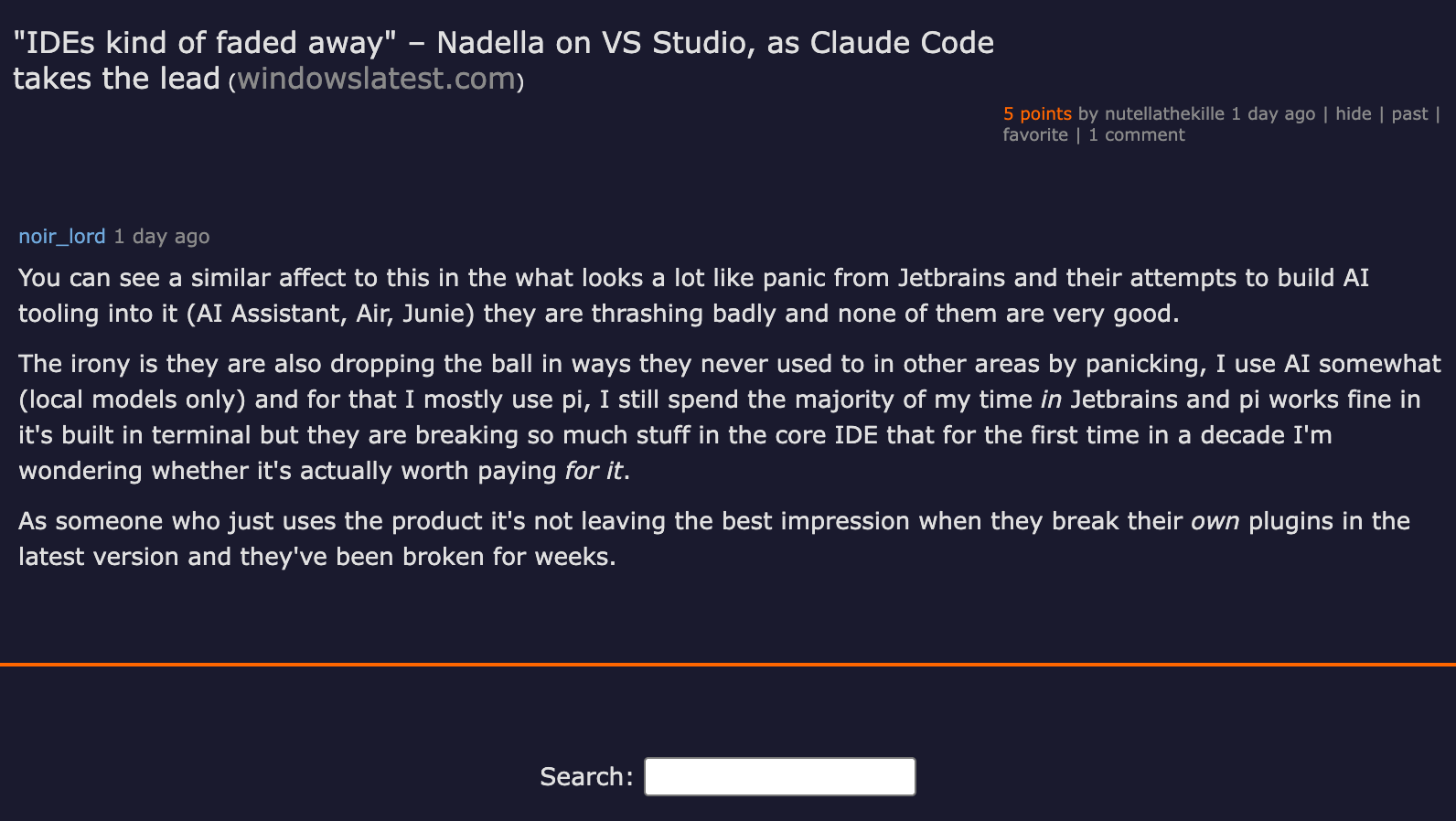
View discussion on Hacker News →
The Timeline of Displacement
- April 2015: VS Code previewed at Build as a free, cross-platform editor
- November 2015: Open-sourced, extensions marketplace launched
- April 2016: VS Code 1.0 — 2 million installs, 500K+ monthly active developers
- June 2021: GitHub Copilot brought AI completions into VS Code
- 2023: Cursor forks VS Code with AI-first agent mode
- February 2025: Anthropic launches Claude Code — terminal-first agent coding
- ~August 2025: Nadella says the IDE “kind of faded away”
- October 2026: Stack Overflow survey shows VS Code dropped to 70.9% from 75.9%
The Numbers Back It Up
The 2026 Stack Overflow Developer Survey — 13,193 respondents — tells the story in data. VS Code usage dropped from 75.9% in 2025 to 70.9% in 2026. Five percentage points of daily developer mindshare evaporated in a single year. Meanwhile, Claude Code topped the coding agents category at 65.5%, with GitHub Copilot at 58.7% and Cursor at 25.5%.
View the 2026 Developer Survey results →
But the more telling number comes from GitHub’s Octoverse 2026 report: more than 40% of all pull requests on GitHub started with an agent’s first draft by September 2026 — up from 17% in March. That is 110 million agent-started PRs in September alone. Agent PRs now merge at 90%, outpacing human-written PRs at 86%.
What those merge rates mean: When agent-written code merges more reliably than human-written code, the value proposition of an IDE — a tool optimized for humans writing code — weakens structurally. The IDE was built for the bottleneck that no longer exists.
A separate Microsoft study found that per-developer throughput at companies using agentic tools reached 2.09x the pre-mandate baseline — from 21.2 to 44.3 merged PRs per active developer. This is not a marginal improvement. It is a step function that makes the old workflow — open IDE, read code, write code, run tests, commit — look like a relic.
The Harness Is the Product Surface Now
This is where the story connects to a thesis we have been tracking all year at AgentConn. The harness — not the model — is the moat. The harness is the product surface. And the IDE’s displacement is the most visible proof.
Consider what developers actually interact with in a Claude Code session:
- The agent loop — the conversation-driven cycle of intent, execution, verification
- The tool registry — MCP servers connecting to databases, APIs, browsers, file systems
- The permission model — what the agent can do autonomously vs. what requires human approval
- The skill library — CLAUDE.md, project skills, hooks that encode team workflows
- The session context — which files are relevant, what the codebase conventions are
None of these are IDE features. They are harness features. The editor is an optional viewport — useful for reading code, but no longer the place where work gets defined or executed. As we wrote in our analysis of the software factory pattern, organizations that restructured around agent throughput did not start by upgrading their IDE. They started by investing in harness configuration.
The adoption data backs this up. When Utah gave Claude Code to 34 developers across 10 state agencies, 80% had a working environment within 30 minutes — no IDE setup required:

Steve Yegge made this argument forcefully at AI Engineer 2025, declaring “2026: The Year the IDE Died.” His prediction was deliberately sweeping: within roughly a year, engineers would oversee large code-generating systems without inspecting every line. He compared the shift to moving from hand tools to CNC machines. What was provocative in December 2025 reads as straightforward description in November 2026.
Microsoft’s Response: Absorb or Be Absorbed
To Microsoft’s credit, they are not sitting still. The response has been to turn VS Code into a harness host rather than fight the harness directly.
VS Code 1.109 led with Claude-specific changes: VS Code now reads Claude configuration files directly, so CLAUDE.md, MCP server configs, skills, and hooks work across both tools. VS Code 1.133 added the ability to switch model providers between turns in Claude sessions. And the November 2026 releases — 1.146 and 1.147 — added an agent inbox, model comparison tools, scheduled agent requests, and browser integration.
View original article on WindowsLatest →
Nadella himself hinted at the strategy: “I don’t say it’s a permanent shift. There could be a rebirth even of an IDE.” He envisions the future IDE as “more about how do I really input the specs and the markdowns” — less about writing code, more about specifying intent and reviewing agent output. He also mentioned Copilot Fusion routers that would send some tasks to local models and some to the cloud, calling it the start of a “hybrid intelligence era.”
Contrarian Corner: The IDE Is Not Dead — It Is Being Absorbed
There is a plausible counter-argument here. VS Code at 70.9% usage still dwarfs every competitor. The JetBrains 2026 survey shows similar IDE resilience. And Microsoft is aggressively retrofitting VS Code as the agent coordination layer.
The question is not whether VS Code survives — it almost certainly does. The question is whether the editor paradigm survives. If VS Code’s value is increasingly as a viewport for agent sessions, a host for MCP servers, and a manager of CLAUDE.md files, then it has already conceded the thesis. The harness is the product. The editor is the chrome.
Orosz drew the “embrace, extend, extinguish” parallel — wondering whether Microsoft is running the classic playbook on Claude Code’s ecosystem. That framing may be too generous. It implies Microsoft is in control. The more accurate read may be that Microsoft is scrambling to remain relevant as a container for someone else’s product surface.
The Internal Signal: Microsoft Cancelled Claude Code Licenses
Perhaps the most revealing data point is what happened inside Microsoft. In May 2026, Windows Central reported that Microsoft cancelled internal Claude Code licenses and shifted developers to GitHub Copilot CLI. The scope was broad — covering the Experiences and Devices division (Windows, Office, Teams, Surface).
The official rationale was strategic consolidation and fiscal discipline. But the subtext was unmistakable: Microsoft’s own engineers preferred Claude Code so strongly that the company had to mandate its own tool. When the CEO publicly admits the competitor caught them off guard and the company has to revoke the competitor’s licenses internally, the competitive dynamic is clear.
The timing also matters. This happened just months before Nadella sat down with Orosz and said the IDE “kind of faded away.” The two stories — the internal license revocation and the public admission — are the same story told from different angles.
The practitioner signal is consistent. Duncan Rogoff’s breakdown of spending over 1,000 hours in Claude Code — without opening an IDE — illustrates what Nadella is describing at the macro level. When an experienced developer can work full-time in a terminal-based harness and report higher productivity, the IDE is not dying because it got worse. It is dying because the developer’s attention moved.
The Verification Bottleneck
Nadella raised one more point worth unpacking: “In a world where code generation has become cheap, what has become hard is verification.”
This matters because verification is fundamentally a harness problem, not an editor problem. The IDE was designed around a workflow where humans write code and need syntax highlighting, autocomplete, and debugging tools to do it well. Verification — checking whether agent-generated code actually does what it should — requires a different stack: automated test execution, intent review, security scanning, behavioral comparison, production monitoring.
The companies that have solved the software factory workflow did it by building verification into the harness itself. At Cognition, every Devin PR enters a verification pipeline that includes both automated checks and human intent review. At PostHog, agent PRs go through the same CI/CD gates as human PRs, but with additional semantic checks. The IDE plays no role in this loop.
Nadella’s framing also explains why he thinks the IDE could return in a new form — as a tool for “inputting specs and markdowns.” If verification is the bottleneck, the new IDE is not an editor for code but a workbench for specifying intent and reviewing results. That is essentially a harness dashboard with a different name.
What This Means for You
If you are building with agent harnesses today — and if you are reading AgentConn, you probably are — here is what the Nadella admission means in practice:
Three things to do this week:
-
Audit your team’s workflow surface. Where do developers actually spend their time? If the answer is “configuring CLAUDE.md, writing MCP server configs, and reviewing agent output” — your harness IS your IDE. Invest in it like one. Version it, review it, iterate on it.
-
Stop treating harness configuration as secondary. Your CLAUDE.md, project skills, hook scripts, and permission models are production infrastructure. They determine how 40%+ of your PRs get generated. Treat them with the same rigor you apply to CI/CD pipelines.
-
Rethink your extension investment. If your team has spent significant time building VS Code extensions and editor customization, evaluate whether that effort should shift to harness plugins and skills. The return on investment has inverted: a well-configured harness now drives more throughput than a well-configured editor.
The harness community is already quantifying this shift. Garry Tan’s public eval work shows how harness configuration — not editor choice — determines throughput:
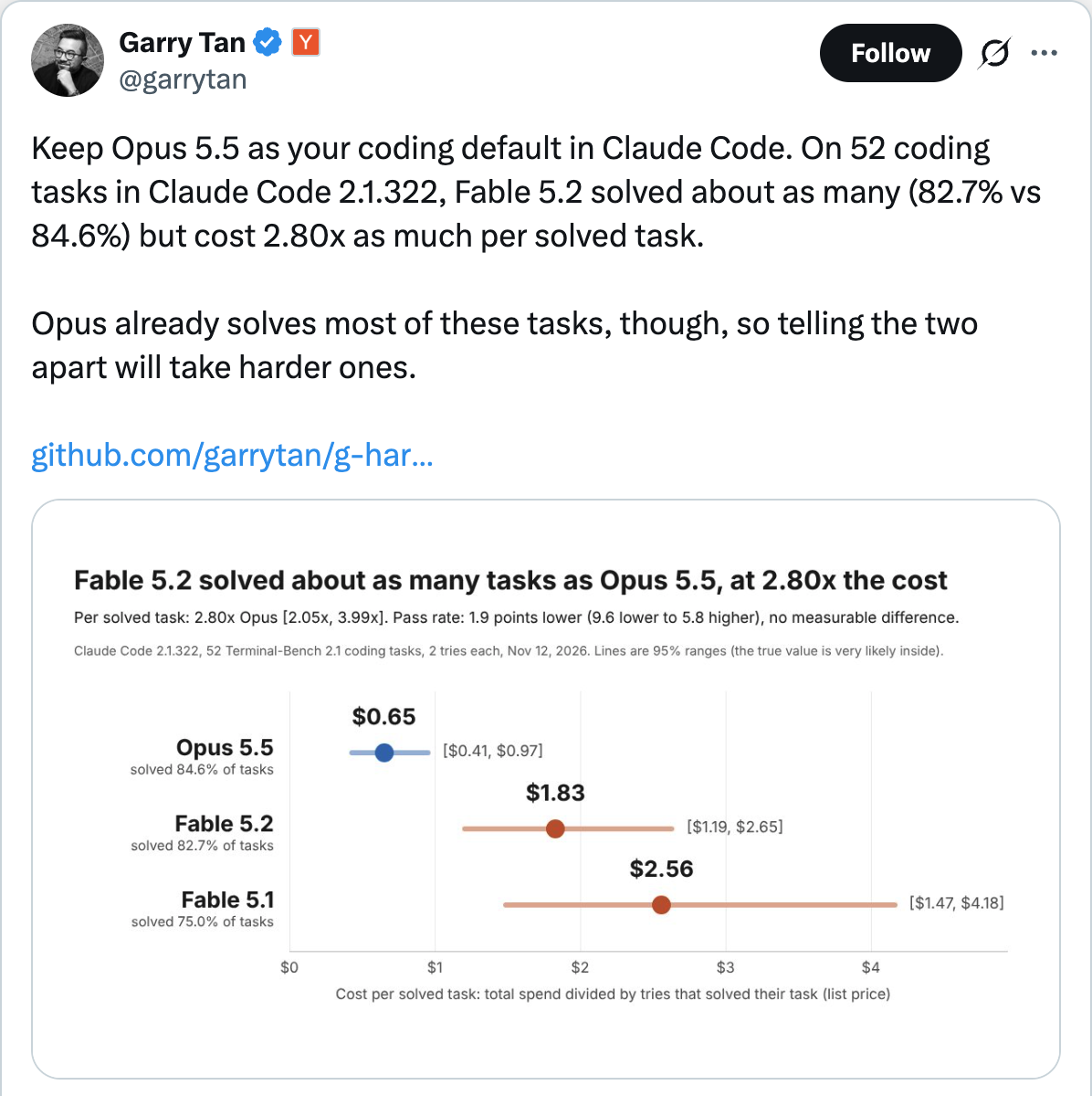
The IDE is not dead. But the IDE as the product surface — the place where developer work is defined, executed, and shipped — is fading. Nadella said it. The numbers confirm it. The question is not whether it happened but what you build on the surface that replaced it.
As Nadella told Orosz: “Don’t be in love with what you built.” The engineers who internalize that advice — and redirect their tooling investment from the editor to the harness — will ship faster than those who wait for the IDE to reinvent itself.
The agent harness thesis has been building all year. For background on why the harness is the competitive moat, see our coverage of DeepSeek’s open-source harness, big tech open-sourcing agent harnesses, and the software factory pattern.