Field report · · AgentConn Team
Astra Is an Agent Runtime, Not a Model
GPT-6 Astra's async tool calling, sub-agent slots, and mid-turn steering make it the first model shipped as orchestration infrastructure.
Astra Is an Agent Runtime, Not a Model
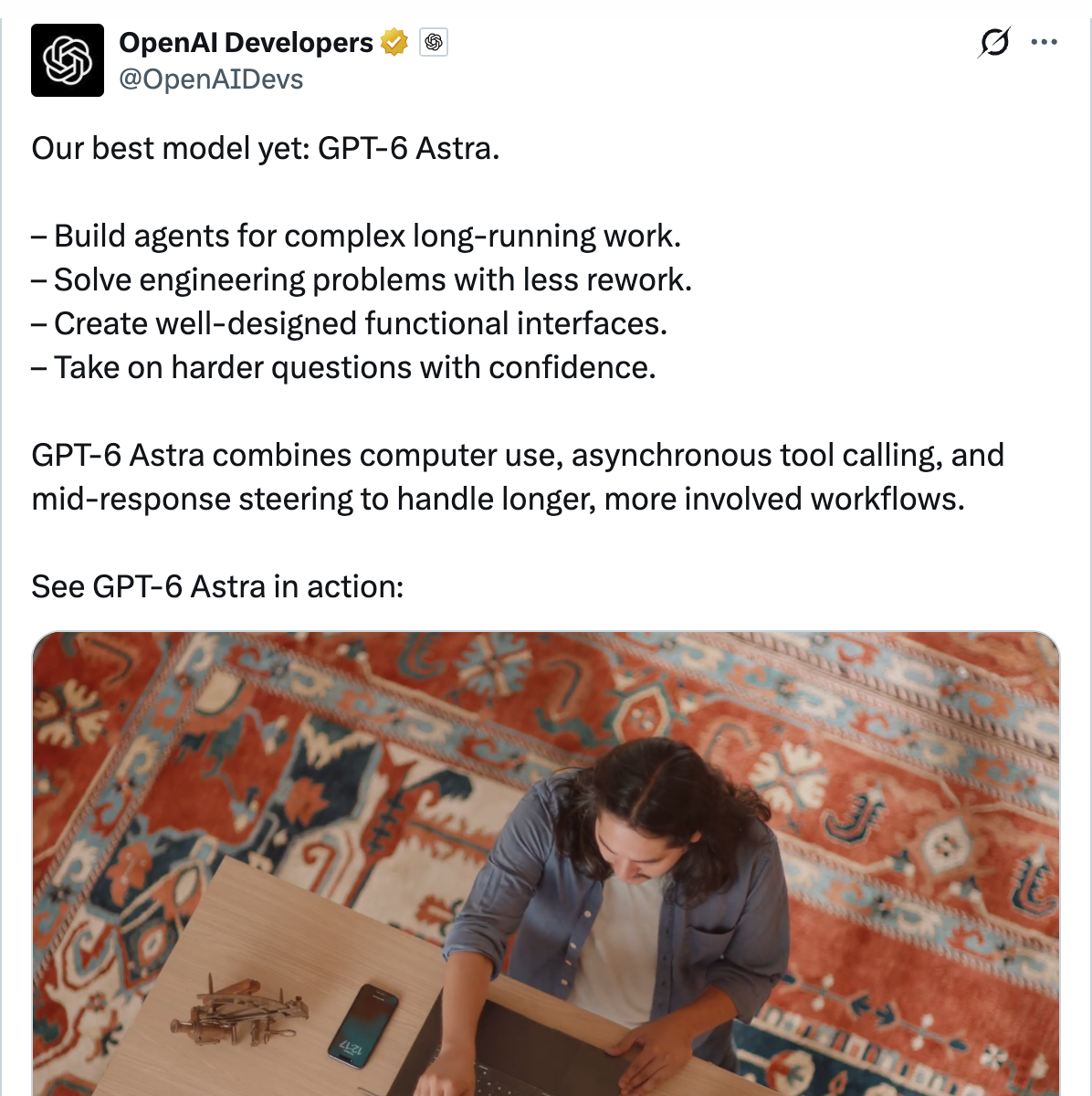
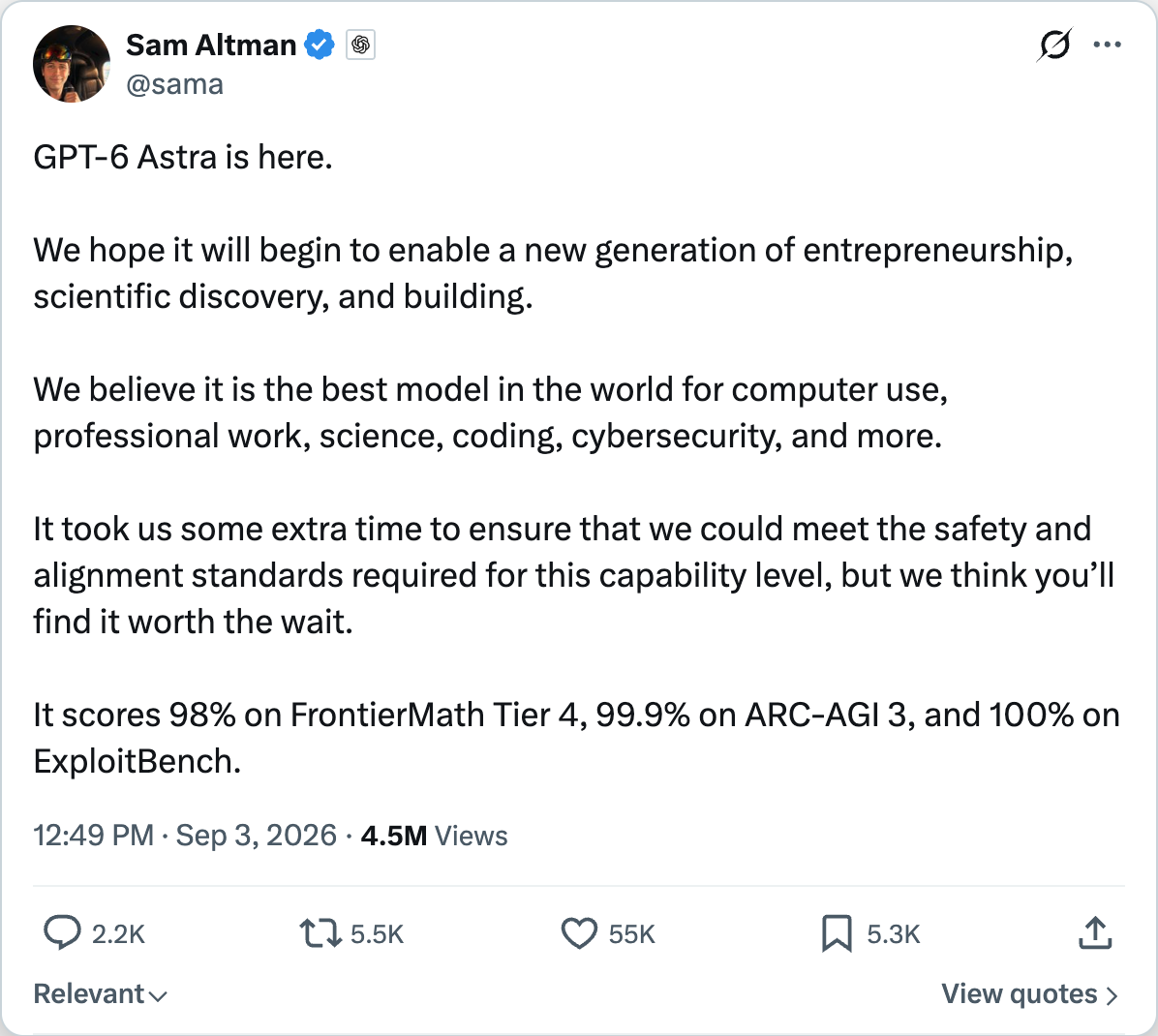
Everyone is talking about GPT-6 Astra’s benchmarks. FrontierMath 98%. ARC-AGI-3 99.9%. ExploitBench 100%. The numbers are real and they’re impressive. But if you’re building agents, the benchmarks are the least interesting thing OpenAI shipped this week. The interesting thing is the three Responses API primitives that arrived alongside the model: async tool calling, mid-turn steering, and sub-agent orchestration slots. Those aren’t model capabilities. They’re runtime infrastructure. OpenAI didn’t just release a smarter model — they released an agent runtime dressed as a model upgrade.
This matters because every agent framework for the past two years — LangChain, CrewAI, AutoGen, Orca — has been building orchestration from the outside. Tool dispatch, parallel execution, state management, result routing: all application-layer code wrapping a fundamentally synchronous model API. Astra moves that orchestration inside. And that changes the build-vs-buy calculus for every agent builder reading this.
The Three Runtime Primitives
Strip away the benchmark hype and Astra ships three capabilities that have nothing to do with “intelligence” and everything to do with execution infrastructure.
1. Async Tool Calling: The Model Stops Blocking
Every agent framework in production today has the same bottleneck: when the model calls a tool, it waits. The entire reasoning chain halts while your database query runs, your API call resolves, or your browser automation finishes. For a single tool call, the latency is manageable. For a ten-step agent workflow where each step depends on a different external system, the serial wait time compounds into minutes of dead inference.
Astra’s async: true parameter on function definitions changes this at the protocol level. When a tool is marked async, the model issues the call, receives a call_id, and continues reasoning on independent parts of the task while your application executes the tool in the background. When the result comes back, you submit it against the original call_id and the model incorporates it into its ongoing work.
{
  "type": "function",
  "name": "run_regression_suite",
  "parameters": {
    "type": "object",
    "properties": {
      "repo": {"type": "string"},
      "branch": {"type": "string"}
    }
  },
  "async": true
}
This isn’t prompt engineering. It’s a protocol change. The model is no longer a request-response endpoint — it’s an event-driven process that can issue work, continue thinking, issue more work, and reconcile results as they arrive. That’s the definition of a runtime.
The key architectural insight: Async tool calling separates the model’s reasoning timeline from your application’s execution timeline. The model doesn’t wait for your CI pipeline to finish running tests — it moves on to reviewing documentation while the tests execute, then merges both results when they’re ready. This is how human engineers work. It’s the first time a model API has supported it natively.
2. Mid-Turn Steering: Redirect Without Restart
The second primitive is mid-turn steering over WebSocket. While Astra is actively generating a response, you can inject a response.steer message that adds new instructions, corrections, or context — without restarting the generation. The model preserves completed work and incorporates the update into its continuation.
This solves a real production pain point. Today, if your agent is halfway through a complex task and you realize it’s heading in the wrong direction, your options are: wait for it to finish and waste the tokens, or cancel and restart from scratch and waste the context. Steering lets you course-correct mid-flight.
The constraints matter too. Steering is WebSocket-only, connection-local (pending steers don’t survive disconnects), and cannot undo already-emitted output or cancel tools that have already started. These aren’t bugs — they’re the honest semantics of a concurrent system. OpenAI is telling you: this is a runtime primitive, not a magic undo button. Design your reconnect logic accordingly.
3. Sub-Agent Slots: Native Parallel Execution
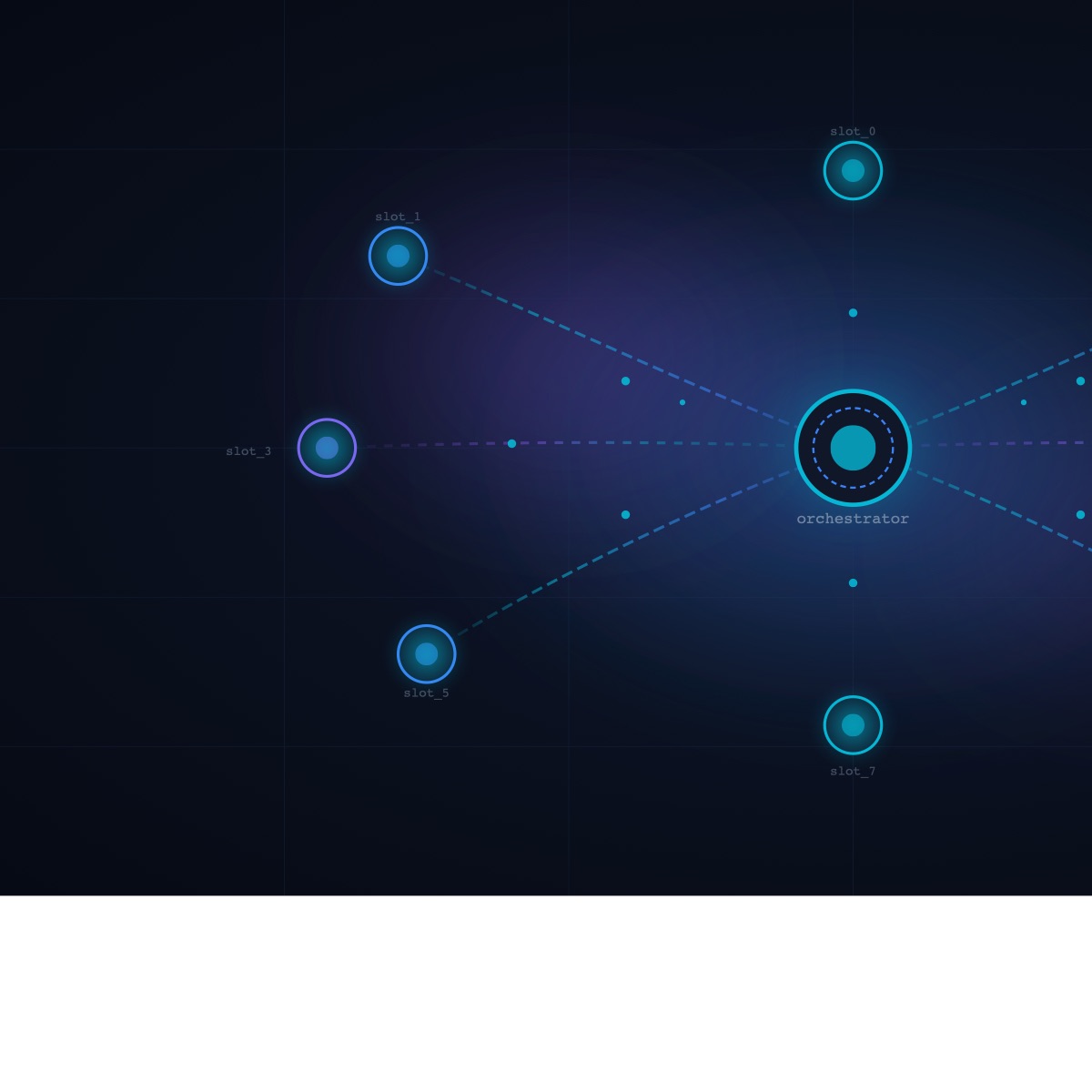
Per OpenAI’s Ben Davis, Astra can spin up approximately 10 parallel sub-agent “slots” with a main agent orchestrating the work. He demonstrated this with DEF CON puzzles — including one no human had solved — where Astra formed a theory, dispatched sub-agents to test different approaches in parallel, and self-corrected instead of disappearing down a single bad path.
This is the feature that should have been the headline. Every multi-agent framework — CrewAI’s crews, LangGraph’s subgraphs, Orca’s fleet management — exists because models couldn’t natively parallelize. You had to build the fan-out, manage the context windows, route the results, and handle the failures in your application code. With sub-agent slots, the model does the fan-out internally, with shared context and coordinated reasoning.
The implications for fleet orchestration are significant. If the model can internally manage 10 parallel execution threads, the orchestrator layer gets simpler — or, for some use cases, disappears entirely.
The Five-Component Control Plane
Async tool calling and sub-agent slots are primitives. To run them in production, you need infrastructure around them. The emerging architecture pattern — documented in detail by ChatGPT AI Hub and converged on independently by early adopters — is a five-component control plane:
- Responses API session handler — streams model events and detects async tool calls
- Tool-call dispatcher — validates authorization, creates registry rows, enqueues work
- Durable job registry — persists
call_idmappings, state transitions, and results - Worker pools — claim jobs, execute application code, record completion
- Result-delivery component — submits results via original
call_id
def worker_loop():
    task_handle = receive_from_queue()
    job = registry.claim_for_work(task_handle)
    try:
        result = execute_tool(job)
        registry.mark_completed(job.task_handle, result)
    except RetryableError:
        registry.mark_failed(task_handle, error, terminal=False)
        schedule_retry(task_handle)
    except Exception:
        registry.mark_failed(task_handle, error, terminal=True)
The idempotency rule nobody mentions: Execution retries and delivery retries must be completely separated. If a tool call succeeds but result delivery to the model fails, you resubmit the persisted result payload — you never re-run the tool. This distinction is trivial in documentation and catastrophic in production when your “retry” sends a duplicate payment or deploys a second container.
This control plane pattern is familiar to anyone who has built a durable execution system — it’s essentially a task queue with model-aware routing. The difference is that the model itself is now a participant in the dispatch loop, not just a consumer of the results.
The Monitoring Gap
OpenAI didn’t just ship runtime primitives — they shipped a monitoring layer around them. As Gabriel Anhaia detailed on Dev.to, Astra launched with misalignment monitoring during tool-using inference, alignment evaluations that block responses (not post-hoc reviews), and a staged rollout that prioritized cybersecurity defenders before general access.
The critical insight from that analysis: your agent operates one layer beyond OpenAI’s monitoring boundary. OpenAI can observe model-to-tool transitions. They report that Astra “received roughly half as many flags for higher-severity misaligned behaviour as Sol” across 54,000 tasks. But they cannot see tool-to-system effects — the database writes, the emails sent, the deployments triggered. That’s your responsibility, and most teams don’t have the observability stack to match what OpenAI runs internally.
The recommended pattern is a unified wrapper capturing nine fields per tool call: runId, callId, tool name, input/output (redacted), decision (allowed/blocked), approvedBy, costCents, latencyMs, and startedAt. Blocked calls still generate audit rows. This isn’t optional overhead — it’s the minimum viable guardrail stack for an async agent runtime where calls execute concurrently and failures may not surface until results are reconciled.
The Ecosystem Is Already Pivoting
The strongest signal that Astra’s runtime primitives are real — not marketing fluff — is the ecosystem response. LangChain pushed LangSmith features specifically for long-running, multi-step sub-agent traces in the same week as Astra’s launch. They’re threading runs over time so you can see what a swarm actually did across its full execution lifetime — not just a single request-response cycle.
When your vendor observability roadmap pivots to sub-agents in the same week that a model ships sub-agent slots, the ecosystem is confirming the pattern. This isn’t LangChain chasing hype — it’s them pre-positioning for the architecture that just became native.
Chase AI’s head-to-head benchmarks tell the pricing story: on Terminal Bench 4.0, Astra scored 56.7 versus Fable 5.1’s 55.8 — essentially a coin flip on capability. But Astra hit that score at approximately half the token cost ($10.35 versus $19.50). If the capability gap is negligible, the competition shifts to who provides the better runtime. And right now, no competitor offers async tool calling, mid-turn steering, or native sub-agent orchestration in their API.
What the Community Is Saying
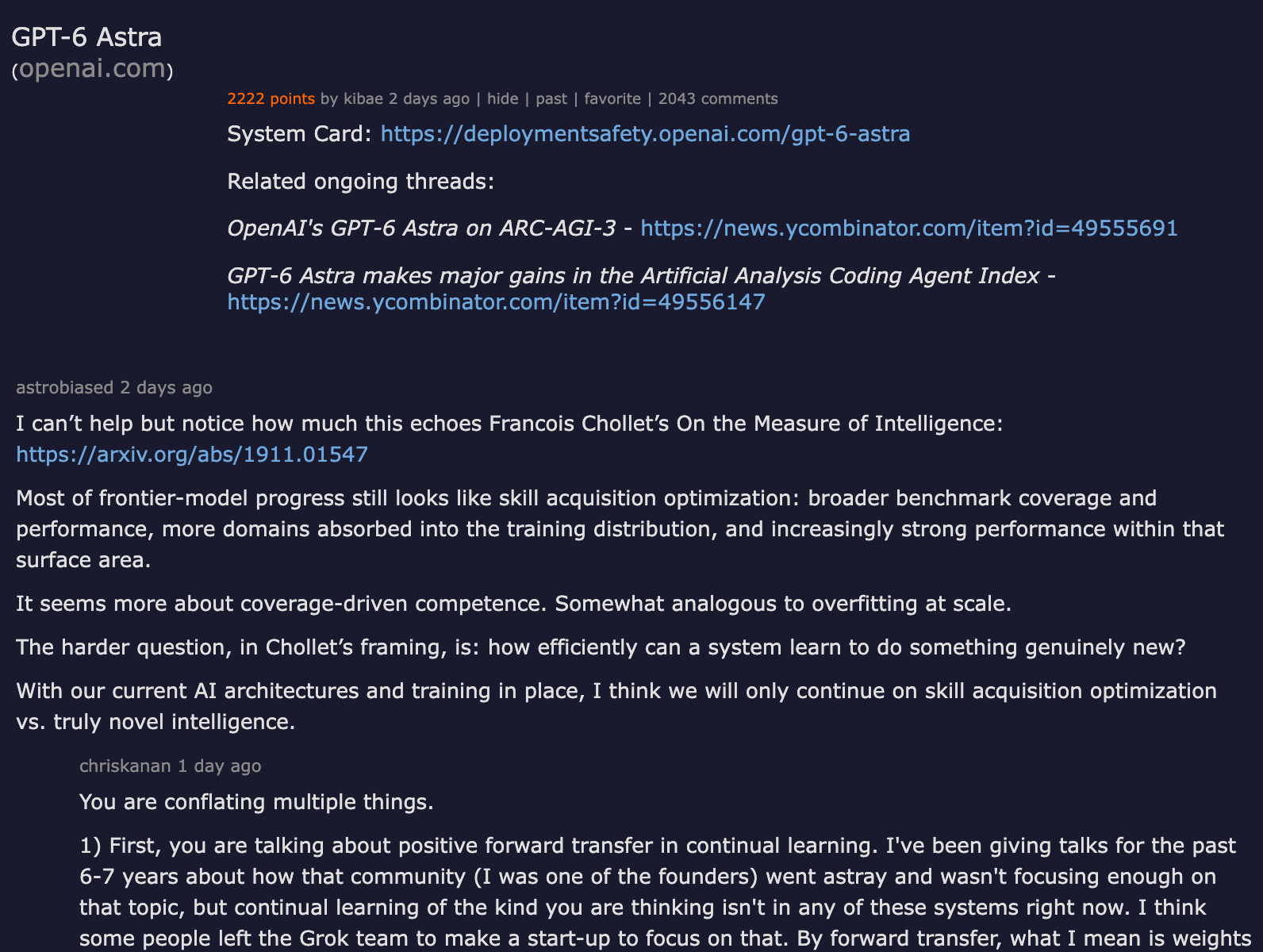
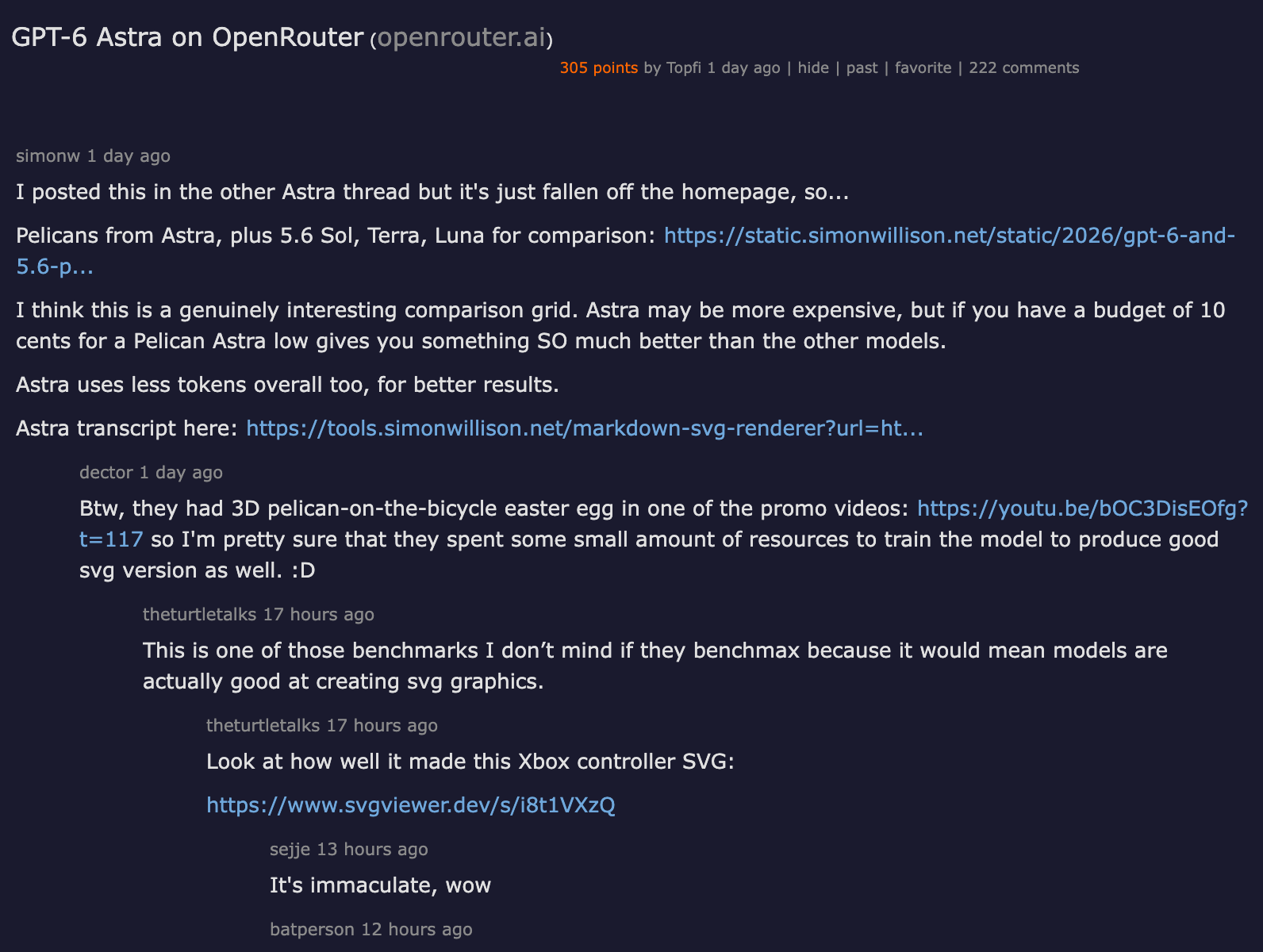
The Hacker News threads (launch thread, rollout thread, OpenRouter pricing thread) are split between benchmark reactions and the more nuanced runtime discussion. On the OpenRouter thread (279 points, 201 comments), Simon Willison posted a comparison grid of Astra versus Sol, Terra, and Luna — the kind of systematic evaluation that reveals whether the runtime improvements translate into real-world task completion, not just benchmark scores.
Early tester “dannyw” on HN noted that Astra “retains the best parts and overall grounded collaborator and executor” character while showing a “significant leap in capabilities” — framing it explicitly as a tool for collaboration, not autonomous operation. That framing matters for agent builders: the runtime primitives enable longer-horizon autonomy, but the model’s personality is tuned for human-in-the-loop workflows.
The reported “neuralese” concern: Two independent sources flag a reported (unverified, sourced to The Information) architecture change called “recurrence depth” — where the model reasons in latent space rather than English. If true, the chain-of-thought we rely on to audit agent decisions goes partially dark. This is exactly the monitorability tradeoff that makes the nine-field audit wrapper non-optional. Build your monitoring stack now, before you need it.
Contrarian Corner: The Lock-In Tax
Here’s the argument against adopting Astra’s runtime primitives wholesale: every async: true parameter, every call_id persisted in your job registry, every WebSocket steering connection, every tool_search invocation creates coupling to OpenAI’s Responses API that’s harder to unwind than a simple model swap.
The open-source agent ecosystem built these exact patterns — async dispatch, parallel execution, result reconciliation — in a model-agnostic way. LangGraph’s subgraphs work with any model. CrewAI’s crew orchestration is provider-independent. Orca’s fleet management doesn’t care which API generated the tool calls. If you adopt Astra’s native runtime, you’re trading portability for performance. The model manages orchestration faster and with less application code, but your agent architecture becomes non-portable.
The pragmatic answer depends on what you’re building. If you’re shipping a product — a specific agent that solves a specific problem — use the native runtime. The reduced application complexity and lower latency are worth the vendor coupling. If you’re building a platform — infrastructure that other teams deploy agents on — keep the orchestration layer external and model-agnostic. The portability premium is real.
What This Means for You
If you’re an agent builder evaluating Astra, here’s the concrete decision framework:
Adopt the native runtime if:
- Your agent runs long-horizon tasks (>5 minutes) with multiple external dependencies
- You’re already on the OpenAI API and vendor lock-in isn’t a primary concern
- You want to eliminate your custom orchestration code
- Your use case benefits from parallel sub-agent execution (research, testing, analysis)
Keep external orchestration if:
- You need model portability (multi-provider strategy)
- Your compliance requirements demand full chain-of-thought auditability
- You’ve already invested in LangGraph/CrewAI/Orca infrastructure
- You need more than ~10 parallel execution threads
Either way, build the control plane now:
- The five-component pattern (session handler, dispatcher, job registry, worker pools, result delivery) is the new minimum viable agent architecture
- The nine-field audit wrapper is non-optional for async agents
- Separate execution retries from delivery retries — this will bite you in production
The model race is fascinating to watch, but the real competition just shifted. It’s no longer about which model scores highest on benchmarks. It’s about which provider ships the best runtime for the agents those models power. With async tool calling, mid-turn steering, and sub-agent slots, OpenAI just made the first serious move. The rest of the industry — Anthropic, Google, the open-source ecosystem — has to respond not with a better model, but with a better runtime. That’s the game now.