Field report · · AgentConn Team
Cloudflare Shipped 3 Agent Tools in One Day
Cloudflare shipped AI Platform, Email for Agents, and Artifacts/Git on the same day. Setup guide + when to use each for production AI agents.
Cloudflare Shipped 3 Agent Tools in One Day
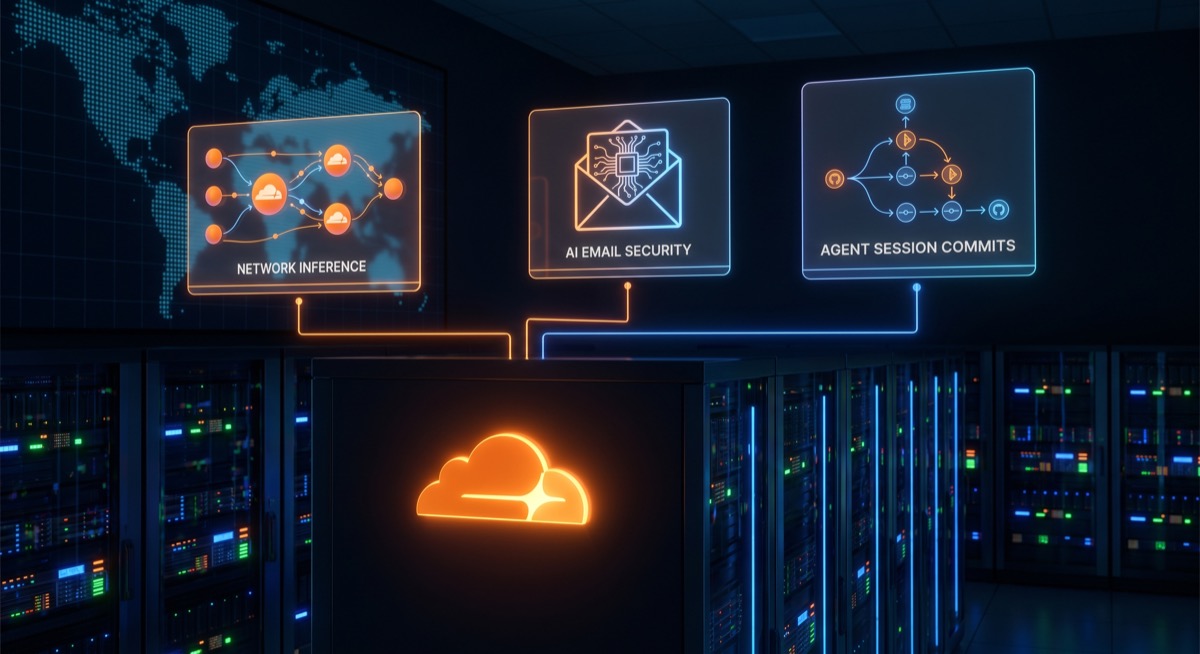
On April 16, 2026, Cloudflare shipped three separate agent-specific tools in a 24-hour window: AI Platform (a unified inference and orchestration layer for agents), Email for Agents (real email identities for AI agents to send and receive programmatically), and Artifacts/Git (versioned storage for agent state and outputs with a full Git API). When the company handling 20% of global internet traffic ships three agent infrastructure tools in a single day, that’s not a product launch—that’s an infrastructure signal. The agentic web has a new foundation, and it runs at the edge.
This guide explains what each tool does, the problems they solve, how they work together, and when to use Cloudflare’s agent stack versus AWS/GCP/Azure. We’ll walk through a practical example: an agent that receives an email, takes action, stores versioned output, and calls the best available model—all on Cloudflare’s infrastructure.
Why Three Tools in One Day Matters
The density of this launch is intentional. Cloudflare’s “Agents Week 2026” is a coordinated release across every dimension of the agent stack: compute, connectivity, security, identity, economics, and developer experience.
Three tools in one day means three separate problems Cloudflare has decided to own:
- Model access fragmentation: Developers call 3.5 models per application on average. Each has its own API format, rate limits, failover logic. AI Platform standardizes this.
- Agent communication: AI agents currently operate in chat UIs or custom interfaces. Most of their human users live in email. Email for Agents closes the gap—agents get real inboxes.
- Agent state management: Where does agent output go? How do you inspect what an agent did three runs ago? Artifacts brings version-control semantics to agent state.
View original discussion on Hacker News →
Tool 1: Cloudflare AI Platform — Unified Inference for Agents
The problem: Agents make dozens of model calls per task, often chaining 10+ calls for a single workflow. When you’re calling OpenAI for reasoning, Anthropic for code review, and a specialized model for vision—with different API keys, formats, error handling, and cost tracking—the overhead compounds fast.
What it does: A unified inference layer giving your agents access to 70+ models across 12+ providers through a single AI.run() binding—the same one already used for Workers AI. Switching providers requires a one-line change.
// Workers AI (self-hosted) — unchanged
const result = await env.AI.run("@cf/meta/llama-3-8b-instruct", { prompt });

// Third-party provider (new) — same binding
const result = await env.AI.run("@openai/gpt-4o", { messages });

// Switch providers with one change
const result = await env.AI.run("@anthropic/claude-opus-4-7", { messages });
Automatic failover: If a provider goes down mid-agent-run, AI Platform reroutes to another provider with the same model automatically—no failover code required. For long-running agents where a single 500 error can derail an entire workflow, this matters.
Streaming resilience: AI Gateway buffers streaming responses independently of the agent’s lifetime. If your agent disconnects and reconnects, it picks up the stream without duplicate charges or lost tokens.
Edge positioning: Cloudflare operates in 330 cities globally. Inference requests run from the PoP closest to your users. For agent latency (especially multi-hop chains), time-to-first-token matters more than raw throughput.
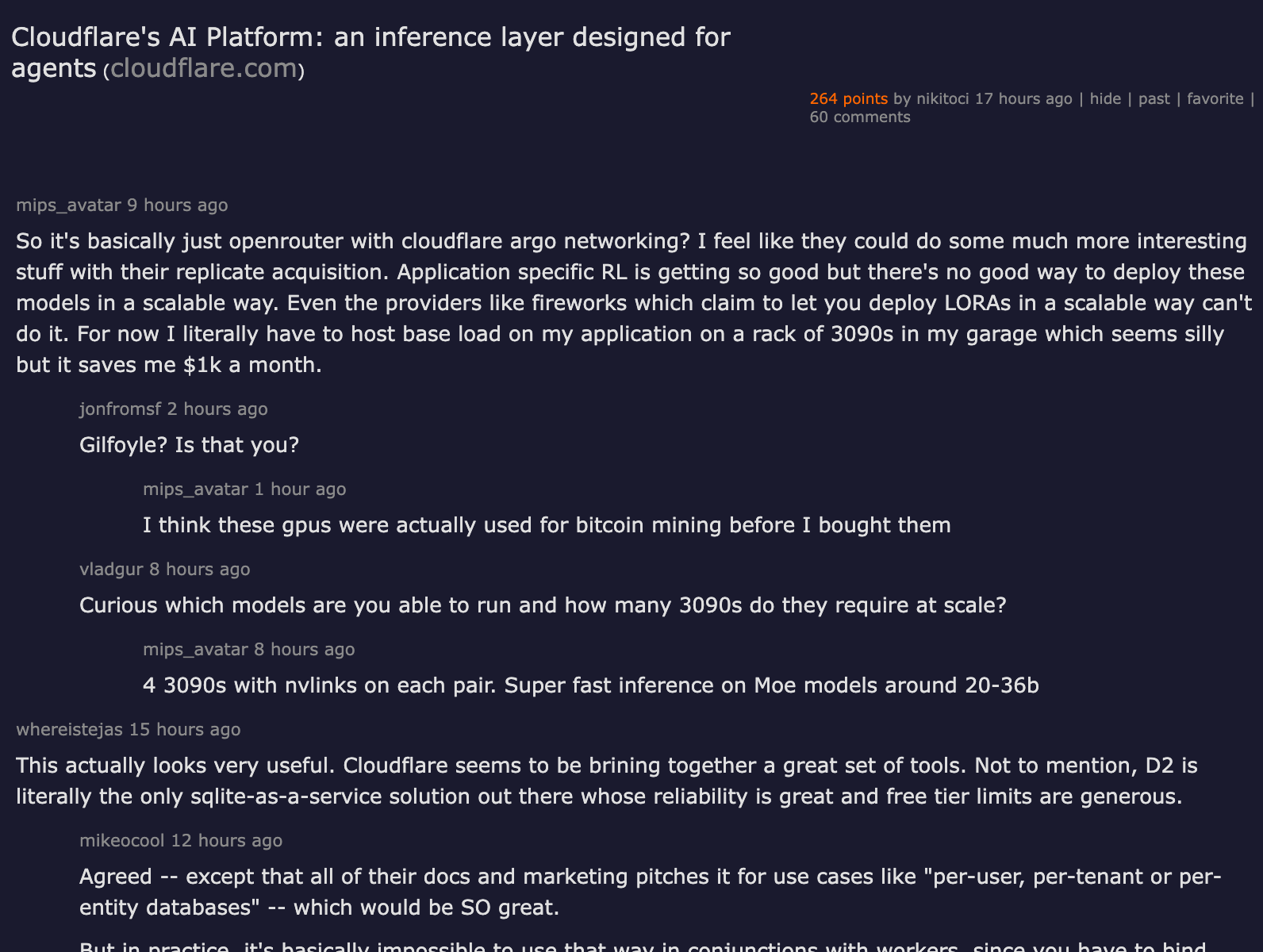
The honest concern: HN commenters surfaced two legitimate issues. First, the privacy question: a unified inference proxy sees every prompt and response. Second, cost controls: hard spend limits are currently absent from AI Platform. Verify your limits before production.
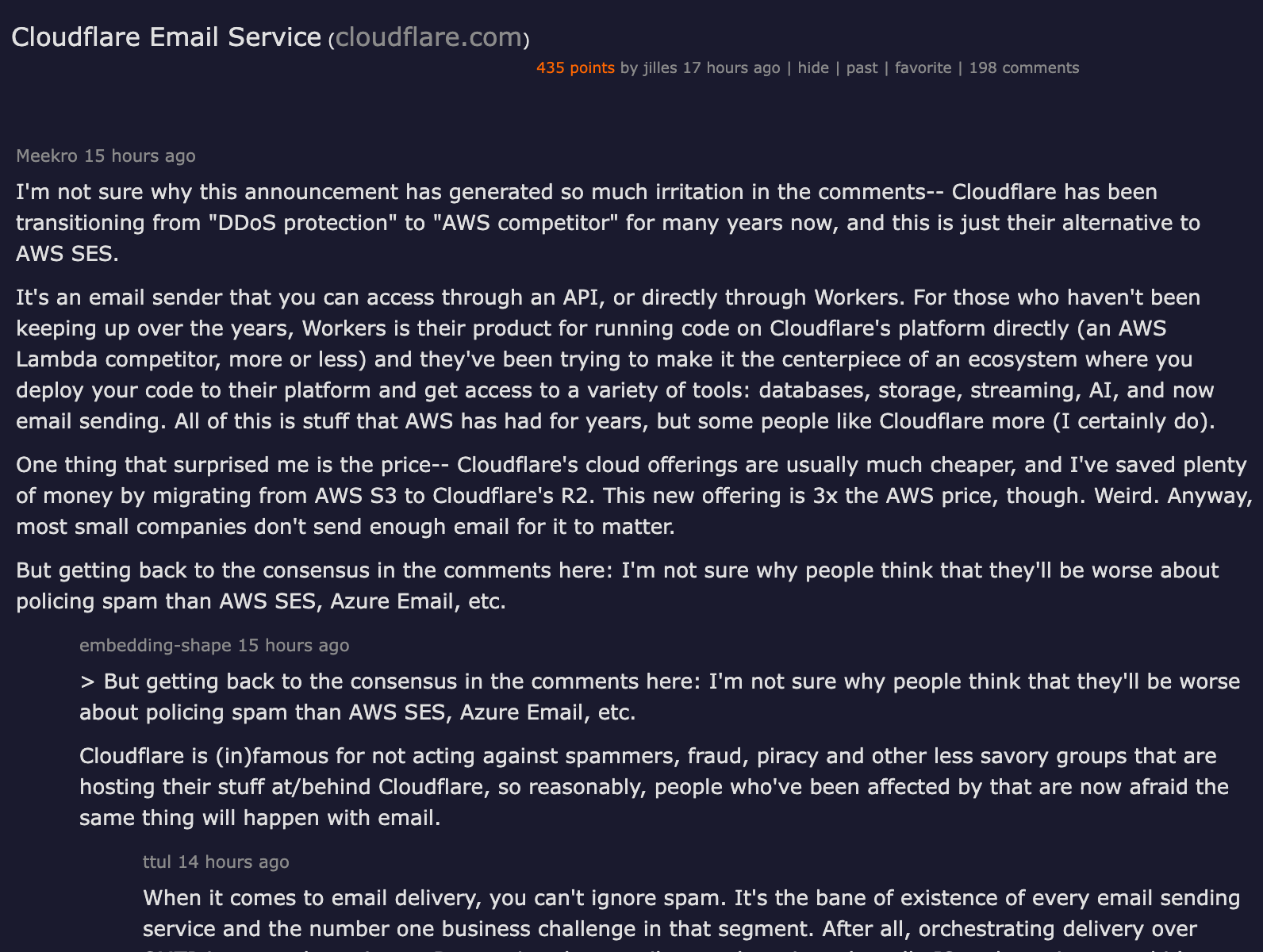
Tool 2: Email for Agents — Real Inboxes for AI Agents
The problem: Most users live in email. Most AI agents live behind custom chat UIs that users have to adopt. Email for Agents closes this gap—agents get real email addresses, can receive messages, orchestrate work, and respond asynchronously, in the channel users already use.
What it does: The service entered public beta on April 16, 2026. Agents receive email via Cloudflare Email Routing (triggers the agent’s onEmail hook) and send email via a native Workers binding—no API keys required, with SPF/DKIM/DMARC auto-configured by Cloudflare.
Agent email identities: Routing is address-based within a single domain:
support@yourdomain.com→ customer support agent instancesales@yourdomain.com→ sales qualification agentinvoices@yourdomain.com→ invoice processing pipeline
Sub-addressing creates namespace isolation: NotificationAgent+user123@yourdomain.com routes to a specific user’s namespace without separate email addresses.
Minimal implementation:
export default {
  async email(message: EmailMessage, env: Env): Promise<void> {
    const body = await new Response(message.raw).text();

    const classification = await env.AI.run("@cf/meta/llama-3-8b-instruct", {
      prompt: `Classify this email as: support/sales/billing. Email: ${body}`
    });

    const agentId = env.AGENT_DURABLE_OBJECT.idFromName(classification.result);
    const agent = env.AGENT_DURABLE_OBJECT.get(agentId);
    await agent.handleEmail(message);
  }
};
Security model: Reply routing uses HMAC-SHA256 signed headers to prevent attackers from forging message routes. Agents can persist conversation history, contact data, and context in Durable Objects without external databases.
Reference application: Cloudflare open-sourced agentic-inbox—a complete email client + AI agent running entirely on Cloudflare Workers. Deploy it in one click to get a full production reference for inbound routing + outbound sending + AI classification + R2 attachments + stateful agent logic.
View original discussion on Hacker News →
Tool 3: Artifacts/Git — Versioned Storage for Agent State
The problem: Where does agent output live? Git is the natural answer for code, but most agent frameworks treat file output as ephemeral—it exists for the session, then disappears. Artifacts extends Git semantics to agent state: every session is versioned, forkable, and inspectable.
What it does: A distributed versioned filesystem that speaks Git. Agents create repositories programmatically, connect from standard Git clients, and store both code artifacts and session history. Cloudflare supports creating tens of millions of repositories at scale.
The key insight: Agents know Git—it’s deep in the training data of virtually every code model. Using Git as the protocol means agents can navigate, diff, and branch repositories using knowledge they already have—no new abstractions to learn.
Dual persistence model:
- Filesystem state: The current state of files the agent is working with
- Session history: Complete prompt and interaction logs that produced those files
Practical implementation:
// Agent creates its working repository
const { remote, token } = await env.ARTIFACTS.create("feature-xyz-session-1")

// Standard Git operations work from any client
// git clone https://remote --token token
// git add . && git commit -m "Agent session complete"

// Fork from any historical session point
const fork = await env.ARTIFACTS.fork({
  source: "feature-xyz-session-1",
  revision: "abc123"
})
Session forking for debugging: When an agent run goes wrong, fork the session from the last known-good state, share the URL, and debug collaboratively without touching the original. This changes the debugging experience from “restart from scratch” to “branch and investigate.”
Availability: Private beta April 16, 2026. Public beta expected early May 2026.
How the Three Tools Work Together
The power of this stack becomes clear when the tools compose:
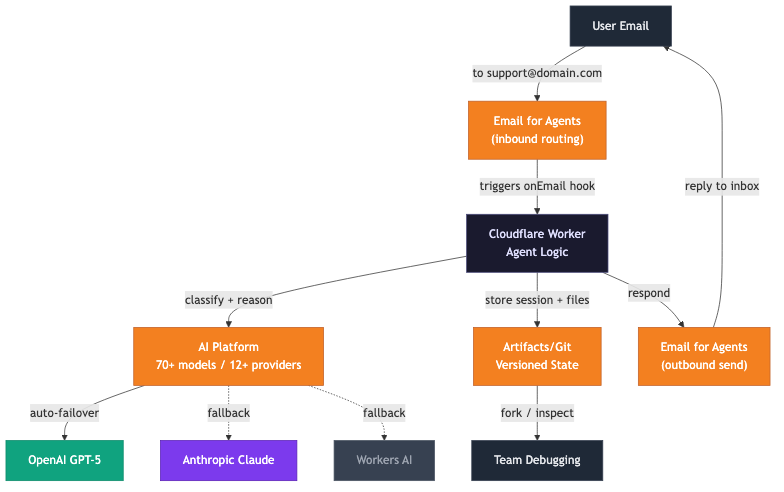
Complete email-to-action agent:
- User sends email to
support@yourdomain.com - Email for Agents receives it, triggers
onEmailhook - AI Platform routes the classification call with automatic fallback
- Agent takes action: queries a database, generates a report, creates a PR
- Artifacts stores session state + output files in a versioned repository
- Email for Agents sends the response back to the user
- All model costs tracked centrally via AI Platform metadata
This workflow runs entirely on Cloudflare Workers—no separate infrastructure for the email layer, storage service, or API gateway.
Cloudflare vs. AWS/GCP/Azure for Agent Infrastructure
| Dimension | Cloudflare Agent Stack | AWS (Bedrock + SES + S3) | GCP (Vertex + Gmail API + GCS) |
|---|---|---|---|
| Inference providers | 12+ via one binding | Bedrock models only | Vertex models only |
| Email for agents | Native, built-in | SES (send) + complex routing (receive) | Gmail API (requires OAuth per account) |
| Versioned state | Git-native Artifacts | S3 versioning (no Git semantics) | GCS versioning (no Git semantics) |
| Edge inference | ✅ 330 cities | Regional (us-east-1 default) | Regional |
| Lock-in risk | Medium | High | High |
| Hard spending limits | None currently ⚠️ | Budget alerts available | Budget alerts available |
Choose Cloudflare when:
- You need multi-provider model flexibility without writing failover logic
- Email is a primary channel for your agent (no good alternative at this abstraction level)
- You’re already on Workers and want a unified stack
- Low-latency agent chains matter (edge positioning helps multi-hop)
Choose AWS/GCP/Azure when:
- You have significant existing infrastructure investment
- You need deep compliance certifications (FedRAMP, HIPAA BAA)
- Your workloads need predictable committed-use discounts
- You need hard spending limits (currently absent from Cloudflare AI Platform)
What the Community Is Saying
The HN community reaction to the AI Platform launch mixed technical enthusiasm with sharp criticism. The comparison to OpenRouter came up immediately: “basically just openrouter with cloudflare argo networking.” This undersells the edge positioning advantage but accurately identifies the feature overlap.
The missing features list from HN is worth watching: unified response format support (OpenAI and Anthropic format), rate limit documentation, hard spend limits, and transparent pricing. These are solvable in a quarter; their absence on launch day is a gap, not a dealbreaker.
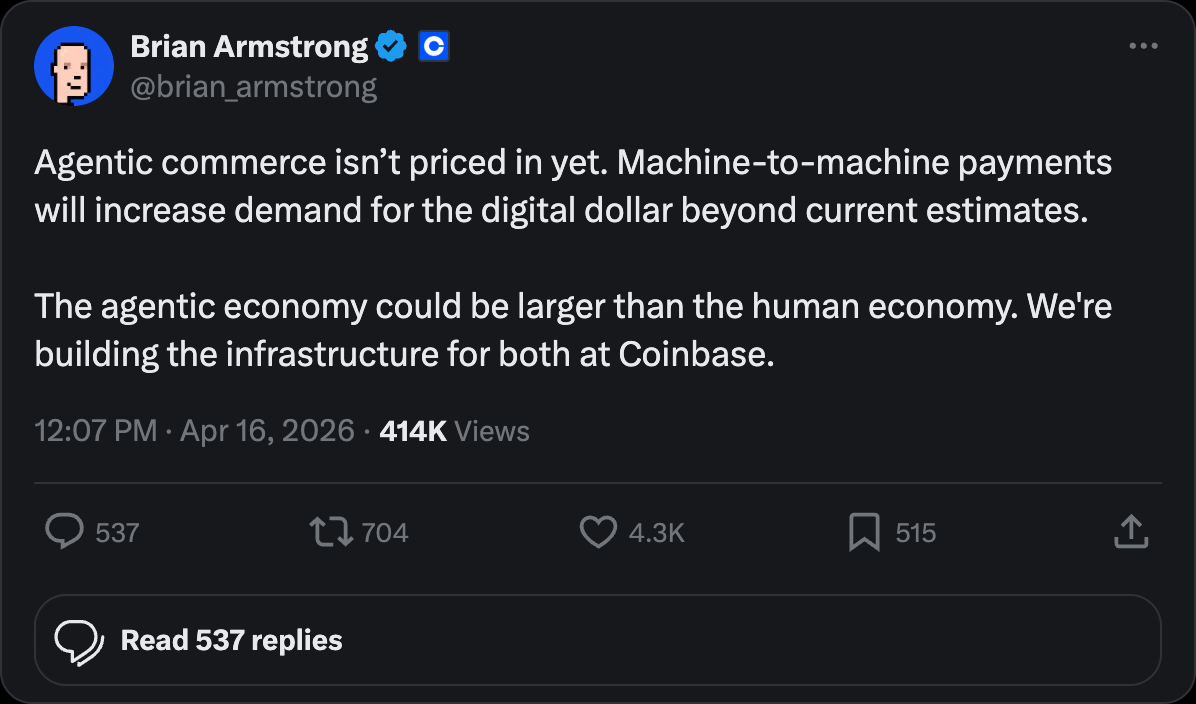
The broader infrastructure signal: Brian Armstrong’s agentic commerce thesis connects directly to this stack. Machine-to-machine payments require machine-to-machine communication—and email is one of the oldest, most reliable forms of that. Cloudflare’s email layer isn’t just about notifying humans; it’s infrastructure for the agent commerce layer.
The Infrastructure Signal
Three tools in 24 hours from a company with this network position is not a coincidence. Cloudflare handles 20% of global internet traffic—their edge network already runs near the users and services that agents need to reach. Building agent infrastructure on top of that edge is a defensible moat that AWS and GCP, with their region-centric architectures, can’t replicate cheaply.
For agent builders, the practical message is clear: Cloudflare’s stack now offers a coherent, production-ready foundation that didn’t exist six months ago. Email for Agents alone is worth evaluating for any workflow where humans need to stay in the loop without adopting a new interface.
For a broader look at how agent frameworks layer on top of infrastructure like this, see our reviews of Archon and multica. For patterns on giving agents persistent identity across sessions, see our SOUL.md guide.
AI Platform and Email for Agents are in public beta as of April 16, 2026. Artifacts is in private beta with public beta expected May 2026. All three tools are available at cloudflare.com/agents-week.