Field report · · AgentConn Team
The Best Code Your Agent Writes Is the Code It Doesn't
Ponytail hit 118K stars by naming what every team knows: AI agents overengineer by default. The decision ladder that fixes it.
The Best Code Your Agent Writes Is the Code It Doesn’t
Ask your coding agent for a date picker. You will get a 400-line component with timezone support, localization hooks, and accessibility features you never requested. Ask for a color parser and you will get a polymorphic class hierarchy with factory methods. The agent is not wrong — the code compiles, the tests pass, and every edge case is handled. It is also three times more than the task requires, and now you own all of it.
This is not a hypothetical. Developer Charly Wargnier captured the moment that launched Ponytail into the stratosphere: “A dev got so frustrated watching his AI agent write 500 lines for a 5-line problem that he built a fix.”
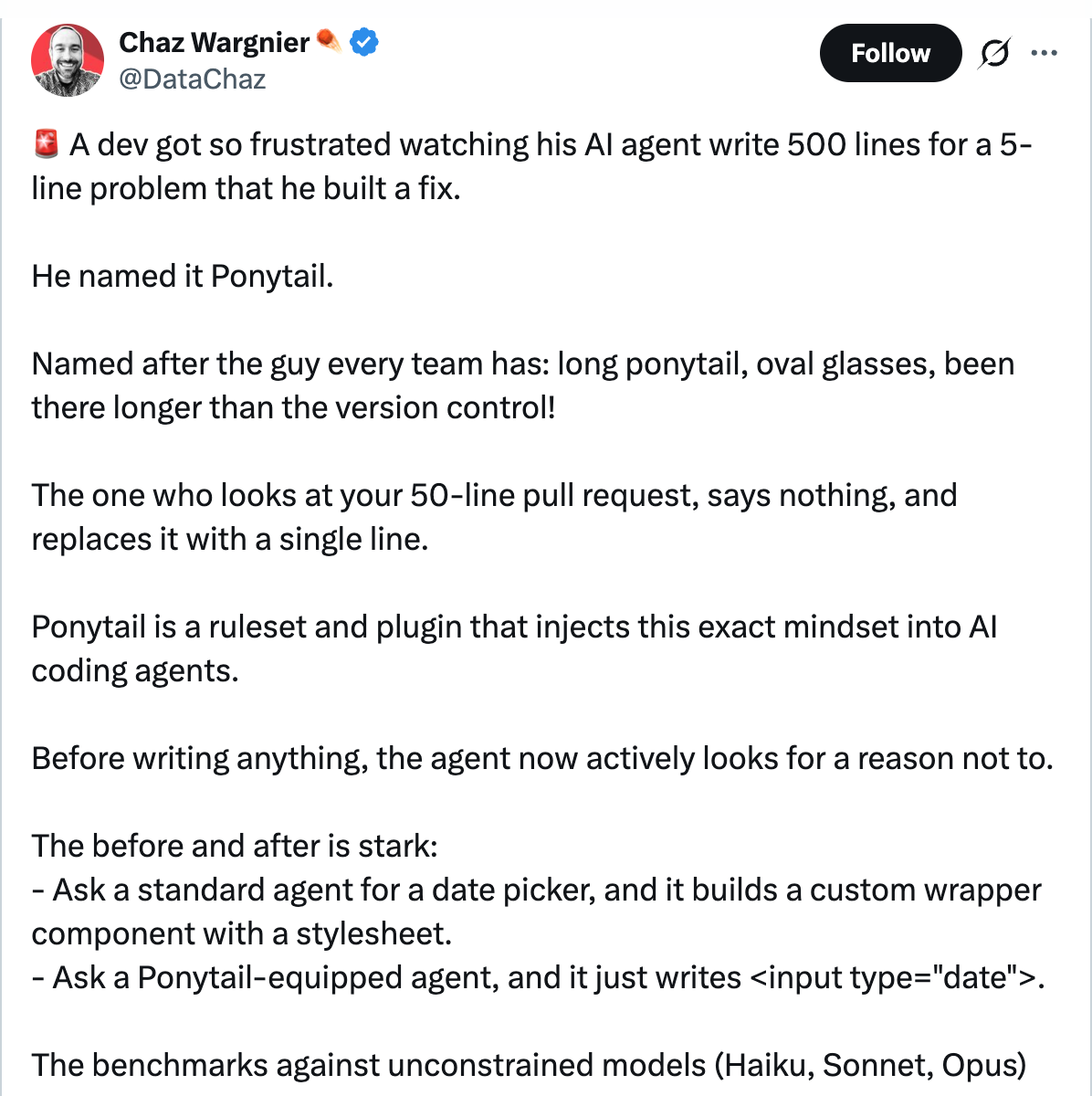
That dev was Dietrich Gebert. His fix — a decision ladder that forces agents to exhaust every existing solution before writing a single new line — has collected 118,000 GitHub stars, hit #1 on GitHub Trending, and become the fastest-growing developer tool of 2026. But the viral run is a symptom, not the story. The story is that AI coding agents have no natural brake on complexity, and the bill is coming due.
The Invisible Tax on Every AI-Generated Line
The numbers paint a clear picture of the problem Ponytail addresses. GitClear’s 211-million-line study found that copy-pasted code rose from 8.3% to 12.3% while refactored code fell from 22% to 10%. AI-generated code now accounts for 41% of all new code written in 2026 and introduces 1.7x more issues than human-written code. Teams that do not actively manage this debt are watching maintenance costs compound to 4x traditional levels within two years.
As Anton Minin Baranovskii put it in his essay on the topic: “The only natural brake on overengineering is gone. It is not about the quality of the generation: the code can be excellent. It is that the code became too cheap.”
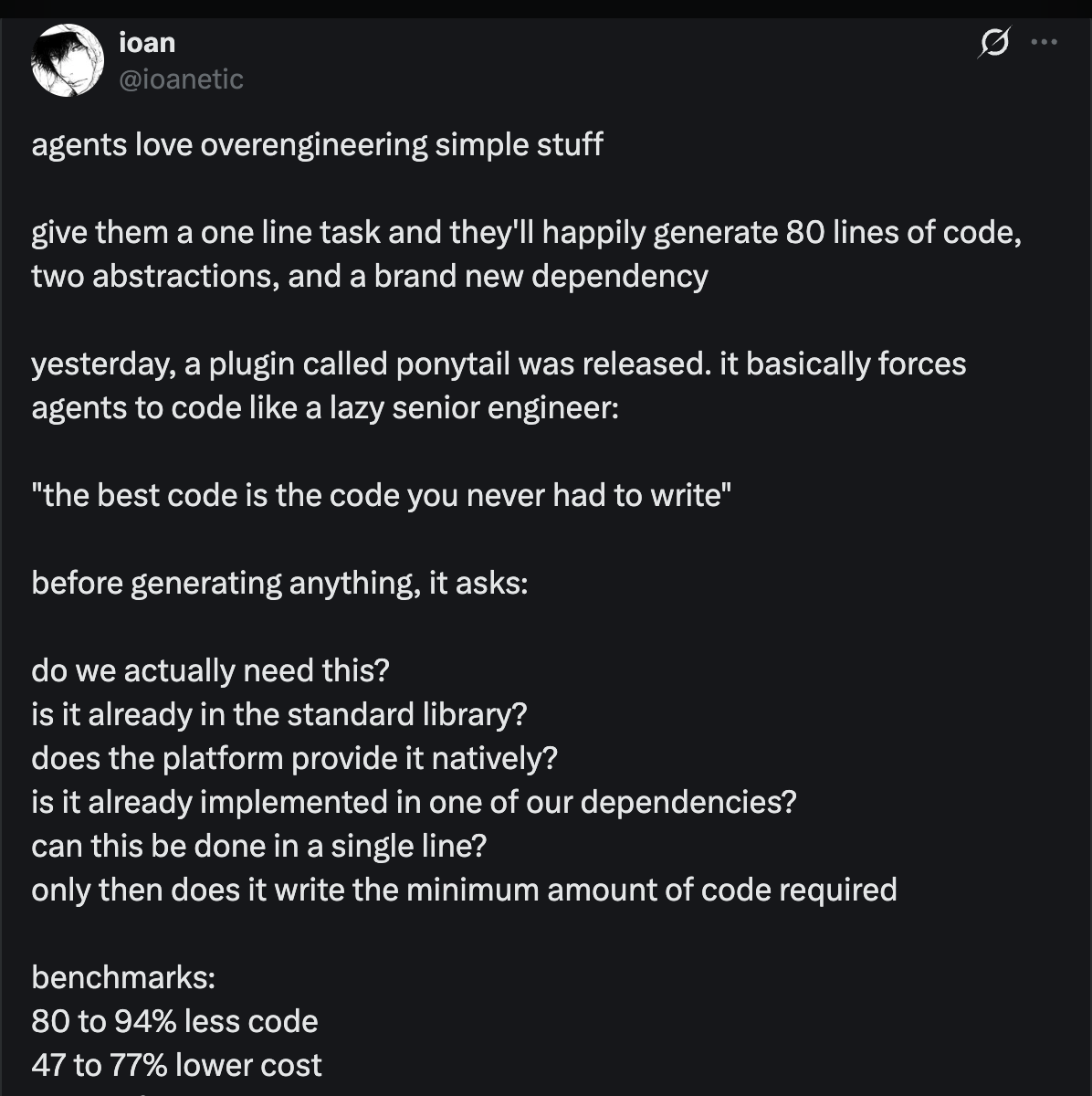
Ioan nailed the daily experience: “agents love overengineering simple stuff — give them a one line task and they’ll happily generate 80 lines of code, two abstractions, and a brand new dependency.” Every developer using a coding agent has lived this moment. The agent is doing its best. Its best is often far more than the task requires.
This is what we explored in 10x PRs, 1x Reviewers: The Code-Quality Bottleneck — the review bottleneck is real, and agent overengineering makes it worse. When every PR is 3x longer than it needs to be, your human review capacity does not scale to match.
The Decision Ladder: Seven Gates Before Writing Code
Ponytail’s core insight is deceptively simple. Before writing any new code, the agent must pass through seven sequential gates:
The Ponytail Decision Ladder
- Does this code need to exist at all?
- Does the codebase already have it?
- Does the standard library cover it?
- Is there a native platform feature?
- Does an installed dependency handle it?
- Can it be a one-liner?
- Only then — write the minimum viable solution.
Each gate is a hard stop. The agent cannot proceed to gate 7 without genuinely exhausting gates 1 through 6. This is not a suggestion — it is an enforcement mechanism that runs before every code generation session. The full Ponytail review on AgentConn covers the compatibility matrix and intensity levels in detail.
The results from Gebert’s benchmarks on a real FastAPI + React repository are striking: 54% less code output, 22% fewer tokens consumed, 20% lower cost, and 27% faster execution. Security compliance stayed at 100% — the decision ladder explicitly exempts validation, error handling, and accessibility code from its cuts.
Better Stack’s deep-dive shows the 94% reduction case — the upper bound when the decision ladder discovers that the entire requested feature already exists in the standard library or an installed dependency. That is not the median, but it illustrates the ceiling of waste in a typical agent session.
Why 118,000 Developers Said Yes
Ponytail did not invent the YAGNI principle. “You Ain’t Gonna Need It” has been an engineering axiom since the 1990s. What Ponytail did was solve the delivery problem.
Style guides sit in Confluence. Code review checklists exist in Notion. Every senior engineer knows these rules. But knowledge that lives in documentation is knowledge that gets ignored — by humans and especially by agents. Ponytail ships as an agent skill: a versioned instruction set that installs into your coding tool and runs at session start. The rules execute before generation, not after.
This is the pattern we identified in Agent Skills Are the New Dotfiles — the skills ecosystem is where engineering discipline now lives. Ponytail proved that the highest-value skill is not one that adds capability. It is one that removes it.
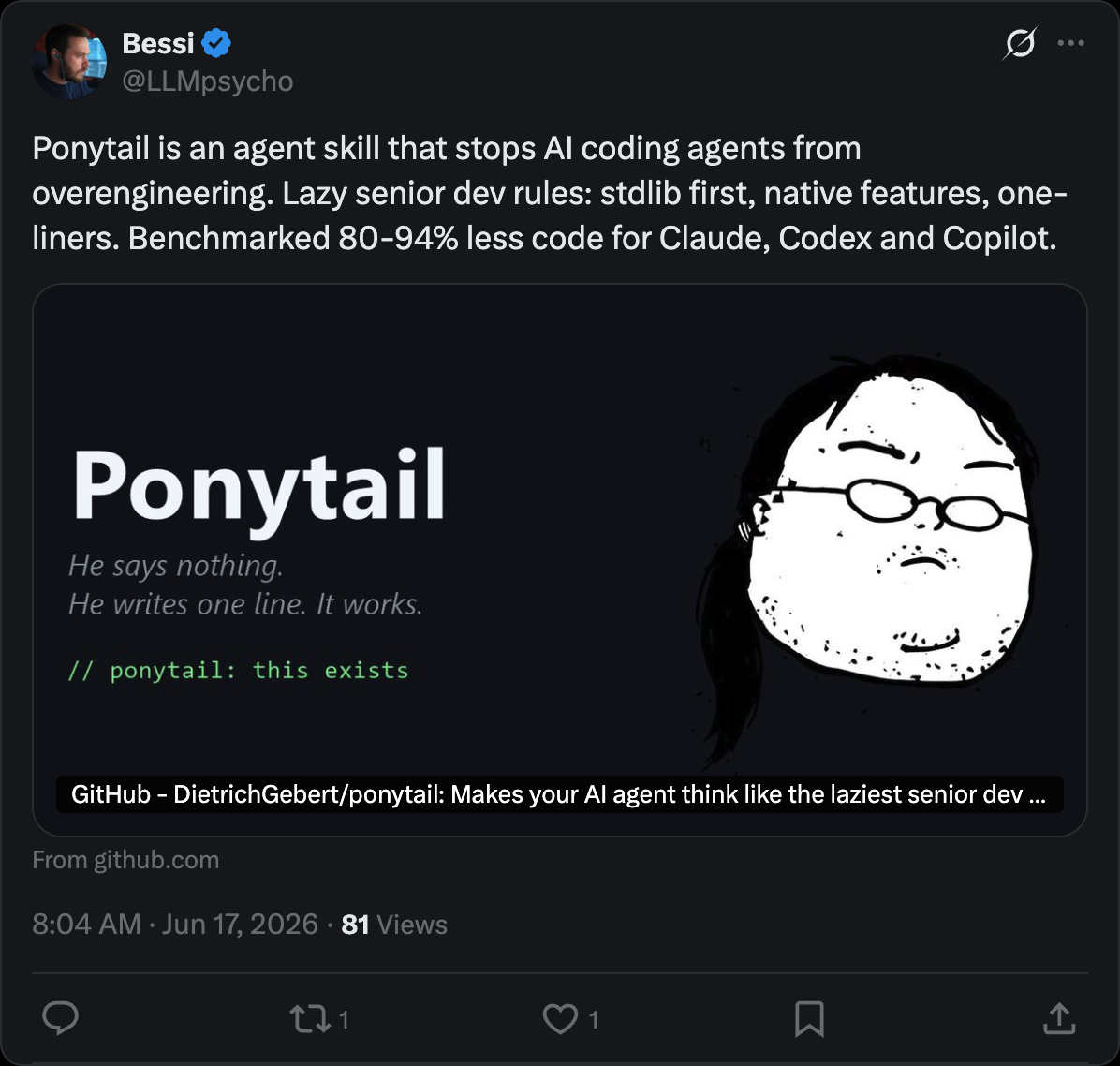
The benchmarks Bessi highlighted — 80-94% less code for Claude, Codex, and Copilot — show that the problem is universal. It is not a model-specific quirk. Every frontier coding agent, across every provider, defaults to overengineering. The decision ladder works across all of them because the underlying behavior is consistent: when you give a model a coding task, it generates the most thorough solution it can imagine, not the most appropriate one.
What the Community Is Saying
The Hacker News thread for Ponytail (98 points, 17 comments) captures the debate perfectly. The skeptics say the project is overengineered itself — user donatj noted the irony of a “metric ton of boilerplate surrounding the actual rules” that could fit in a code block. User mpalmer went further: could the entire repo be replaced with one question — “Is there a simpler solution?”
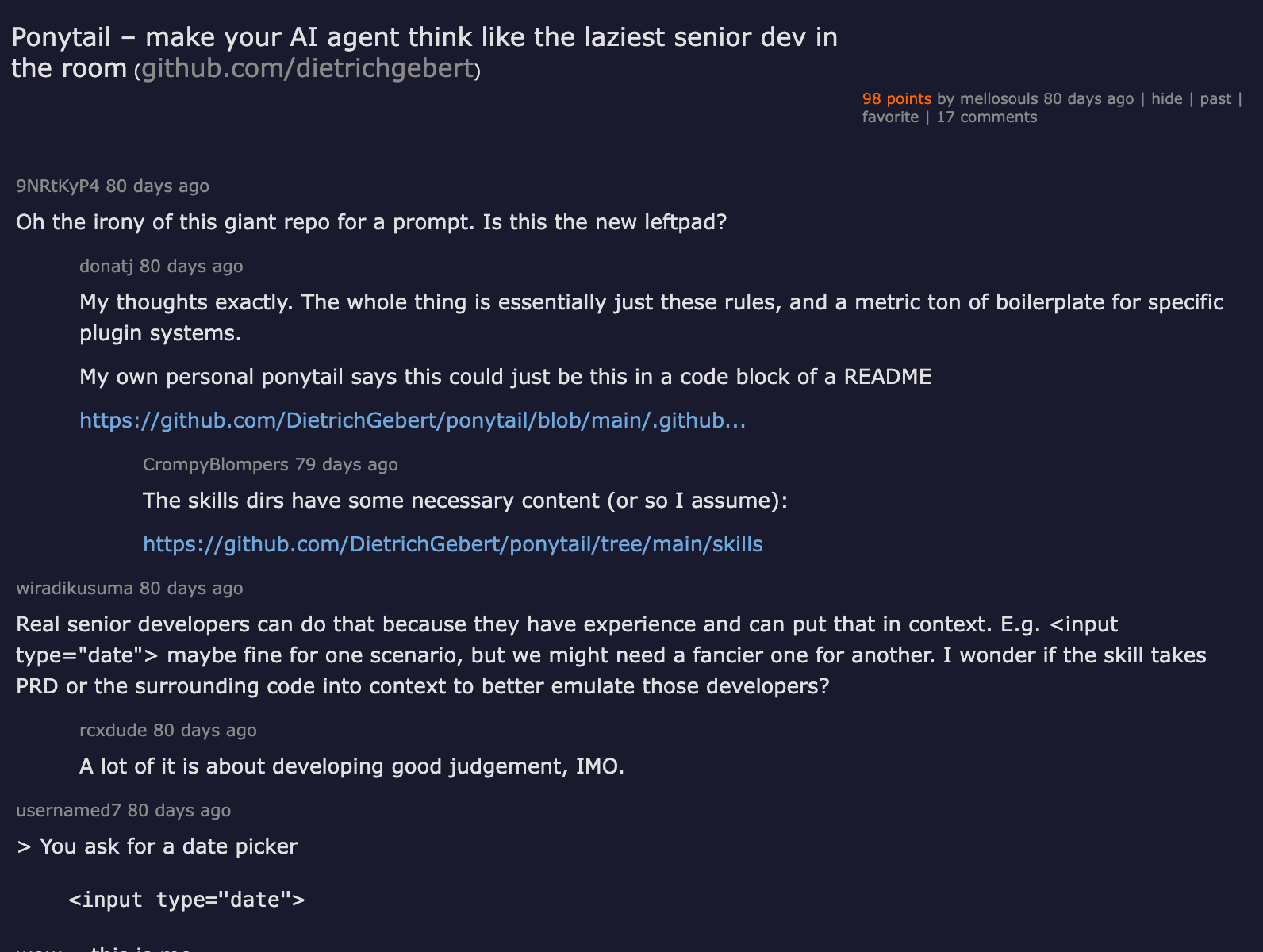
But the defenders make the stronger case. User kamphey reported the five heuristics are “genuinely helpful for making agents handle very simple deletions and text edits quicker.” And user Neywiny hit the core issue: AI models “love to put in everything” the instructions forbid — unnecessary lambda functions, redundant abstractions, defensive code that defends against nothing.
The skeptics are correct that the wisdom is not new. They are wrong that the packaging does not matter. A .md file that runs before every agent session is a fundamentally different artifact from a blog post about YAGNI that engineers nod at and then ignore.
Contrarian Corner: Is Ponytail Just a Viral README?
Fair question. The core rules fit on a napkin. The repository has more scaffolding than substance. HN’s top comment calls it “leftpad for agent skills.” But this critique confuses the content with the mechanism. The value of Ponytail is not that someone wrote down “check the stdlib first” — it is that the instruction executes automatically at the start of every agent session across 25+ tools. Documentation humans ignore becomes enforcement agents obey. The packaging is the product.
The Deeper Pattern: Constrain the Input, Not the Output
Hugo Bowne-Anderson’s O’Reilly piece on agent harness design makes the structural argument: “Give the model the few tools it needs, test the loop, and add infrastructure only when a real failure demands it.” Ponytail is the coding-layer instantiation of this principle.
Most teams today try to fix agent overengineering at the output layer — code review, linting, PR size limits. We covered this approach in The Anti-Slop Linter for Your Coding Agent. These gates are necessary but insufficient. They catch overengineered code after the tokens have been burned, the review cycle has been consumed, and the developer’s context has been interrupted.
Ponytail works at the input layer. It constrains what the agent considers before it generates. The tokens never get burned. The review cycle never starts. The PR that would have been 300 lines arrives at 30.
This is the same principle behind Verify, Don’t Review — confident constraint up front produces output that needs verification, not interpretation. And it extends the thesis from Stop Chasing Models. Fix Your Harness: the moat is not which model you use, it is the discipline layer around it.
AI Coding Daily’s hands-on test confirms the pattern holds across real projects — shorter code, lower cost, and no safety regressions. The three intensity levels (lite, full, ultra) let teams calibrate how aggressive the constraints should be.
When the Ladder Goes Too Far
Ponytail is not universally correct. Its strict YAGNI stance optimizes for code minimalism, which is not always the right objective.
Codebases that need plugin architectures, extensibility points, or genuine future-proofing may find the decision ladder too aggressive. The ultra mode in particular can strip useful abstractions — the kind of indirection that looks unnecessary today but saves a month of refactoring when requirements change.
The decision ladder also assumes the agent has enough codebase context to identify reuse opportunities. In large monorepos with poor discoverability, the agent may miss existing utilities and generate duplicates — exactly the failure mode Ponytail is designed to prevent, but triggered by a context-window limitation rather than a decision-process failure.
And there is the meta-risk: teams that internalize “less code is always better” may underinvest in the structural complexity that separates a prototype from a product. The 80% Problem that Augment Code documented — where AI handles the visible 80% while omitting the invisible 20% of error handling, observability, and compliance — could be amplified by a tool that rewards the agent for writing less.
What You Should Do About It
The practitioner takeaway is not “install Ponytail” (though you should try it — it is MIT-licensed and zero-dependency). The takeaway is the pattern: constrain agent behavior before generation, not after.
Three moves for your team this week:
- Audit your last 10 agent-generated PRs. Count the lines that could have been a stdlib call, an existing utility, or a one-liner. If the ratio exceeds 30%, you have an overengineering problem.
- Install a pre-generation constraint. Ponytail is the most mature option. Start with lite mode. Graduate to full after a sprint.
- Shift review effort upstream. Stop reviewing agent output for style and structure. Start reviewing agent instructions for completeness and constraint. The PR is a downstream artifact — the skill file is where the quality is determined.
The irony of Ponytail’s success is that it proves the agents are already good enough. The models do not need to be smarter. They need to be told, clearly and automatically, when not to write code. The best code your agent writes is the code it does not.
Ponytail is listed in the AgentConn directory with full compatibility details, intensity levels, and installation instructions for 25+ agent harnesses.