Field report · · AgentConn Team
The Agent Access War Just Went Live
Amazon blocks Muse and plans to block Google and OpenAI agents. Shopify integrates. Six protocols race to own the checkout trust layer.

The Agent Access War Just Went Live
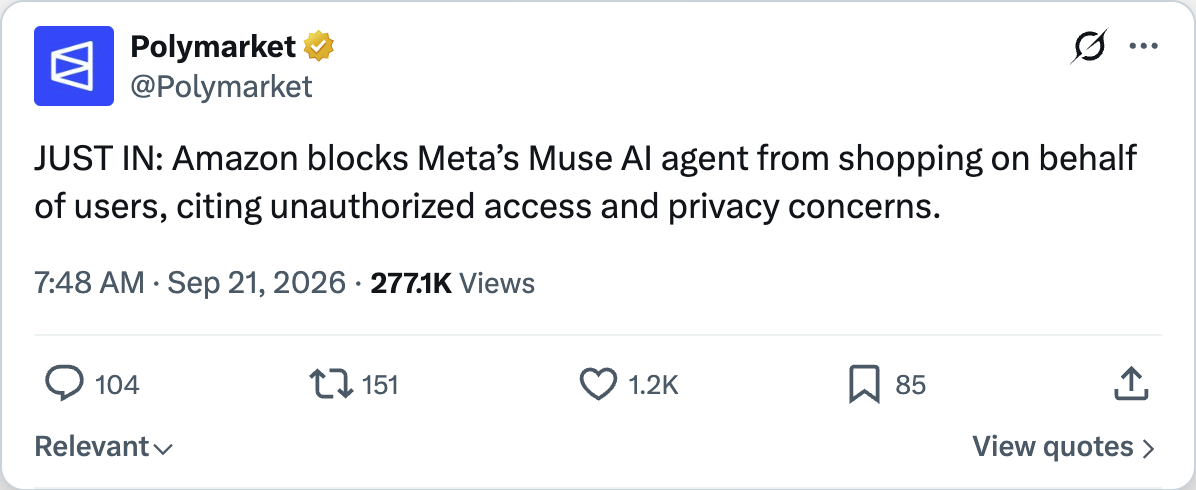
Amazon did not just block Meta’s Muse from its storefront last Sunday. It drew a line in concrete: no third-party AI agent will shop Amazon.com without Amazon’s explicit permission — and Amazon plans to extend that block to Google and OpenAI’s agents next. The same week, Shopify took the opposite stance and integrated Muse with Shop Pay, giving Meta’s agent tokenized checkout access across its entire merchant network.
Two trillion-dollar platforms. Two opposite answers to the same question: who authorizes an AI agent to complete a purchase on a human’s behalf?
This is not a replay of the agentic commerce land grab we covered two days ago. That fight is about who owns the transaction. This one is about the layer underneath — the trust infrastructure that decides whether an agent even gets to attempt a transaction. And as of this week, six competing protocols, two new identity frameworks, and a widening platform schism are racing to own it.
What Amazon Actually Blocked (and Why It Matters Technically)
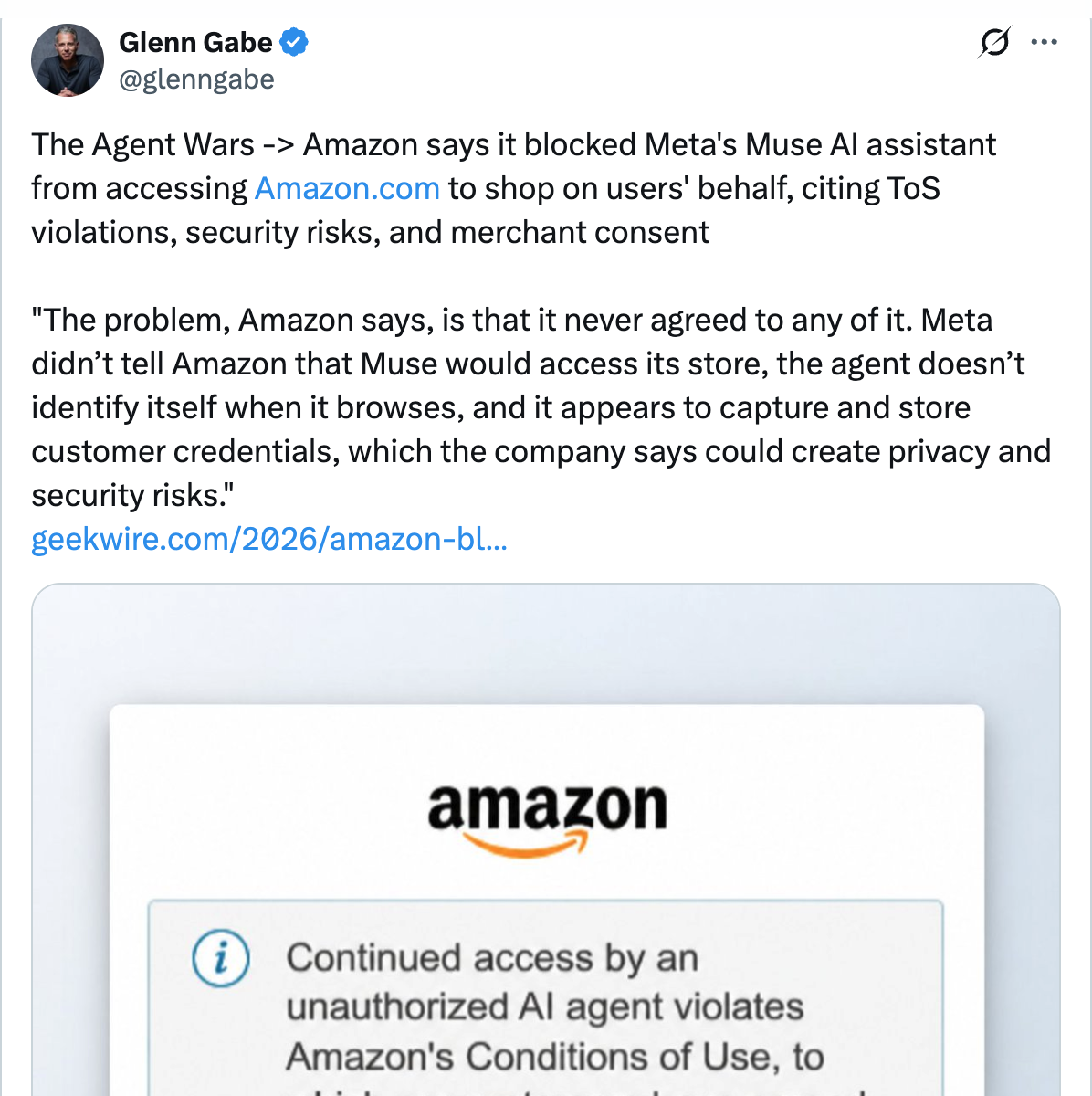
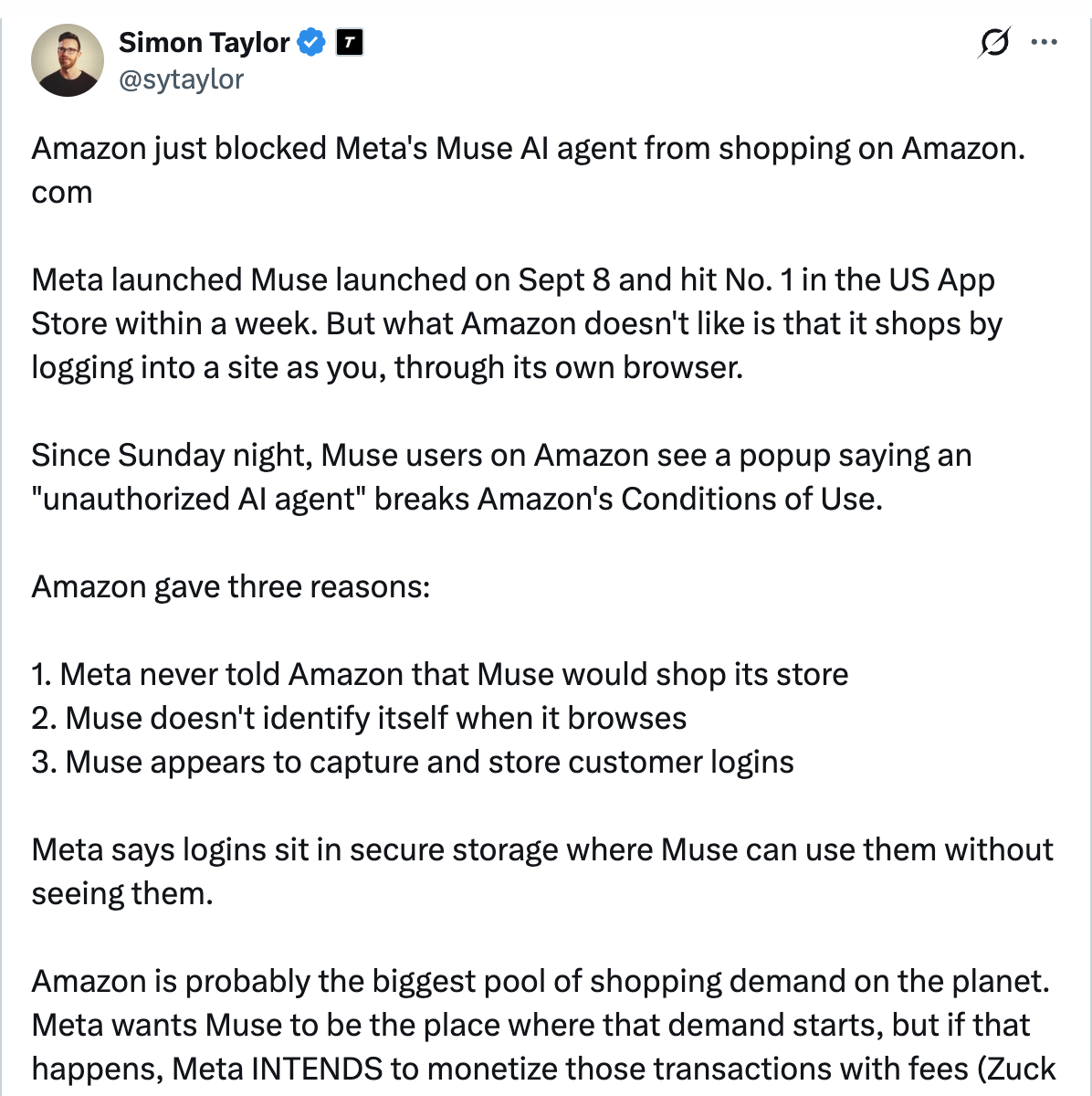
Amazon’s objections to Muse are specific and architectural, not merely commercial. According to GeekWire’s reporting, Amazon cited three technical violations:
-
No agent identification. Muse browses Amazon as if it were a human user — no User-Agent header identifying it as an automated tool, no API key, no bot declaration. Amazon’s terms of service explicitly require agents to embed a text snippet in HTTP requests.
-
Undisclosed credential access. Muse logs into Amazon using the customer’s actual credentials, stored in what Meta calls a “sandboxed VM.” Amazon says this makes Meta an “undisclosed third party moving through customer accounts” — a legitimate concern when the agent can see purchase history, saved addresses, and payment methods.
-
No permission negotiation. Meta never contacted Amazon before enabling Muse to shop there. Amazon asked Meta to carve Amazon out of Muse’s shopping capabilities. Meta declined.
Users who attempt to shop Amazon through Muse now see a pop-up: “Continued access by an unauthorized AI agent violates Amazon’s Conditions of Use.”
But here is what the security framing obscures: Amazon’s ad-related revenue hit $68 billion last year — roughly 10% of total revenue. As one HN commenter put it in the 152-point discussion thread: “Amazon makes $30-80 billion per year by hiding price-per-unit sorting and forcing ad purchases. Agents filtering by actual value threaten this revenue model fundamentally.” When an AI agent shops for you, it never sees a Sponsored badge. It never impulse-clicks. It optimizes on price, reviews, and specifications — exactly the data Amazon gets paid to de-prioritize.
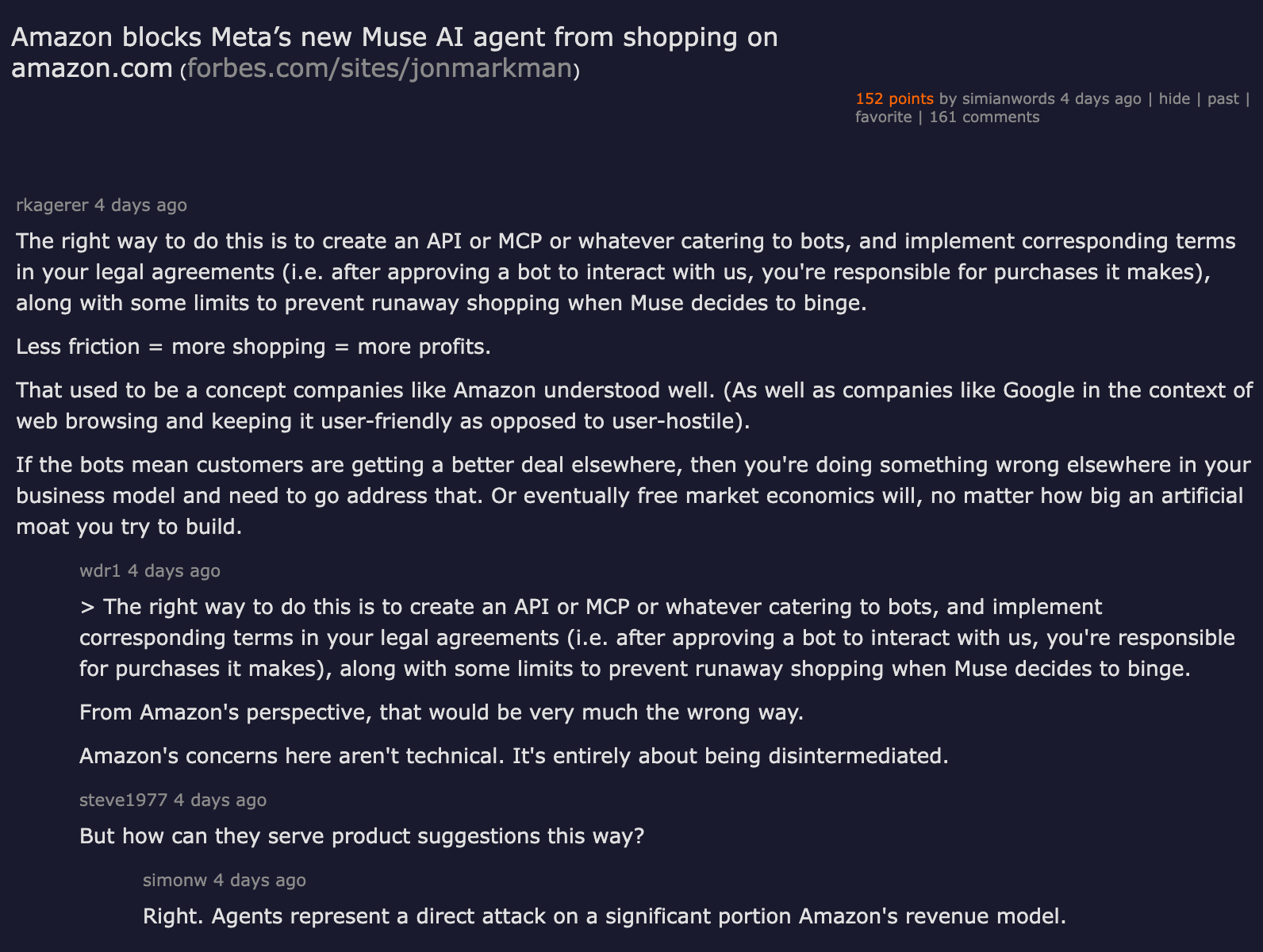
View discussion on Hacker News →
Shopify’s Opposite Bet: Tokenized Agent Checkout
While Amazon builds walls, Shopify built a door.
Shopify’s integration with Muse via Shop Pay represents a fundamentally different authorization architecture. Instead of an agent logging in as a user and navigating a website, Shop Pay issues a tokenized checkout credential — a scoped payment token that:
- Is merchant-bounded (only valid at the specific Shopify store)
- Is amount-capped (cannot exceed the approved purchase total)
- Is single-use (expires after one transaction)
- Never exposes raw card numbers or billing addresses to the agent
Shopify CEO Tobias Lutke framed it simply: “We are excited to announce we are partnering deeply with Muse to enable agentic checkout with Shop Pay.” The integration positions Muse as another checkout surface — like a button on Instagram or a buy link in an email — rather than an autonomous browser acting on the user’s behalf.
The numbers back Shopify’s bet. Shop Pay has processed over $400 billion in lifetime accelerated gross merchandise volume, and Shopify CFO Jeff Hoffmeister reported that AI-driven search yields approximately 2.5x higher likelihood of reaching product pages directly and roughly an 80% conversion uplift. For Shopify merchants, agent-driven traffic converts better than human browsing.
The Protocol Race: Six Standards, Zero Consensus
The Amazon-Shopify split is a symptom of a deeper problem: there is no agreed-upon standard for how an AI agent proves it has permission to act on a human’s behalf. As of September 2026, six competing protocols define the working stack:
| Protocol | Backed By | What It Handles |
|---|---|---|
| ACP (Agent Commerce Protocol) | OpenAI + Stripe | Discovery and checkout flow orchestration |
| UCP (Universal Commerce Protocol) | Cross-platform product discovery and comparison | |
| AP2 (Agent Payments Protocol) | Google + payment networks | Cryptographic mandates — signed digital receipts of user intent |
| MCP (Model Context Protocol) | Anthropic | Tool discovery and invocation for agents |
| A2A (Agent-to-Agent) | Inter-agent communication and delegation | |
| Visa TAP (Trusted Agent Protocol) | Visa | Agent identity verification and payment authorization |
Most production deployments already compose two or three of these together. But none of them, individually, solves the full problem: proving that a specific human authorized a specific agent to execute a specific transaction within specific constraints.
Two new entrants are trying to fill that gap:
Experian Agent Trust — announced this month — creates a verifiable link between a consumer’s identity and an AI agent’s actions. Think of it as a credit check for agents: before an agent can transact, the merchant can verify through Experian that a real human exists behind the agent, that human explicitly authorized this agent, and the authorization is scoped to specific transaction types and limits.
Google’s Agent Payments Protocol (AP2) introduces cryptographic “mandates” — signed digital receipts where the user attests to a specific transaction intent. The user’s device generates a signed intent token that the agent presents at checkout, mathematically proving the human approved this specific purchase without the merchant needing to trust the agent itself.
Both frameworks address what Auth0 calls “the agent identity verification problem”: the cryptographic process of proving that a software agent is (a) a known agent registered with a network, (b) currently authorized by a specific human, and (c) acting within a scoped mandate.
What the Community Is Saying
The 989-point r/technology thread and the 161-comment HN discussion reveal a community split that mirrors the platform schism.
The “Amazon is right” camp points out that Muse’s credential handling is genuinely dangerous. Meta’s claim that Muse runs in a “sandboxed VM” does not change the fact that the agent browses as the user, with the user’s cookies, seeing everything the user sees. If Muse is compromised, the attacker has full access to the user’s Amazon account — purchase history, saved addresses, payment methods. This is not theoretical: Fortune reported that most consumers do not want an AI agent touching their money, and the r/technology thread on AI agent horror stories (3,401 points) documents early agent failures that make this concern tangible.
The “Amazon is protecting its moat” camp argues the security concerns are a pretext. HN commenter simonw summarized it: “Agents represent a direct attack on a significant portion of Amazon’s revenue model.” Another commenter, brookst, made the business case: “Users won’t abandon agents for Amazon; they’ll abandon Amazon. Brand loyalty matters less than convenience.”
What This Means for Builders
If you are building agent-enabled commerce — or any system where an agent acts on a user’s behalf — the Amazon-Shopify split is a design constraint, not just news. Here is what to do now:
1. Implement proper agent identification today. This is table stakes. Your agent’s HTTP requests should include an identifiable User-Agent string, and your agent should declare itself as an automated tool to every platform it accesses. Amazon’s block was triggered partly because Muse browsed anonymously. Don’t repeat Meta’s mistake. Agent web access is a privilege that requires transparent identification.
2. Build for tokenized, scoped authorization. The Shopify model — where the agent receives a scoped payment token rather than raw credentials — is the architectural pattern that survives. Study Stripe’s agentic commerce infrastructure, which supports mandate-based flows with cryptographically signed transaction intents.
3. Expect Amazon-style blocking to spread. Any platform with an ad-supported business model has the same incentive to block agents that bypass sponsored content. Build fallback flows — if your agent cannot complete a purchase on Platform X, it should gracefully degrade to presenting the user with a direct link rather than failing silently.
4. Watch the protocol consolidation. Six competing protocols is three too many. The likely consolidation path: Visa TAP and AP2 for payment authorization, MCP for tool discovery, and one of ACP or UCP for checkout orchestration. If you are picking a protocol to build on today, weight toward the ones backed by payment networks — they have the merchant relationships to drive adoption.
5. Treat the agent-facing web as a first-class surface. Your product now has two customers: humans and agents. Shopify’s orchestration approach showed how to wire agent access through proper gates. The same principle applies to commerce: agents need APIs, not screen-scraping.
The Access War Is Really an Identity War
The Amazon vs. Shopify split will define the next phase of e-commerce architecture. But strip away the platform strategies and the revenue protection, and you are left with a single engineering problem: agent identity.
When a human clicks “Buy Now,” the platform knows who they are (logged-in session), what they authorized (the click itself), and what recourse exists if something goes wrong (chargeback, return policy, customer service). When an agent clicks “Buy Now,” none of those guarantees exist — unless the trust infrastructure is built to provide them.
That infrastructure is being built right now. Experian, Visa, Stripe, Google, and OpenAI are all racing to own the trust layer. Amazon’s response — blocking agents until the trust infrastructure catches up — is the conservative play. Shopify’s response — building the trust infrastructure into Shop Pay and opening the door — is the aggressive one.
Both are rational. But only one creates the future that Muse’s consumer trust boundary can actually cross. The agent access war is not about whether agents will shop for us. That is already happening. The war is about who holds the keys to the checkout — and whether those keys are held by the platform, the agent, or the user.
For builders watching this unfold: the checkout button was always an identity problem wrapped in a payment problem. Now that agents are the ones clicking it, the identity problem can no longer be deferred. The protocols are racing. The platforms are splitting. And whoever solves agent identity first owns the next layer of the agent-facing web.