Field report · · AgentConn Team
REA Hit 248K Stars. The Real Story Is Scarier.
How REA gives coding agents reverse engineering superpowers, why the hype outpaces reality, and what operators should do now.
REA Hit 248K Stars. The Real Story Is Scarier.

A week ago, morluto/rea had fewer than 10,000 GitHub stars. Today it has over 248,000 — making it one of the fastest-growing repositories in GitHub history. Matthew Berman, the AI educator with millions of followers, saw it and posted two words: “Software is done.”
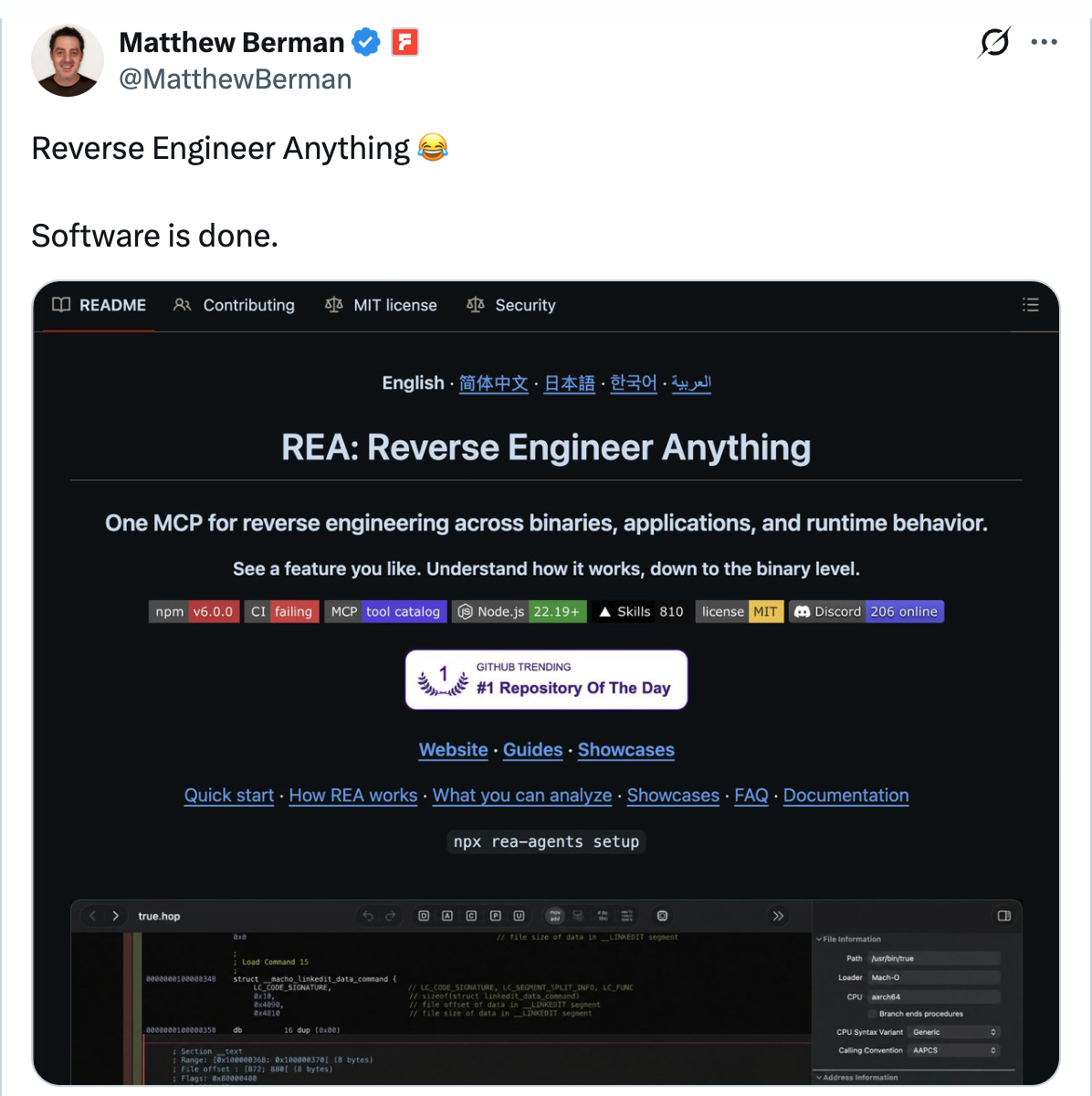
He is wrong. But he is wrong in an interesting way — and understanding why matters for every team that ships software with a client-side component.
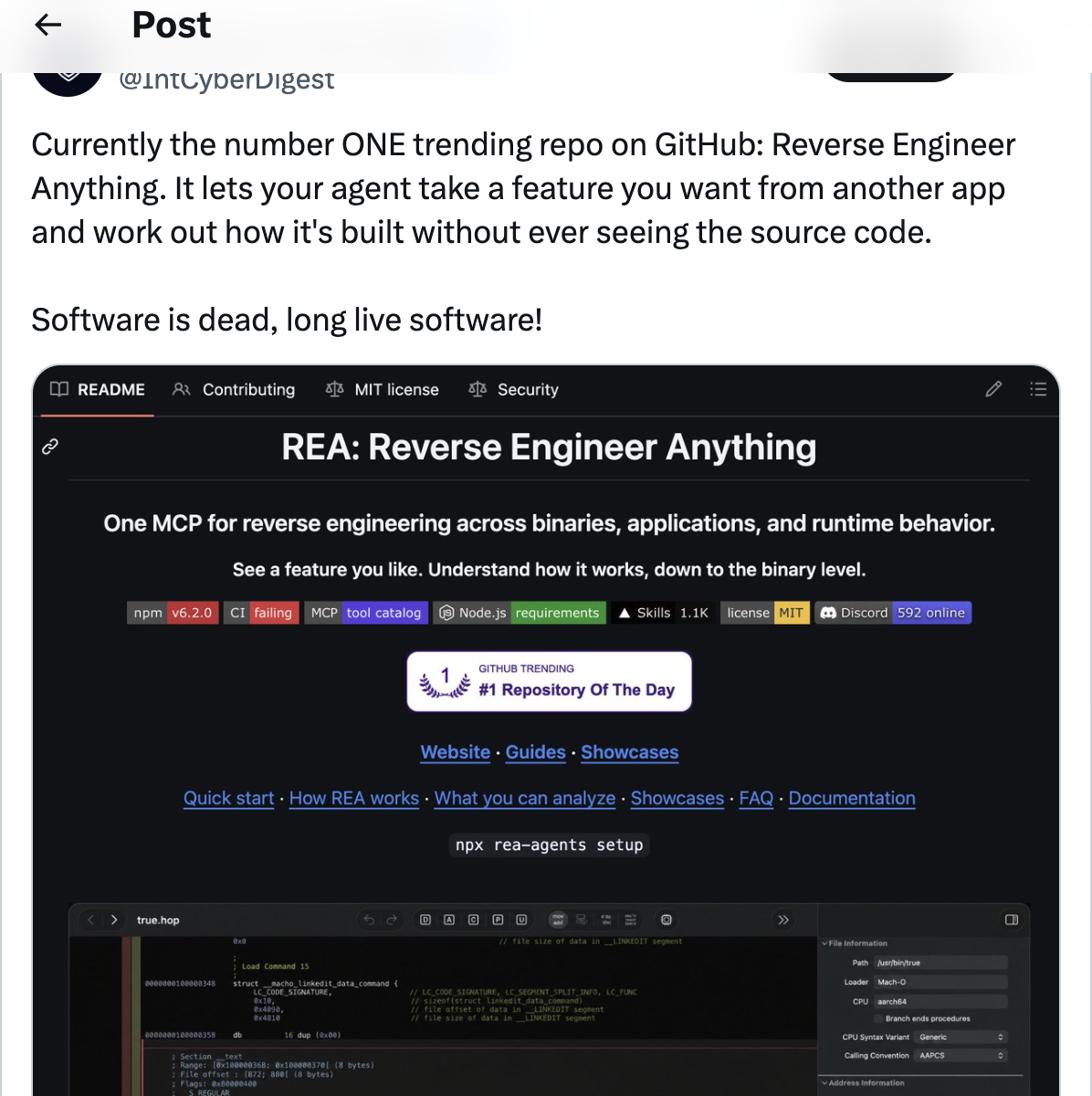
REA stands for “Reverse Engineer Anything.” It is an MIT-licensed MCP server and CLI tool that connects coding agents — Claude Code, Codex, Cursor, Gemini CLI — to established reverse engineering tools like Ghidra, Hopper, and IDA. The agent asks how a feature works. REA hands it decompiled pseudocode, execution traces, and structured evidence records. The agent explains the behavior or rebuilds it in your stack.
That description sounds like a breakthrough. It is not. REA does not contain a new decompiler. It does not introduce novel static analysis. What it does — and what the star count reflects — is something more consequential: it removes the skill barrier that has protected closed-source software for decades.
What REA Actually Does (and Doesn’t Do)
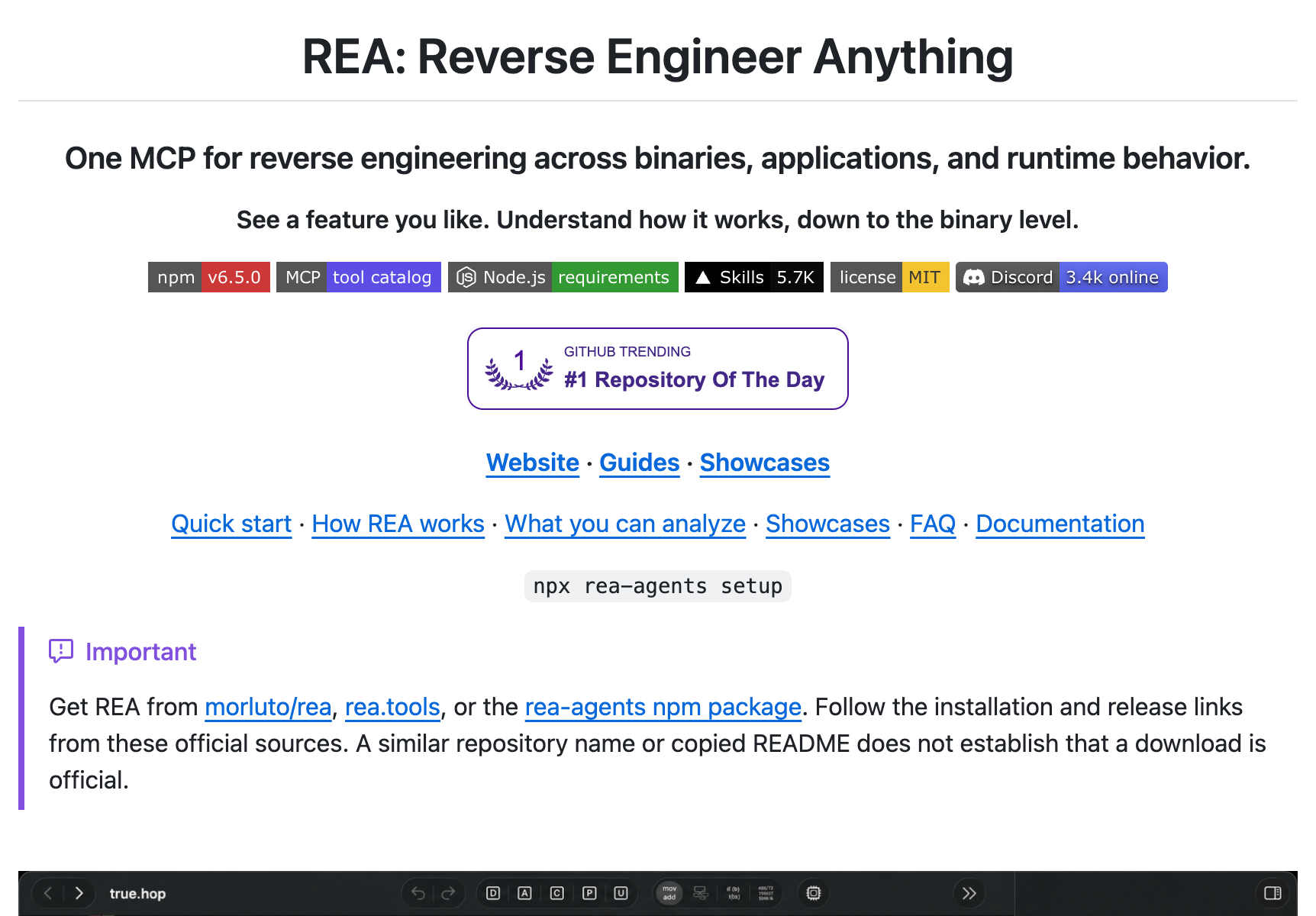
REA’s architecture is a thin orchestration layer. The project’s own README describes it plainly: “One MCP for reverse engineering across binaries, applications, and runtime behavior.” Under the hood, the heavy lifting belongs to tools that have existed for years:
- Native binaries: Delegates to Hopper, Ghidra, or IDA for pseudocode, assembly, symbols, and call graphs
- JavaScript/Electron apps: Parses modules, IPC routes, and native add-ons without running the application
- .NET assemblies: Static inspection of IL bytecode
- Android APKs: Integrates JADX and Apktool
- Websites: Chrome DevTools Protocol for runtime observation
- Firmware, WASM, EVM bytecode, SQLite databases, packet captures — the list keeps expanding with each release
Setup is a single command: npx rea-agents setup. The installer detects which agents you have, registers REA as an MCP server, and hands the agent structured access to every analysis engine on your machine.
The critical design decision is the Evidence v2 record system. Every finding REA returns includes the provider that generated it, a confidence level, and an explicit statement of limitations. This is not a cosmetic feature — it is what separates a useful tool from a hallucination generator. When an agent says “this function uses a left-right pan formula,” REA backs it with the exact file, line, and disassembly output that supports the claim.
Evidence over assertion: REA labels static inference separately from runtime observation and reports incomplete data as incomplete. Each result is a structured record with provider, confidence, and limitations — not a language model guess.
The Star Growth Is Real. The Claims Around It Are Not.
The numbers are staggering. REA went from under 10,000 stars on October 6 to over 100,000 by October 12, according to Decrypt’s timeline. It gained 30,000 stars in a single day. Eight releases shipped between October 3 and October 11.
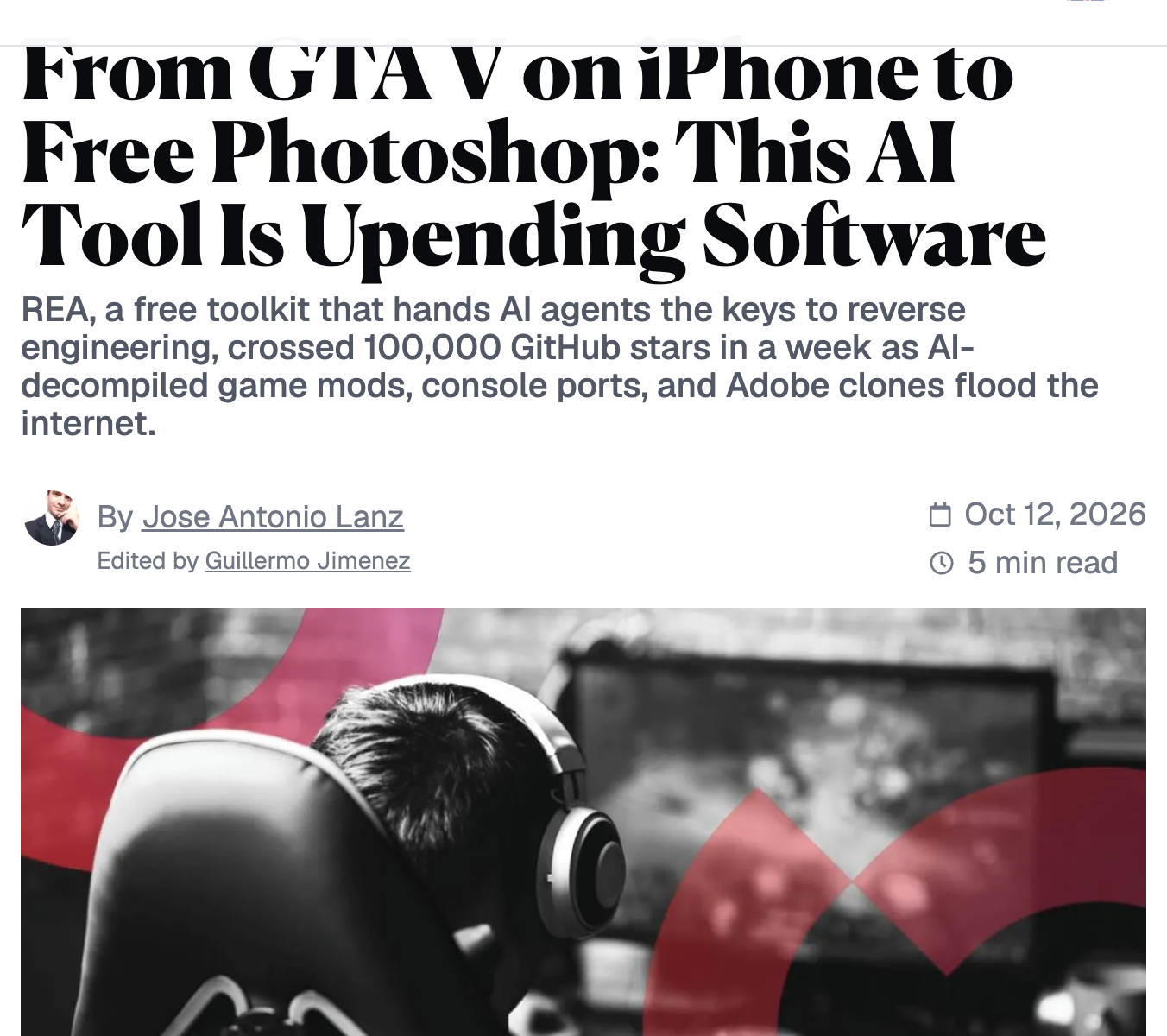
But the hype cycle has already outrun the tool’s actual capabilities.
Claim: REA can clone any app. The README explicitly says otherwise: “REA does not claim to recover original source code or automatically clone an application.” What it produces is pseudocode, module graphs, and execution traces — not a one-click reproduction engine.
Claim: “Software is done.” Brandon Thomas used Claude Opus 5.5 to build ArtCraft, a set of open-source apps that mirror Adobe’s Creative Cloud. Thomas himself initially promised feature parity within a month, then revised to “99% in under a year.” Current coverage puts actual parity at 25-35%. A pixel artist called the Photoshop clone “completely unusable.” Thomas also clarified that ArtCraft was built as a clean-room reimplementation from public documentation — not with REA.
Claim: REA dramatically outperforms vanilla agents. MindStudio’s hands-on comparison tested REA against a plain agent (no reverse engineering library) rebuilding Mac’s Preview app. The vanilla agent finished first. MindStudio’s verdict: “REA produced a solid result, but it wasn’t dramatically better than an agent working from screenshots and general reasoning.”
What the Community Is Actually Saying
View discussion on Hacker News →
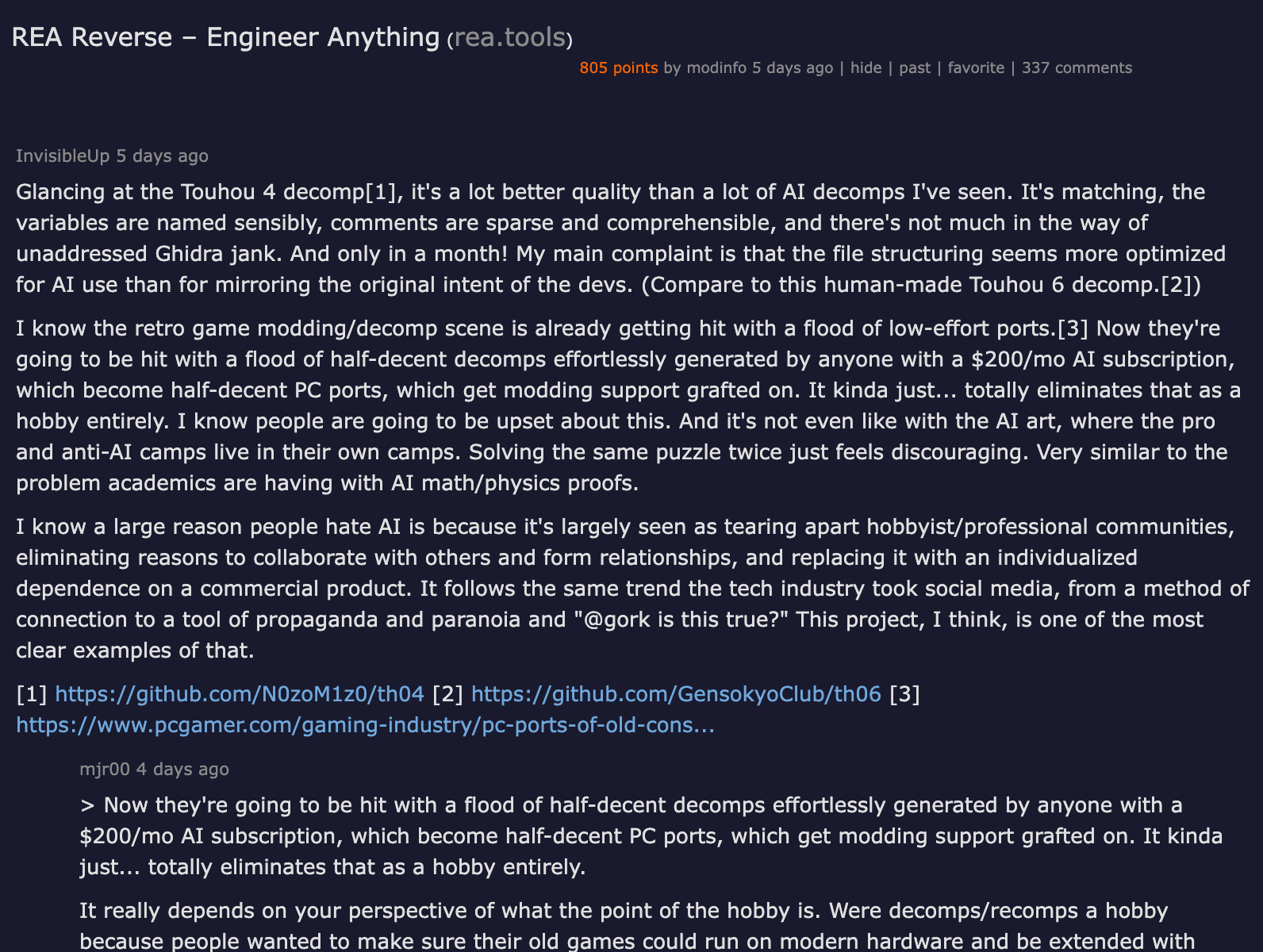
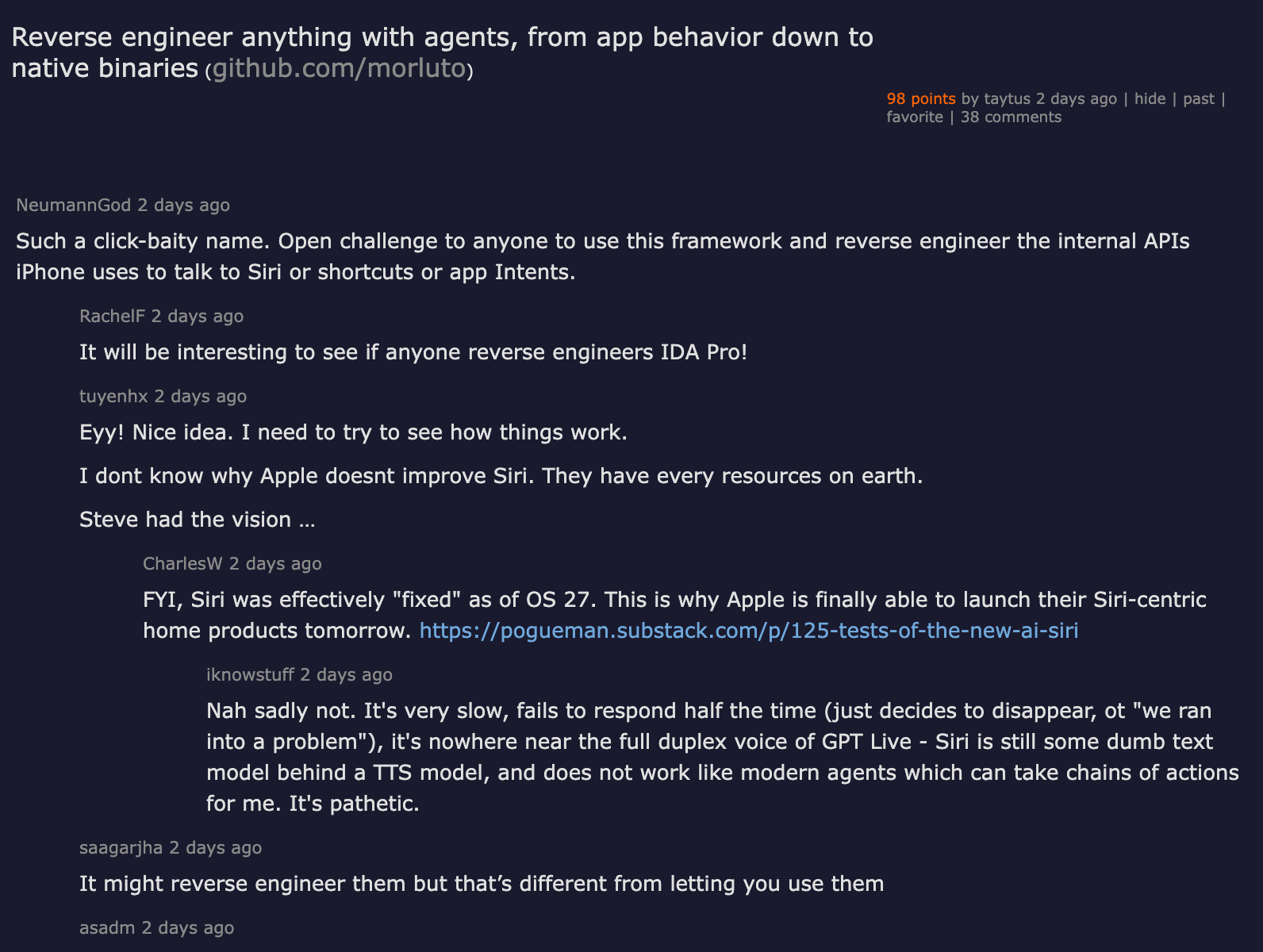
The Hacker News thread that drove REA’s viral moment (805 points, 337 comments) tells a more nuanced story than the headlines suggest.
The most upvoted skeptical comment asked what every experienced reverse engineer was thinking: “How exactly is this better than telling Claude to install Ghidra?” Other commenters pointed out that radare2, Binary Ninja, and IDA Pro all have their own MCP integrations already. REA is not the only MCP server for reverse engineering — it is the one that went viral.
The practical comments were more interesting. One user described using Codex to rebuild an abandoned MS-DOS game from its data files. Another asked about recovering old Motorola MC68010 games from executables. A third suggested bringing back Xara Xtreme for Linux. The pattern: people want REA for software preservation and interoperability, not for cloning competitors.
International Cyber Digest captured the prevailing sentiment on X: “Currently the number ONE trending repo on GitHub: Reverse Engineer Anything. Software is dead, long live software!”
But the thread also surfaced real concerns. Several users reported that frontier models sometimes refuse reverse engineering requests outright — a tension between the tool’s capabilities and the model provider’s safety policies. And one commenter warned about a lookalike repository that appeared within hours of REA trending, designed to trick people into downloading something that was not the official tool.
View discussion on Hacker News →
Impersonation risk: The REA README warns against lookalike repos. Within days of trending, at least one copycat appeared. Always install from the official rea-agents npm package or the morluto/rea GitHub repository.
The Accuracy Problem Nobody Is Talking About
The most rigorous independent test came from SystemDesign Academy, which ran REA 6.4.0 against an open-source Electron app with known source code.
The results were mixed:
- 30/30 file-and-line locations were correct — REA accurately cited where things lived in the codebase
- 18/17 IPC channels found — REA actually found one aliased channel that a text search missed
- 0/8 reply-back locations found — REA completely missed every instance where the app sends a reply to a window
- 1/8 windows detected — the app creates 8 windows; REA found 1
- 0/4 nodeIntegration settings found — a security-relevant configuration that REA silently overlooked
The conclusion: REA’s file-and-line citations are precise, but its coverage is incomplete. The tool’s silences are dangerous because an agent will treat the absence of a finding as evidence of absence. If REA does not report that an Electron app enables nodeIntegration, the agent may incorrectly conclude the app is following security best practices.
Coverage gaps matter most for security. REA missed 100% of nodeIntegration settings in an Electron app — exactly the kind of finding that a security audit must not miss. As the SystemDesign Academy review put it: “Missing findings do not establish absence.”
The Case Studies That Actually Work
Where REA genuinely shines is in narrow, verifiable tasks — not full app cloning.
DX-Ball sound-pan formula: REA recovered the logic that maps a brick’s horizontal position to a left-right sound pan from a 2000s-era game binary. The rebuilt C function was verified against the original x86 code on 3,205 test cases. Under a pinned VC4.0 toolchain, the compiled output matched byte-for-byte — all 63 bytes. The wider project maintains 55 C functions and 45,380 comparisons.
Notion clipboard path: REA traced the copy-paste chain through Notion Desktop 7.6.1: clipboard.write wrapper, ipcRenderer.invoke, ipcMain.handle receiver, to the Electron clipboard API. It identified the notion:clipboard:write channel name and the sender verification that restricts clipboard access to Notion’s own web contents. It found the hidden comment that links to locally stored block data under a custom MIME type.
TH04 bullet ring: REA recovered fixed and aimed angle calculations behind a bullet-ring pattern in a 16-bit DOS game using Ghidra, and the logic was rebuilt in C++ for historical comparison.
The DX-Ball case study verified 3,205 test cases with byte-level matching against the original x86 function. The wider project maintains 55 C functions and 45,380 comparisons. This is where REA excels — answering specific questions about specific functions, not wholesale application reproduction.
The pattern is clear: REA excels at answering specific questions about specific functions — not at wholesale application reproduction. “How does this sound panning work?” is a better use case than “Clone this entire app.”
The Security Angle That Should Keep You Up at Night
Here is where the operator story gets serious.
Startup Fortune connected REA’s launch to the ARTEX incident — a separate open-source agentic pentesting tool that CrowdStrike tied to breaches at South Korean banks in late September and early October. At least seven banks were affected, with roughly 68,000 people impacted. ARTEX’s developer pulled the project from GitHub on October 8. Forks and mirrors remained.
REA is not ARTEX. REA is a reverse engineering tool, not a penetration testing framework. But the timing is not coincidental. The two tools represent complementary stages of the same workflow: REA handles reconnaissance (understand the target), and tools like ARTEX handle exploitation (act on what you learned).
The Mayhemcode analysis made the defensibility argument clearly: server-heavy products are much safer. If the valuable logic runs on your server, an agent decompiling your client binary learns the UI and the API calls — not the business logic. The author estimated roughly 70/30 in favor of server-side safety.
But client-side software — desktop apps, mobile apps, Electron apps, browser extensions, games — now faces a fundamentally different threat model. Work that once required years of reverse engineering expertise can now be initiated by someone with a text prompt and an npm command.
The moat has moved. Proprietary client-side code was never a legal moat, but it was a practical one — few people had the skills to decompile and understand it. REA does not change the law. It changes the skill requirement from “years of training” to “one npx command.”
What Operators Should Do Now
This is not a “wait and see” situation. If you ship software with client-side logic, here is the operator playbook:
1. Audit your own releases first. Run REA against your latest binary before someone else does. What it finds is what a motivated agent-assisted attacker would find. The gaps in REA’s coverage (as documented above) are also your blind spots — use traditional tools to fill them.
2. Move sensitive logic server-side. Anything that constitutes a competitive advantage — pricing algorithms, recommendation logic, proprietary data transformations — should not live in a binary that ships to users. This was always good practice. It is now urgent.
3. Update your threat model. If your security posture assumed that reverse engineering your binary would require specialized expertise and significant time investment, that assumption is broken. Adjust your timelines accordingly.
4. Watch the MCP ecosystem. REA is one tool. GhidraMCP, radare2-mcp, and IDA Pro’s own MCP integrations are also active. The trend is structural, not a single-repo phenomenon. Our coverage of agent tool use and scoping explored why unrestricted tool access creates security surface area — this is that risk materialized for reverse engineering.
5. Do not panic about “software is done.” The dominant framing — that AI will clone all software — is not supported by the evidence. The actual test results show incomplete coverage, narrow success cases, and a gap between what demos suggest and what production use delivers. The defensibility of software has always been about distribution, data, and relationships, not code secrecy. As we covered in The Real Moat Is Being the Tool Your Agent Reaches For, infrastructure and ecosystem lock-in matter more than ever.
The Contrarian Case: Maybe This Is All Overblown
It is worth sitting with the skeptical view.
REA wraps existing tools. Ghidra has been free and open source since 2019. Hopper has been around since 2009. IDA Pro since the 1990s. Anyone who wanted to reverse engineer a binary could already do it — they just needed the skills. REA makes the skill acquisition easier, but it does not change what is technically possible.
The MindStudio comparison showed that a vanilla agent without any reverse engineering library produced comparable results to REA on a simple app. If a coding agent can already reason about software from screenshots, what does REA add beyond structured evidence records?
And the star count itself deserves scrutiny. The jump from 10,000 to 248,000 in eight days follows the pattern of viral GitHub repos that attract drive-by stars from people who never install the tool. One Chinese financial analysis piece reported that a co-author of a reverse engineering textbook called the hype out and pointed to several similar tools that already existed.
The contrarian conclusion: REA is a useful tool for practitioners who already do reverse engineering work. It is not a paradigm shift. The breathless coverage tells you more about the content cycle around AI tools than about REA’s actual capabilities.
The honest assessment: REA excels at narrow, verifiable tasks (function recovery, IPC tracing) and struggles with comprehensive coverage. If your threat model already accounts for skilled reverse engineers, REA changes the timeline but not the outcome. If it did not, you have a bigger problem than one trending repo.
Where This Goes Next
REA’s roadmap extends to packaged apps, JavaScript bundles, APIs, protocols, mobile artifacts, firmware, and runtime behavior diffing between versions. The tool count is growing — different sources report between 42 and 70 MCP tools depending on the version.
The legal landscape is unsettled. No court has ruled on agent-assisted reverse engineering specifically. The DMCA Section 1201 exemptions for interoperability and security research provide some cover, but the lines between “understanding for interoperability” and “cloning a competitor’s product” are blurry — and they were blurry before AI entered the picture.
What is clear is that REA represents a category, not an anomaly. The MCP ecosystem is enabling agents to interact with every professional tool that exists — not just code editors and search engines, but decompilers, debuggers, network analyzers, and forensic tools. The agent security lethal trifecta — unrestricted tool access, insufficient sandboxing, and over-trusting agent outputs — applies directly.
The tool is real. The capabilities are real. The hype is inflated. And the operators who take this seriously — auditing their own binaries, moving logic server-side, updating threat models — will be better positioned than those who either panic or dismiss it.
REA did not make software done. It made one particular defense — obscurity through compilation — obsolete faster than anyone expected. For everything else, the fundamentals still hold: ship fast, ship reliably, own your data, and build relationships your competitors cannot copy with an npm command.