Field report · · AgentConn Team
The Ramble Session: Context Engineering for Your Agent
Karpathy's voice-ramble technique for LLMs is a context engineering primitive. Here's when it works, when it fails, and how it fits your agent stack.
The Ramble Session: Context Engineering for Your Agent
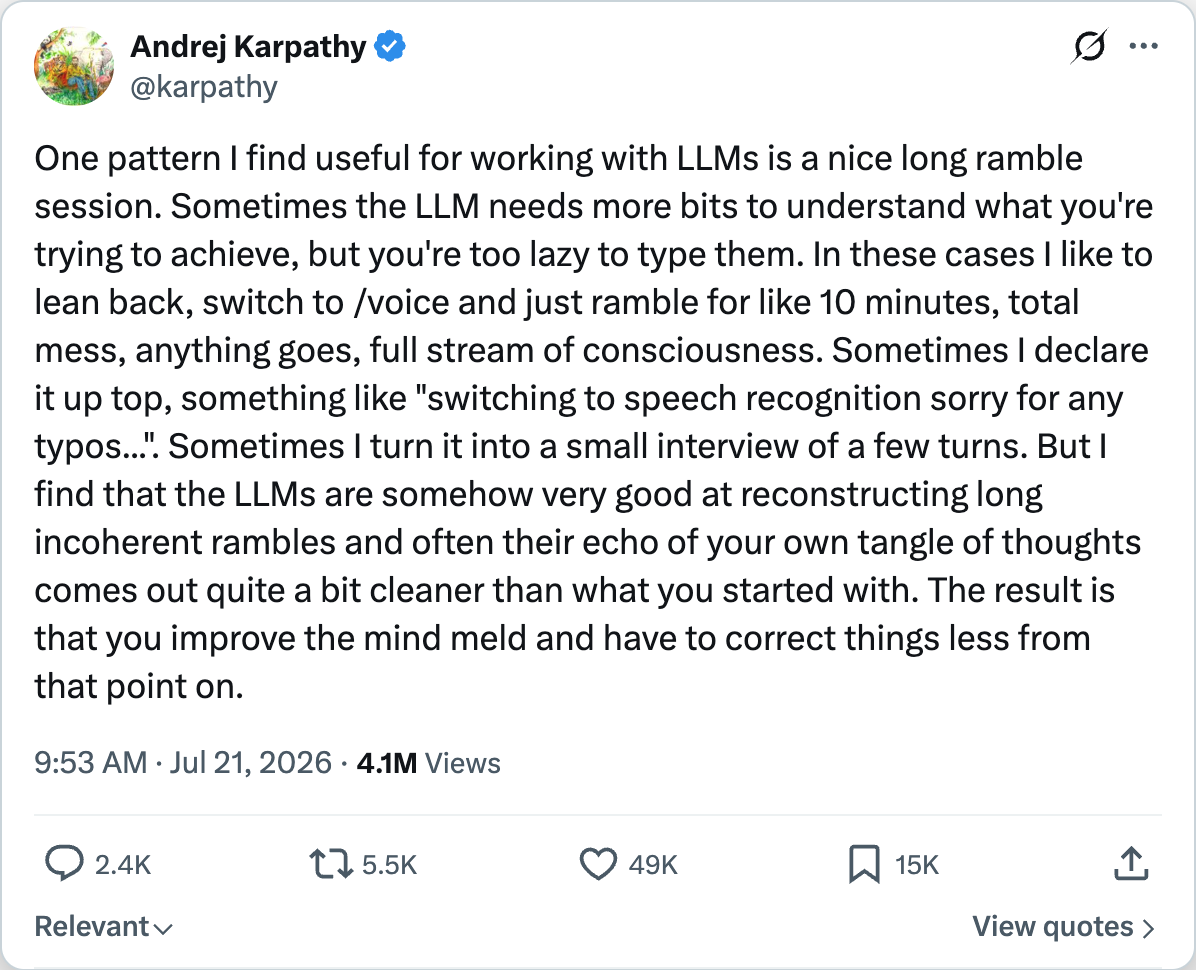
Andrej Karpathy just described his favorite pattern for working with LLMs, and it is not a carefully structured prompt, a multi-step chain-of-thought scaffold, or a fine-tuned system message. It is leaning back in his chair, switching to voice mode, and rambling for ten minutes straight — “total mess, anything goes, full stream of consciousness.”
The post pulled 49.5k likes and 5.6k retweets, which tells you the technique struck a nerve. Developers recognized something they had been doing quietly and feeling guilty about: talking to their coding agent like a colleague at a whiteboard instead of writing precise instructions like a staff engineer filing a spec.
But here is the part most of the reaction threads missed. The ramble session is not a lazy shortcut. It is a context engineering primitive — one that exploits a specific asymmetry in how LLMs process information versus how humans produce it. Understanding why it works, when it fails, and where it fits in your agent stack is the difference between a party trick and a real workflow upgrade.
What Karpathy Actually Said
The core observation is deceptively simple. Karpathy noted that LLMs often need “more bits” to understand what you are trying to achieve, but typing those bits is friction. So instead, he switches to voice mode and delivers a ten-minute stream-of-consciousness dump: design intent, constraints, half-formed ideas, vague preferences, even complaints about the current codebase.
The key insight is what happens next. LLMs, he found, are “very good at reconstructing long incoherent rambles” — and their echo of your tangled thoughts “comes out quite a bit cleaner than what you started with.” The model does not just tolerate the mess. It extracts signal from it, resolves ambiguities you did not know you had, and produces a structured interpretation that improves what Karpathy calls the “mind meld” between you and the agent.
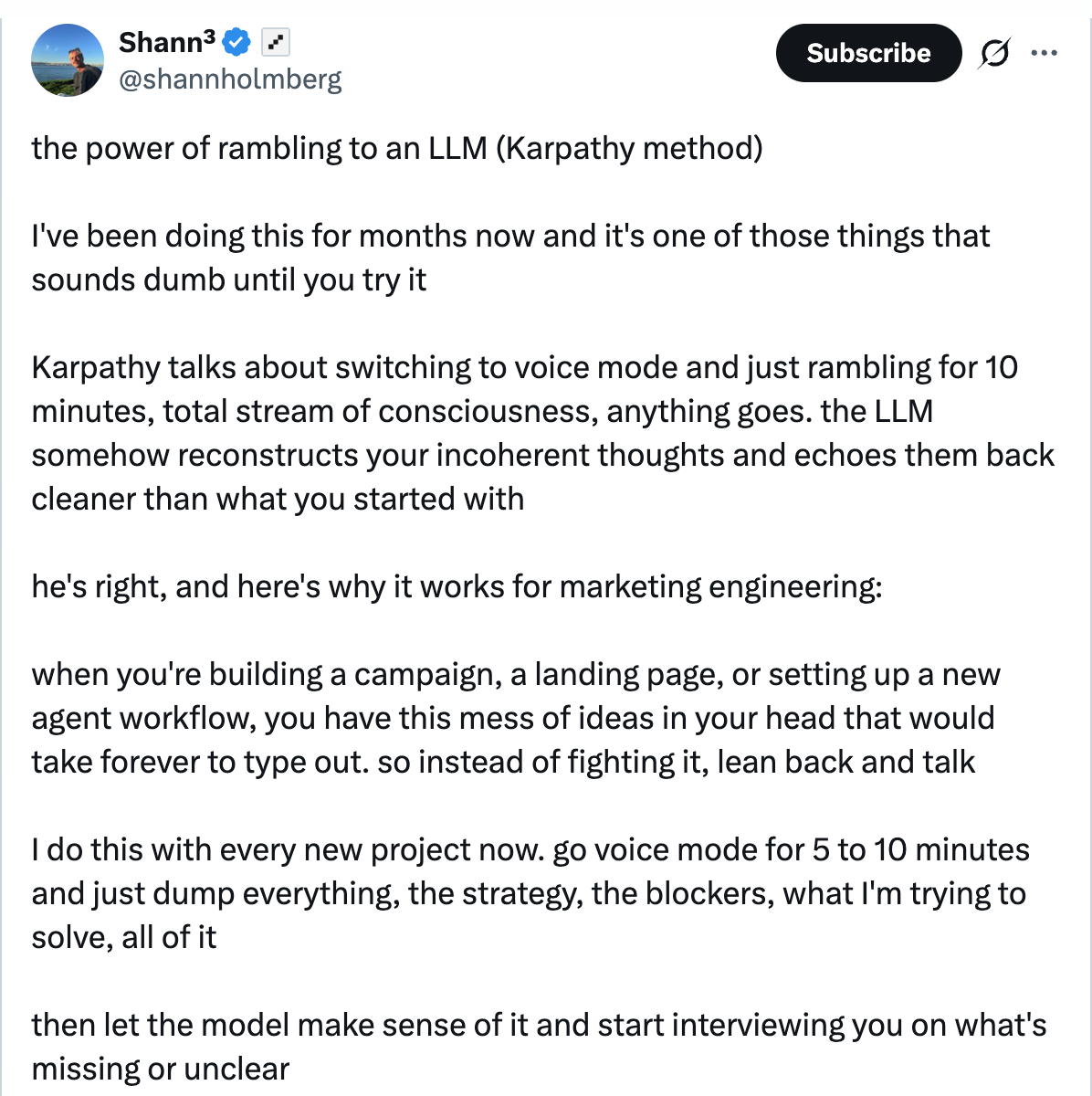
Shann Holmberg captured the practitioner reaction perfectly: “I’ve been doing this for months now and it’s one of those things that sounds dumb until you try it.” The pattern resonated because it describes something that works empirically but violates every instinct developers have about giving machines clear instructions.
Why It Works: The Context Loading Asymmetry
The ramble session works because of a fundamental asymmetry: LLMs are better at reconstructing messy intent than humans are at articulating clean intent.
When you sit down to write a prompt for your coding agent, you make unconscious editorial decisions. You leave out the “obvious” constraints — the ones that are obvious to you but invisible to the model. You skip the design rationale because you think the agent only needs the task description. You omit your preferences about code style, error handling patterns, and architectural boundaries because articulating them feels like overkill for a “quick task.”
The result is a prompt that is technically clear but contextually starved. The agent executes exactly what you asked for and nothing you meant.
Voice rambling bypasses this filter. When you talk for ten minutes without editing yourself, you naturally include:
- Design intent — why you want this feature, not just what it should do
- Negative constraints — what you explicitly do not want (“don’t use a database for this, just a JSON file”)
- Ambient context — the state of the codebase, recent changes, known tech debt, upcoming deadlines
- Preference signals — your style opinions, error handling philosophy, testing expectations
- Uncertainty markers — the parts you are not sure about, which tell the agent where to ask follow-up questions instead of guessing
This is not noise. This is the context that Anthropic’s own engineering team identifies as the difference between an agent that executes a task and one that executes the right task. Their guide defines context engineering as “curating and maintaining the optimal set of tokens during LLM inference” — and rambling, paradoxically, is one of the most efficient ways to generate that optimal set.
Context Engineering Is the Real Discipline
Karpathy’s ramble session lands in the middle of a larger paradigm shift. The industry is moving from “prompt engineering” — wordsmithing individual instructions — to “context engineering” — designing the entire information pipeline that feeds your agent.
Martin Fowler’s ThoughtWorks team frames it precisely: “Context engineering is curating what the model sees so that you get a better result.” They identify three patterns for loading context into a coding agent:
- LLM-triggered — the agent decides what context to pull (tool calls, file reads, search)
- Human-triggered — you decide what to load (pasting files, referencing docs, running commands)
- Agent software — the harness loads context deterministically at lifecycle points (CLAUDE.md on session start, rules on file match)
The ramble session is a human-triggered context load, but an unusual one. Instead of surgically selecting which files or docs to feed the agent, you are bulk-loading your mental model — the messy, interconnected web of constraints, preferences, and intent that lives in your head and nowhere else.
This is also where Karpathy’s broader framework comes in. At Sequoia’s AI Ascent 2026, he laid out the evolution from vibe coding (“just accept whatever the LLM gives you”) to agentic engineering (“orchestrate fallible agents with spec design, diff review, and eval loops”). The ramble session sits at the boundary: it uses the low-friction style of vibe coding but serves the deliberate intent of agentic engineering.
Sourcegraph’s practical guide draws the same distinction: context engineering is “rewording to rewiring” — moving beyond phrasing optimizations to designing the pipeline architecture that determines what tokens reach the model. A ramble session is one input stage in that pipeline.
The Context Engineering Stack
Here is how the ramble session fits into a modern coding agent workflow, from most persistent to most ephemeral:
Layer 1: Persistent Context (always loaded)
CLAUDE.md/AGENTS.md— project conventions, architecture decisions, style rules- Skills files — lazy-loaded instructions for specific task types
- MCP servers — tool integrations that give the agent access to external data
Layer 2: Session Context (loaded per task)
- File references — specific code the agent needs to read
- Docs and specs — requirements, API contracts, design documents
- Ramble sessions — your mental model, design intent, ambient constraints
Layer 3: Dynamic Context (agent-managed)
- Tool call results — search, grep, file reads the agent initiates
- Memory and notes — the agent’s own working scratchpad
- Compaction summaries — compressed history for long-running sessions
The ramble session lives at Layer 2 — it is session-scoped context that you provide at the start of a task. It does not replace Layer 1 (your CLAUDE.md still needs to exist) and it does not replace Layer 3 (the agent still needs to explore the codebase). But it fills a gap that neither persistent config nor dynamic retrieval can cover: your unwritten intent.
We have covered this layering before. Memory is the new moat in coding agents because model choice is increasingly commoditized — the harness, memory, and context pipeline are where differentiation lives. And agent skills are the new dotfiles — persistent context artifacts that developers share, customize, and version-control. The ramble session adds a third dimension: the ephemeral, human-generated context that captures what no config file can.
When the Ramble Session Fails
The technique has real failure modes that the viral thread mostly glossed over:
1. It dies with the session. A ramble session front-loads context into the current conversation window. When the session ends or the context compacts, that context is gone. If you rambled about architectural constraints that should persist across every session, those belong in your CLAUDE.md, not in a voice dump. As we covered in our deep dive on agent memory, the most effective context systems combine ephemeral loading (ramble sessions) with persistent storage (context files, memory systems).
2. It does not scale to teams. Your ramble is your mental model. Your teammate’s mental model is different. If the team relies on individual ramble sessions to load critical project context, you get divergent agent behavior across engineers — each agent “hears” a different version of the project. Shared persistent context (written specs, CLAUDE.md, skills) is the team-scale version of what rambling does for an individual.
3. Voice transcription introduces noise. Karpathy acknowledged this: “switch to speech recognition sorry for any typos.” Current voice-to-text is good but not perfect. Technical terms, library names, and API identifiers get mangled. useState becomes “use state.” FastAPI becomes “fast API” or “fast A P I.” The model usually infers correctly, but on ambiguous terms it can silently misinterpret — and you will not catch the error because you said it correctly.
4. It works best for greenfield, worst for debugging. Rambling is ideal when you are loading design intent for a new feature. It is less useful when you are debugging a specific failing test where the agent needs precise file paths, error messages, and reproduction steps. For debugging, structured context (paste the stack trace, point to the file, describe the expected behavior) beats stream-of-consciousness every time.
How to Actually Do It
Here is a practical protocol for incorporating ramble sessions into your coding agent workflow:
Before the ramble:
- Open your coding agent (Claude Code, Cursor, or equivalent)
- Switch to voice input mode
- Optionally tell the agent: “I’m going to ramble for a few minutes to give you context. Don’t act on it yet — just listen and ask clarifying questions when I’m done.”
During the ramble (5-10 minutes):
- Describe what you are building and why — the business context, user need, or technical motivation
- State your constraints — what tech to use, what not to use, performance requirements, timeline
- Mention recent changes to the codebase that the agent should be aware of
- Share your preferences — how you want errors handled, what patterns you like, how you think about testing
- Flag uncertainties — parts you are not sure about, decisions you have not made yet
- Reference related work — “this is similar to what we did in the auth module” or “look at how the payments service handles this”
After the ramble:
- Ask the agent to summarize what it understood — this is the “echo” that Karpathy describes
- Correct any misunderstandings
- Capture the durable parts. If the agent’s summary contains constraints or conventions that should persist, move them to your
CLAUDE.mdor a project spec. The ramble generated them; now make them permanent. - Proceed with the actual task
The Bigger Picture: Eval Generalization
Karpathy’s ramble session post connects to a deeper theme he has been developing. In a separate thread that pulled 28.1k likes, he argued that we are “leaving the territory where you’d test an LLM by ‘create an SVG of pelican on a bicycle.’” The era of toy benchmarks is ending. Real evaluation requires the kind of rich, ambiguous, context-heavy tasks that production development actually involves.
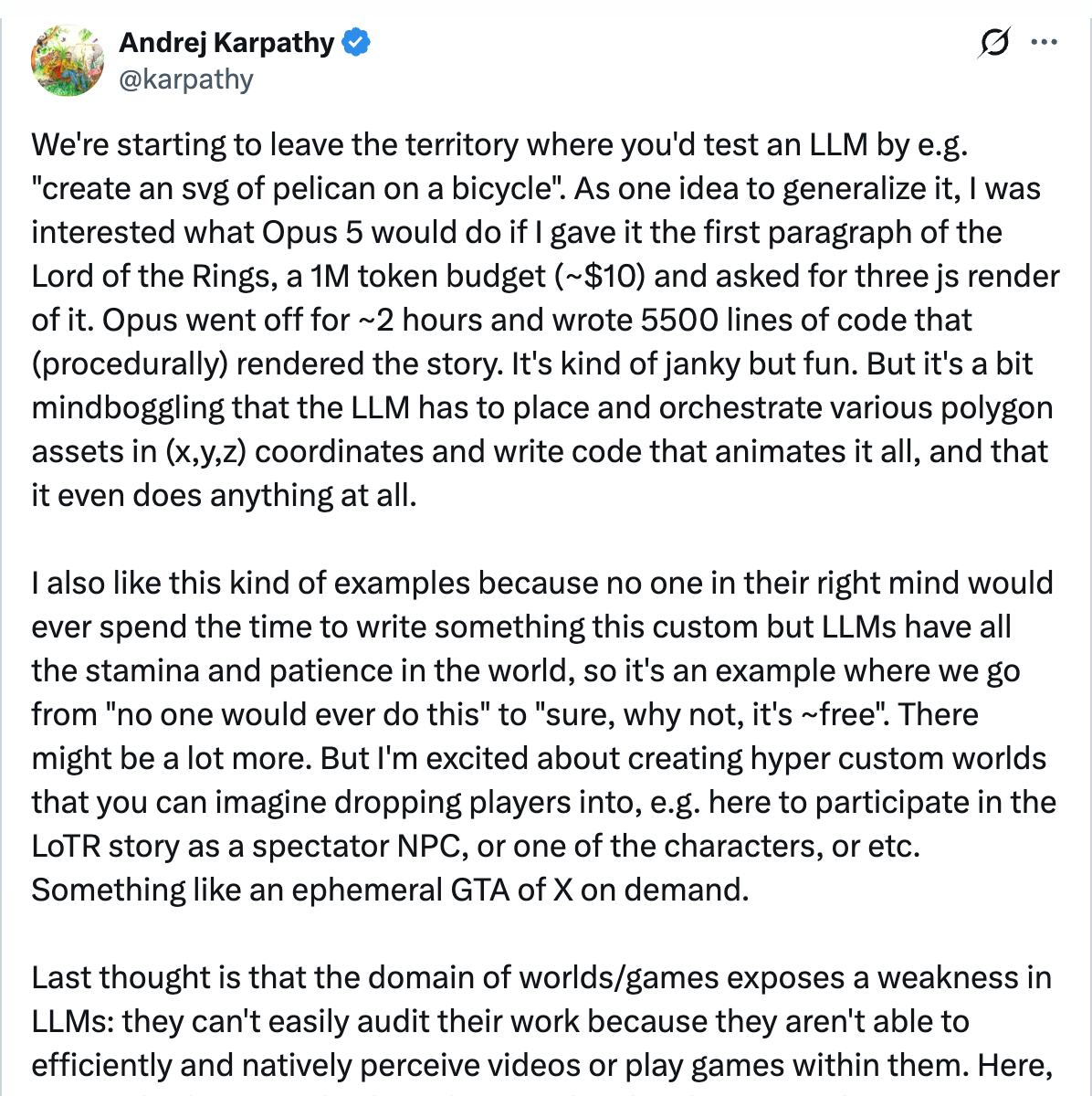
The ramble session is, in a sense, a micro-version of that argument. The toy version of using a coding agent is a clean, one-line prompt: “write a function that sorts this array.” The production version is a ten-minute context dump that includes your architecture, your constraints, your preferences, and your uncertainties — followed by a task that the agent can only execute well if it absorbed all of that context.
Anthropic’s Claude blog reinforced this direction recently by revealing that they removed over 80% of Claude Code’s system prompt for the latest models “with no measurable loss on coding evaluations.” The models are getting better at extracting signal from less-structured input — which means the ramble session’s effectiveness is likely to increase, not decrease, as models improve.
What This Means for You
If you are an individual developer: Try the ramble session today. Literally. Open Claude Code, switch to voice, and talk for five minutes about your current task before asking the agent to do anything. Compare the result to what you get from a typed one-liner. The difference is usually dramatic on the first try.
If you are a team lead: Do not let ramble sessions become a substitute for written context architecture. Every insight that emerges from a ramble and proves useful should eventually migrate into your CLAUDE.md, your project skills, or your documentation. The ramble is the discovery mechanism; persistent context is the delivery mechanism.
If you are building agent tooling: Voice-first context loading is an underinvested UX pattern. Most coding agent interfaces treat voice as an accessibility feature, not a primary input modality. Karpathy’s viral post is a signal that there is unmet demand for voice-native agent workflows — including automatic capture of ramble sessions into structured context artifacts.
The ramble session is not the future of how we talk to coding agents. It is a present-tense technique that exploits a real capability gap. Use it where it works. Pair it with persistent context where it does not. And stop feeling guilty about talking to your tools like they are people — because right now, that is one of the most efficient ways to load the context they need.