Field report · · AgentConn Team
Orca Built an IDE for Agent Fleets. Is the ADE Real?
Orca runs 25+ coding agents in parallel git worktrees. With 53K GitHub stars in five months, is the Agent Development Environment a real category?
Orca Built an IDE for Agent Fleets. Is the ADE Real?
Open GitHub Trending on any day in August 2026 and the pattern screams at you: the entire board is middleware, not models. Hermes-agent at 236K stars. OpenCode at 201K. Codex adding nearly 2,000 stars per day. And sitting in the thick of it, stablyai/orca — a tool that calls itself an “Agent Development Environment” for running a fleet of parallel coding agents — crossed 53,000 stars just five months after its first commit.
Something has shifted. The bottleneck is no longer “which model should I use.” It is “how do I manage the five agents I already have running.”
Vaibhav Sisinty put it plainly: “Most people run one AI agent at a time. Orca runs multiple in parallel. One agent reviews your code. Another fixes bugs. Another writes docs. Another runs unit tests. All at the same time.” That framing — agents as a fleet to be coordinated, not a tool to be invoked — is the thesis behind an emerging product category that Orca’s team calls the ADE.
But is “Agent Development Environment” a real category with staying power, or a transient label for a feature that Cursor, Windsurf, and VS Code will absorb within a release cycle? That question matters more than any individual tool’s star count.
The Middleware Moment
We have been tracking the agent harness thesis on AgentConn for months: the competitive moat in AI tooling is not the model weights — it is the scaffolding around them. Elon Musk admitted Grok 4.6 performs “significantly worse” without its Build harness. Anthropic’s Claude Code ships with its own skills system, CLAUDE.md, and hooks infrastructure. OpenAI’s Codex CLI wraps GPT behind sandboxed execution.
The pattern is convergent. Every serious coding agent now carries a harness layer. But those harnesses are designed for a single-agent workflow: one model, one context window, one set of file edits, one human reviewing one diff.
What happens when you want to run three of them at once?
Right now, most developers improvise. Simon Willison documented the approach in his newsletter: fire up multiple Claude Code or Codex instances, each in a fresh checkout cloned to /tmp, and context-switch between terminals. It works. But as Willison noted, the bottleneck becomes review capacity — “code that started from your own specification is a lot less effort to review” — and the isolation is fragile. File races happen. Branch states collide. The human becomes the scheduler.
This is the gap Orca targets.
What Orca Actually Does
Orca is an open-source (MIT) Electron desktop app built by Stably AI, a four-person Y Combinator-backed team out of San Francisco. It does one thing well: it runs any CLI-based coding agent in its own isolated Git worktree, behind a single control plane.
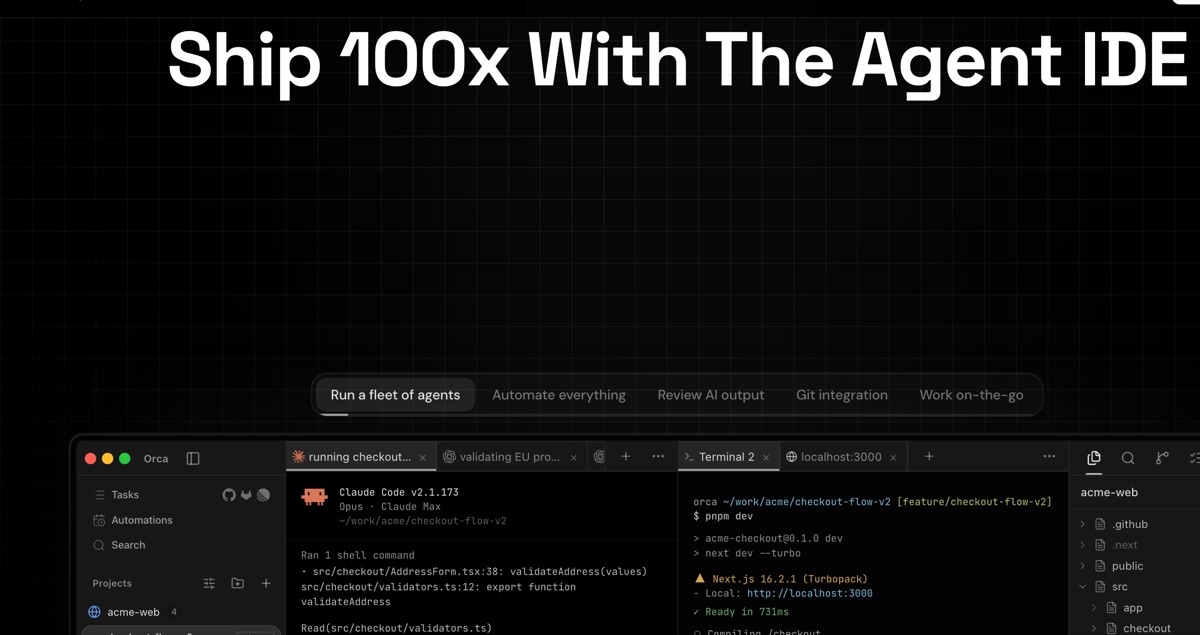
The feature set is concrete:
- Parallel worktrees. Fan one task to multiple agents simultaneously. Each gets its own branch and working directory. Compare outputs side by side. Merge the winner.
- 25+ supported agents. Claude Code, Codex, OpenCode, Cursor CLI, Grok, Gemini, GitHub Copilot, Pi — if it runs in a terminal, it runs in Orca. Bring your own subscription; Orca takes no cut.
- WebGL terminals. Ghostty-class rendering with infinite splits. Not a web terminal wrapper — actual GPU-accelerated rendering.
- Design Mode. A real Chromium window per worktree. Click a UI element and inject the HTML, CSS, or a screenshot directly into the agent’s context. Useful for frontend tasks where the agent needs to see what it broke.
- Inline diff annotation. Drop markdown comments on any diff line and ship them back to the agent. Human-in-the-loop review without leaving the tool.
- Mobile companion. iOS and Android apps for monitoring agent progress remotely. Kick off a fleet of tasks on your desktop, review the diffs from your phone.
- SSH worktrees. Run agents on remote machines with auto-reconnect. The “headless VPS” mode lets you treat a beefy cloud instance as your parallel-agent farm.
The architectural bet is straightforward: Git worktrees are cheap and battle-tested. Every agent gets a full copy of the repo at a consistent commit point. No file-locking conflicts, no partial merges, no shared state. The human reviews completed diffs, not in-progress edits.
Key insight: Orca does not wrap or modify your agents. It wraps the environment around them. Your Claude Code subscription, your Codex CLI, your API keys — they all run unmodified. Orca is infrastructure for the gap between “I have an agent” and “I have five agents working on the same repo.”
IDE vs. ADE: Is This a Real Category?
Rick Hightower’s deep-dive on Substack laid out the category distinction more clearly than anyone else has:
Read the full analysis on Substack →
| Dimension | Traditional IDE | Agent Development Environment |
|---|---|---|
| Optimized for | Human-produced code | Agent-produced code |
| Unit of attention | Individual files | Complete task attempts |
| Concurrency model | Single working state | Isolated worktrees per agent |
| Human role | Writing code | Directing and judging approaches |
| Review flow | Single diff | Comparative multi-diff selection |
| Scaling limit | Typing speed | Human review capacity |
Hightower’s framing: “Your coding agent is no longer the bottleneck. You are.” The ADE exists because the human review loop — not the model — is the binding constraint on throughput.
Addy Osmani reinforced this in his March 2026 essay “Death of the IDE?”: IDEs are being “de-centered” as the primary workspace. The traditional loop of edit, build, debug, repeat is giving way to specify intent, delegate, observe, review diffs, merge. The IDE remains critical for correctness — debugging, code navigation, complex refactors — but it is no longer the cockpit.
This is also the thesis behind the agent-of-agents problem we covered in July. As agents multiply, orchestration becomes its own engineering discipline. Orca is one answer to that discipline at the developer-tooling layer.
The Competitive Landscape Is Already Crowded
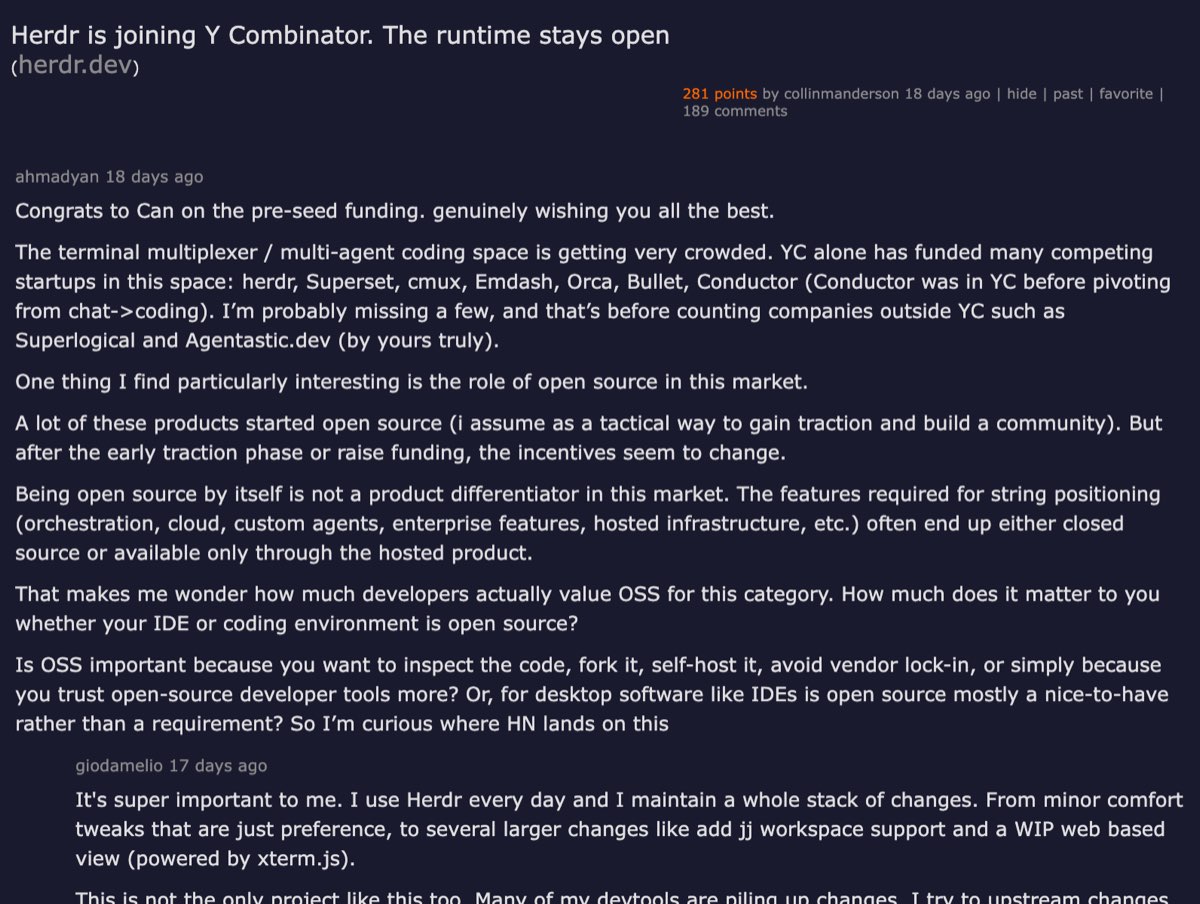
Orca is not alone. The Herdr YC announcement thread on Hacker News (281 points, 189 comments) surfaced at least seven YC-funded competitors in the agent-IDE space: Herdr, Superset, cmux, Emdash, Bullet, and Conductor — plus external entrants like Superlogical and Agentastic.
View the full discussion on Hacker News →
One HN commenter drew the sharpest analogy: “Orca is like VSCode and Herdr is like Sublime Text” — feature-rich versus lightweight. Herdr (Apache-licensed, tmux-style keybindings) appeals to developers who want a keyboard-first, minimal orchestrator. Orca targets the visual, multi-pane, “I want to see all five agents at once” workflow.
The crowding is a signal, not noise. When seven YC-backed startups converge on the same gap in the same batch cycle, the gap is real. The question is whether the gap remains a standalone product or gets absorbed.
What the Community Is Saying
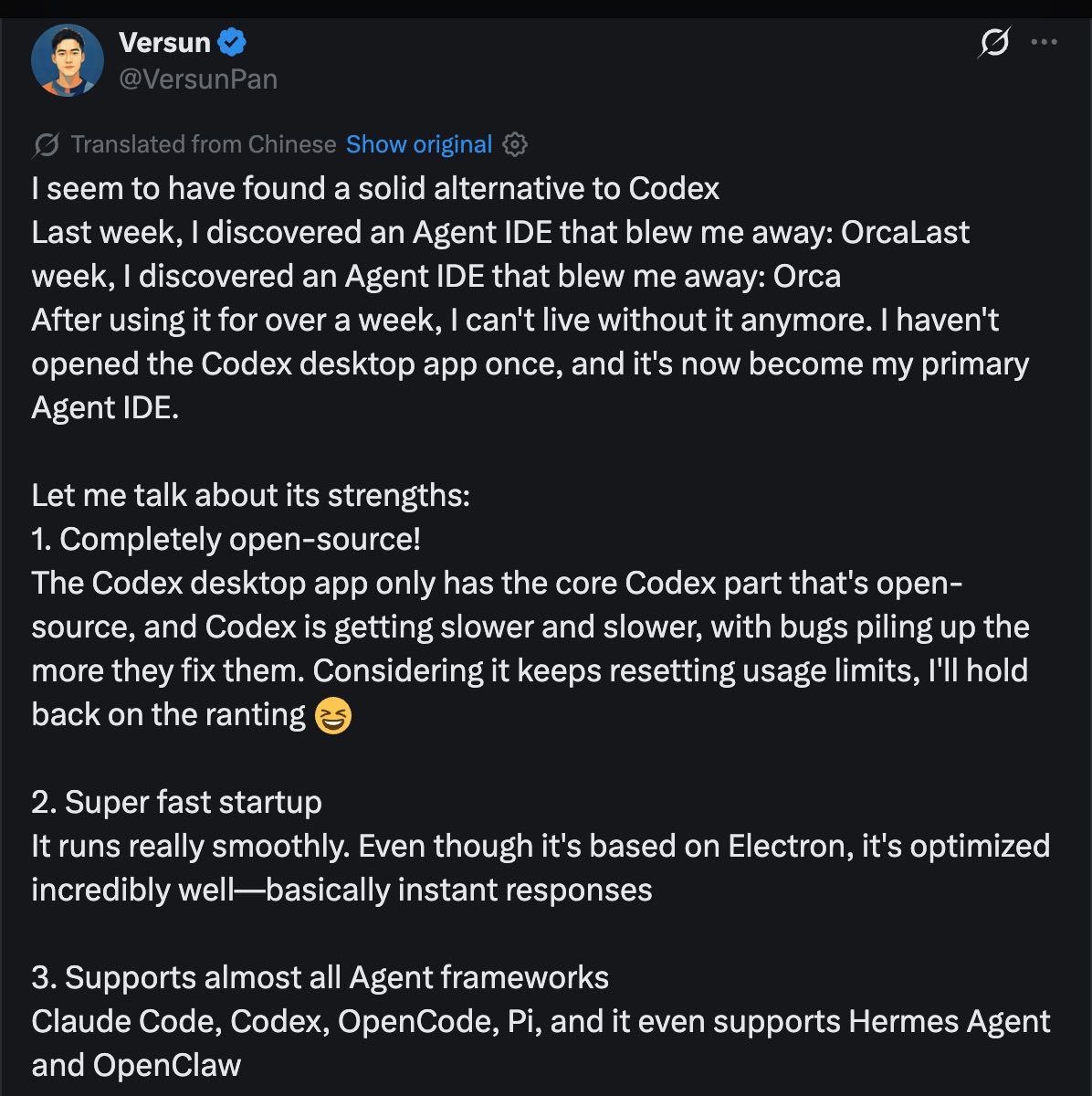
Developer Versun captured a sentiment spreading across the community: after a week using Orca, the Codex desktop app “has not been opened again.” The friction reduction of running agents in isolated worktrees — versus manually cloning repos and juggling terminal windows — is significant enough to change daily workflows.
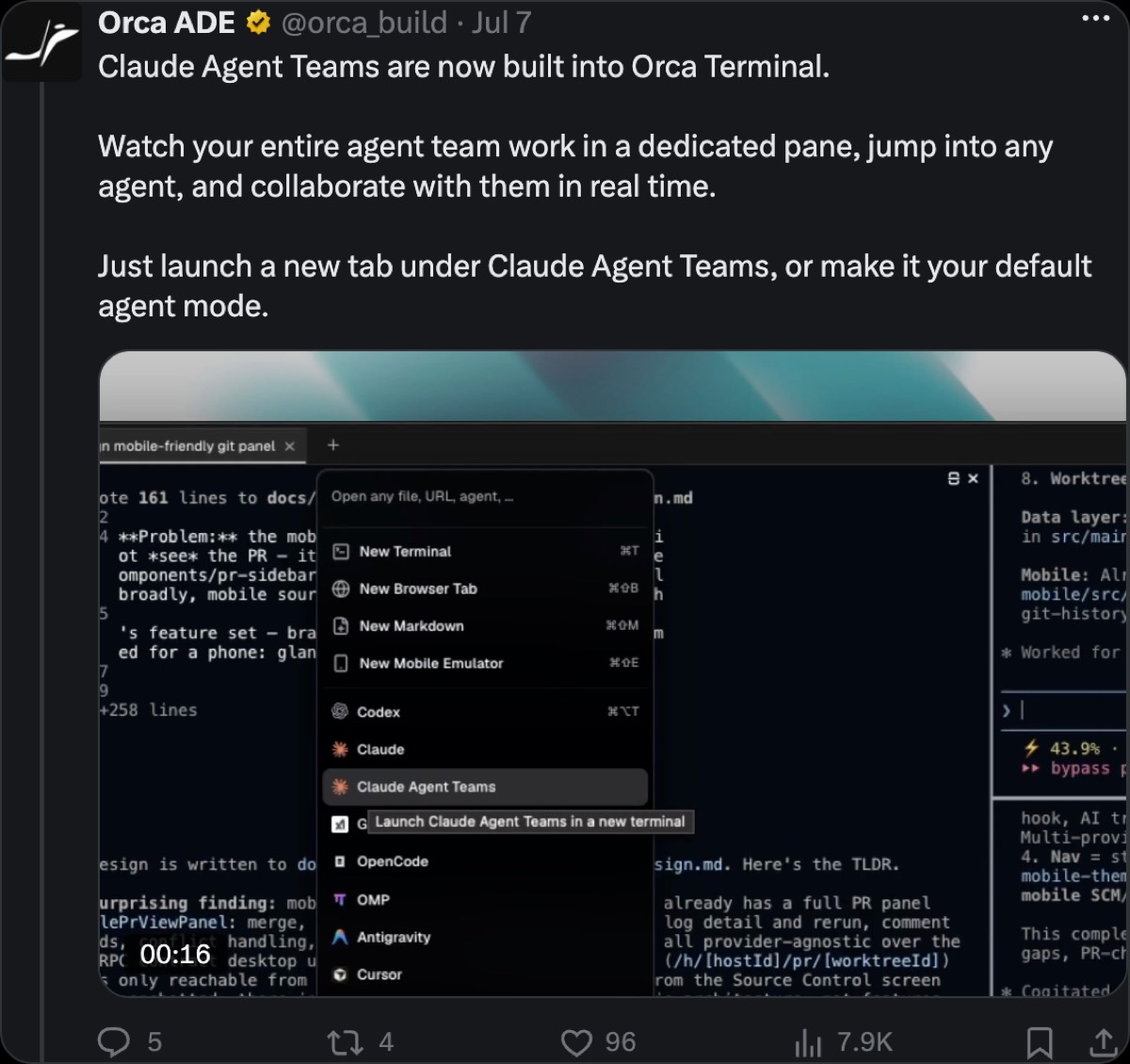
The GitHub star trajectory tells its own story. Orca went from first commit on March 17, 2026 to 53,000 stars by late August — roughly 10,000 stars per month. For context, that growth rate outpaced early Cursor and rivals the best developer-tool launches in GitHub history. The daily gain of 929 stars (as of August 24) puts it in the same league as Codex (+1,990/day) and ahead of OpenCode (+385/day).
But stars are vanity. The more telling signal is the international adoption: reviews and tutorials in English, Japanese, Korean, Portuguese, and Spanish appeared within weeks of launch. The tool’s documentation is English-only, but developers worldwide are producing localized walkthrough content — a reliable indicator that the tool solves a real workflow problem, not just a marketing one.
The Contrarian Case: ADEs as a Transient Shim
Contrarian corner: The strongest argument against standalone ADEs is that parallel-agent support is a feature, not a product. Cursor already runs background agents. GitHub Copilot has agent mode. Windsurf (Codeium) integrates multiple models. If VS Code ships a “parallel worktrees” extension tomorrow — and Microsoft has every incentive to — does Orca become a nice open-source project without a business?
History supports this skepticism. Terminal multiplexers (tmux, screen) never became billion-dollar businesses despite being essential infrastructure. Text editors (Sublime, Atom) struggled to monetize against free alternatives. Developer tooling has historically been winner-take-most, and the winner is usually the one with the largest existing user base — which means VS Code.
The counter-argument is that ADEs do something structurally different from IDEs. An IDE optimized for human code editing does not naturally decompose into a multi-agent orchestrator. The data model is wrong: files versus tasks. The review flow is wrong: single diff versus comparative selection. The concurrency model is wrong: one working state versus many. Bolting these onto VS Code is possible, but it is the kind of bolt-on that produces a worse experience than a purpose-built tool — the same way that adding a terminal to an IDE never killed standalone terminal apps.
Orca’s MIT license and BYOK (bring your own key) model also change the competitive dynamics. There is no vendor lock-in. If Orca dies tomorrow, developers keep their agent subscriptions, their Git repos, and their workflows. The switching cost is near zero, which is both a weakness (low moat) and a strength (low adoption friction).
What This Means for Practitioners
If you are running two or more coding agents daily — and based on our coverage of the top coding agents, many teams now are — the question is not whether to adopt an ADE. It is whether to adopt one now or wait for the category to consolidate.
The case for now:
- Orca is free, open-source, and MIT-licensed. The downside risk is the time to install and learn it.
- Git worktree isolation solves a real problem. If you have lost work to a file-race between two agents editing the same file, you know the pain.
- The BYOK model means you are not adding another subscription. You bring the agents you already pay for.
- Mobile monitoring is a genuine force multiplier. Kick off five tasks, review diffs from your phone during lunch.
The case for waiting:
- The category is six months old. Consolidation is coming. At least half of the seven YC-funded entrants will not exist in 18 months.
- IDE incumbents are watching. Cursor, Windsurf, and VS Code all have the engineering capacity to ship parallel-agent features.
- Your workflow may not need it yet. If you are running a single Claude Code instance and reviewing one diff at a time, Orca solves a problem you do not have.
Bottom line: The ADE is not a gimmick — it addresses a real architectural gap between single-agent harnesses and the multi-agent reality that 2026 developers are already living in. Whether Orca specifically survives the coming consolidation matters less than the pattern it represents: the human review loop is the new bottleneck, and the tooling must adapt to it.
Looking Ahead: The ADE and the Harness Stack
The deeper question is where ADEs sit in the emerging agent harness stack. Today, Orca operates at the “environment” layer — managing worktrees, terminals, and diffs. It does not touch the harness internals: no memory management, no tool routing, no guardrails, no eval loops.
That is both a feature and a limitation. It means Orca is composable — it works with any agent’s harness without conflicting. But it also means that as harnesses grow more sophisticated (background agents, persistent memory, multi-step planning), the ADE will need to integrate with those layers or risk becoming a thin shell around increasingly self-sufficient agents.
The next evolution may be an ADE that understands agent state — not just which worktree is active, but what each agent has tried, what failed, and what the optimal next assignment would be. That is the agent-of-agents problem, and solving it at the IDE layer would be the move that turns the ADE from a nice-to-have into a must-have.
For now, Orca has earned its spot on the radar. Fifty-three thousand developers agree that managing a fleet of coding agents is a problem worth solving. The debate is not whether the problem exists — it is who builds the definitive answer.
Orca is open-source (MIT) at github.com/stablyai/orca. Get started at onorca.dev.