Field report · · AgentConn Team
MCP Ships Skills and Tasks. The 3-Second Problem Remains.
Anthropic shipped Skills-over-MCP and background Tasks. But the real agent UX gap is what happens when your agent goes silent.

MCP Ships Skills and Tasks. The 3-Second Problem Remains.
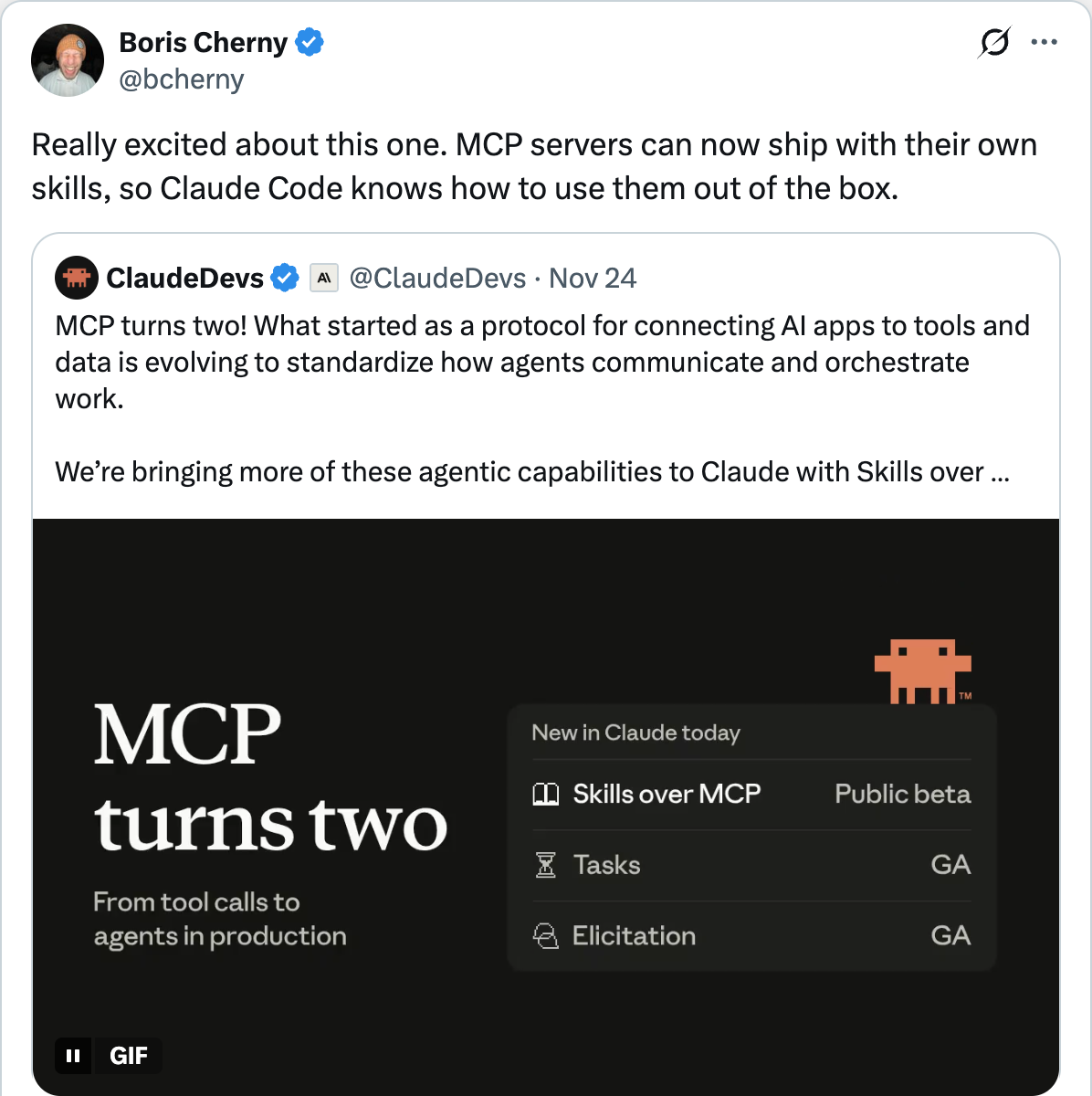
On November 24, 2026 — two years to the week after open-sourcing the Model Context Protocol — Anthropic shipped the biggest upgrade to MCP since launch. Skills over MCP entered public beta. Tasks and Elicitation went generally available. File Uploads are coming. As Anthropic engineer Boris Cherny put it on X:
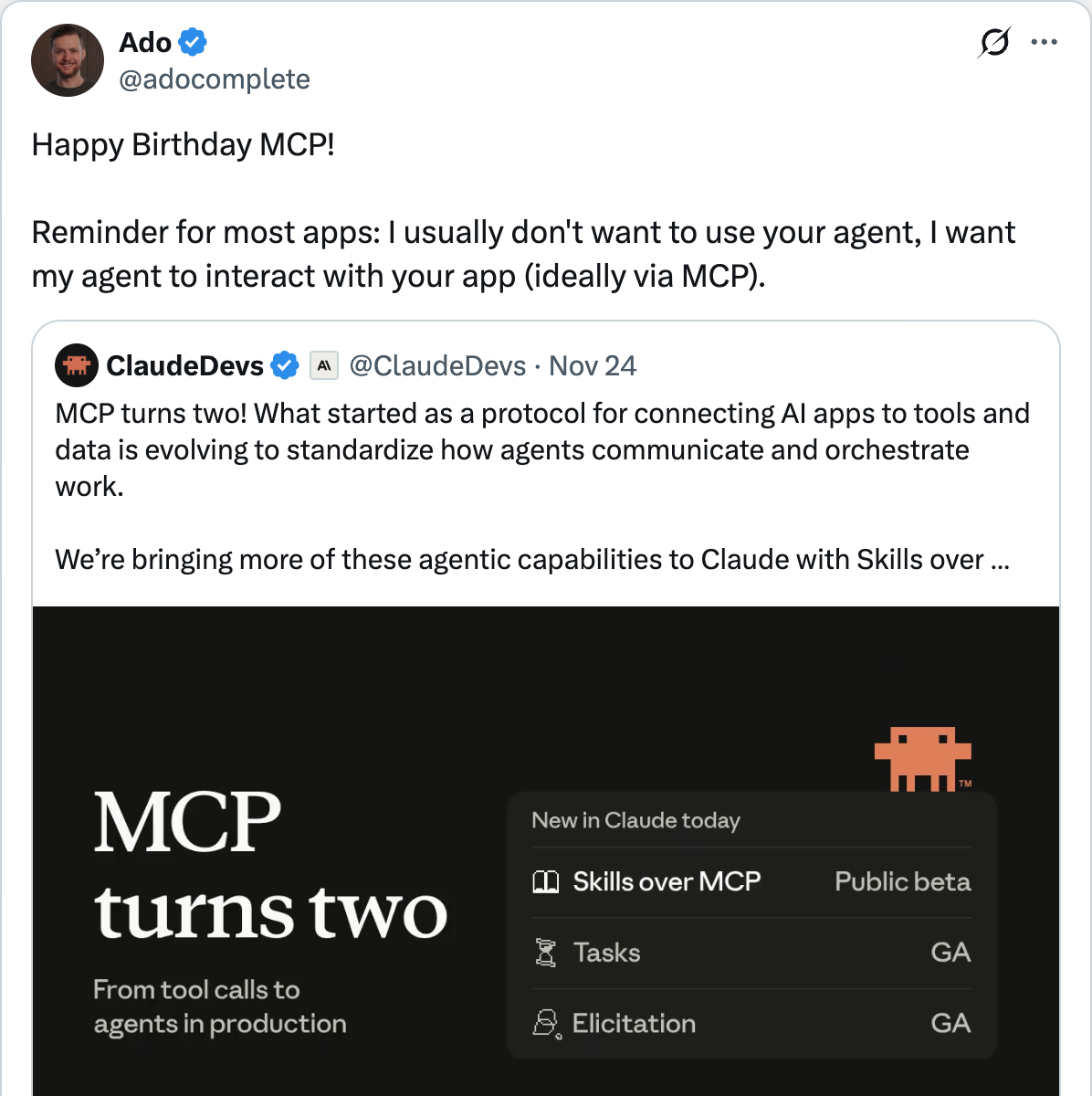
The community response was immediate. Developer Adam DeCosta captured the vibe: “Happy Birthday MCP! …I don’t want to use your agent, I want my agent to interact with your app (ideally via MCP).”
That is four protocol-level upgrades in a single week — the kind of release that makes infrastructure engineers cancel their afternoon. But the most interesting signal from this shipping week didn’t come from Anthropic. It came from a benchmark.
PlivoAI built the same Claude-powered receptionist four different ways — a 5-agent team with a switchboard, a single agent loaded with skills, and two other variants — then graded 672 responses. The skills-based architecture got every answer right on Opus. Perfect score. But callers still sat through 3 seconds of dead air before the agent spoke.
That silence is the gap this article is about. MCP now has the protocol machinery to run background jobs, return durable handles, and stream progress notifications. What it doesn’t have — what nobody ships by default — is an opinion on what the user sees while the work is happening.
What Shipped: The Four-Part Upgrade
MCP November 2026 Release at a Glance
- Skills over MCP — public beta (Pro, Max, Ultra; Team needs admin enable)
- Tasks — GA (durable handles for background work)
- Elicitation — GA (servers can pause and ask for user input)
- File Uploads — experimental, coming soon
- Protocol version: 2026-07-28 | Requires Claude Code v2.1.331+
Skills: The Server Teaches the Model
Before this release, connecting an MCP server to Claude gave the model tools — but no context for how to use them well. A Sentry MCP server could expose get_issues() and create_issue(), but Claude didn’t know Sentry’s conventions, the right query patterns, or the edge cases your team has learned over months.
Skills close that gap. An MCP server can now publish a SKILL.md file (and supporting documents) alongside its tools. When Claude encounters a task that calls for the server’s capabilities, it loads the skill on demand — no eager prefetching, no bloated system prompts. The skill updates with the server, so your instructions stay current without manual intervention.
The technical mechanism is clean: the server declares the resources capability and the io.modelcontextprotocol/skills extension. It implements skills/list and skills/get, then serves its SKILL.md through resources/read. The host verifies each file’s byte size and SHA-256 digest against the manifest before loading anything.
Shopify, HubSpot, and Atlassian are early adopters. The pattern solves a real problem — Armin Ronacher (creator of Flask) documented the pain back in December 2025: MCP tool descriptions are “too short to teach usage well but too long to load eagerly.” He had already moved all his MCPs to skills. Now the protocol catches up.
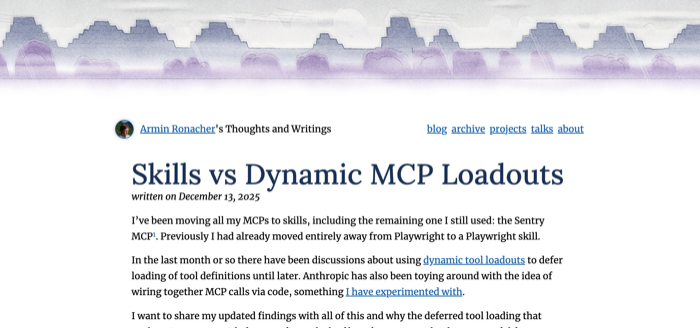
Read Armin Ronacher’s full analysis →
Tasks: Background Work Gets a Handle
Tasks solve the second major pain point: long-running operations. Before this release, an MCP tool call was synchronous — the client waited for the server to return. If your server needed to run a CI pipeline, process a batch, or kick off a research job, the connection sat open, the user stared at nothing, and timeouts were a constant threat.
Now a server can return a durable task handle instead of blocking. The client polls for progress using tasks/get. Tasks carry explicit states — working, input_required, completed, failed, cancelled — so the client always knows where things stand. If the connection drops, the client can reconnect and resume with the same task ID.
This is the right architectural decision. The Agentic AI Foundation’s implementation guide describes it as “the standard way to handle long-running tasks at the protocol level.” ZoomInfo is using it for deeper account research. The pattern maps directly to what enterprises need: batch processing, model training jobs, human-in-the-loop approval workflows.
But notice what Tasks provides and what it doesn’t. Tasks gives you a state machine at the protocol layer. It tells the server how to report progress. It says nothing about what the client does with that information — specifically, what the user sees.
Elicitation: The Server Asks Back
Elicitation lets a server pause mid-operation and request user input through structured forms or URL-based interactions. Supabase uses it to confirm costs before creating paid projects. Railway uses it before destructive changes. GitHub requires it before repository deletion.
The security model is strict: servers cannot use forms to collect passwords, API keys, tokens, or payment credentials. Clients must identify the requesting server and always offer decline and cancel options. This is the trust boundary that File Uploads will eventually extend — keeping file bytes out of model context entirely.
The 3-Second Silence Problem
Here is where the coverage stops and the real issue starts.
PlivoAI’s benchmark didn’t just prove that skills work — it proved that correctness isn’t enough. Their skills-based agent scored 100% on accuracy. It beat the 5-agent swarm architecture. And callers still experienced 3 seconds of dead air between asking a question and hearing a response.
Three seconds doesn’t sound like much. It is enough to make a user assume the system is broken.
Vercel’s Slack Agents Academy quantifies the threshold: users abandon bots that go quiet for 3 or more seconds. Silence reads as failure. The recommendation is to acknowledge every request within about one second and send a progress update every 2-3 seconds during longer work.
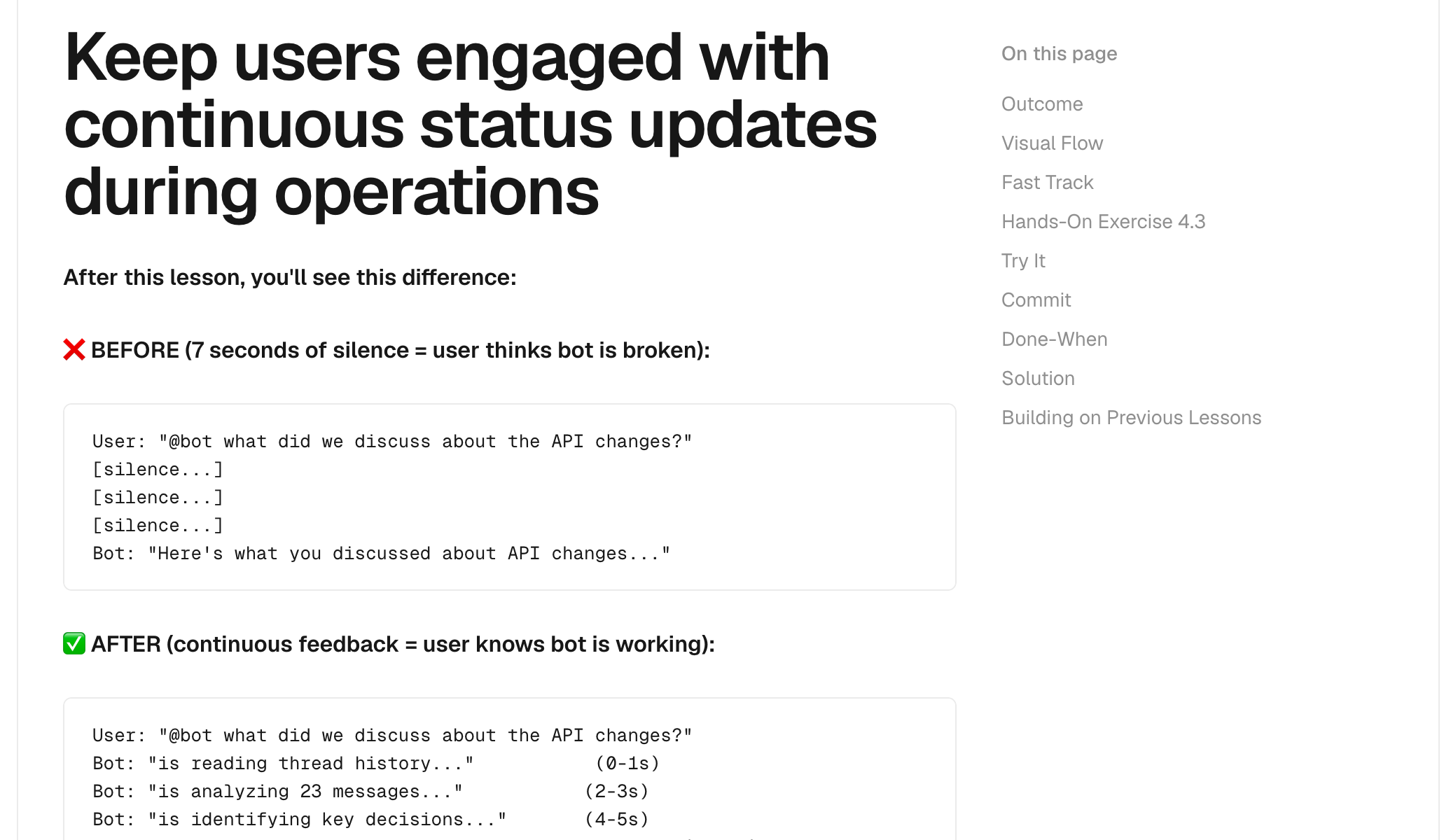
View Vercel’s status communication guide →
The research backs this up across the board:
- A 2026 CHI paper on in-car LLM agents introduced the term “ambiguous silence” — insufficient communication that leaves users uncertain about system progress, undermining trust and perceived responsiveness.
- The agent UX patterns catalog at Inference.sh identifies “Silent Processing” as a named anti-pattern: users assume failure when nothing shows. The proposed fix is explicit status indicators with distinct visuals for each state — thinking, executing, waiting, completed, error.
- A deep analysis of agent loading states defines four latency zones with different UX requirements:
- 0-2 seconds: immediate acknowledgment (disabled button)
- 2-10 seconds: spinner with status label
- 10-60 seconds: continuous visible progress (plan previews, streamed reasoning)
- 60+ seconds: background job with ambient badge and notifications
Contrarian Corner: “Skills Make MCP Obsolete” Is Wrong
Armin Ronacher’s argument that skills replace MCP has been influential in the developer community. He moved all his MCPs to skills and says “if MCP never existed, nobody would invent it today.” But notice what just happened: Anthropic shipped skills over MCP. The two converged, not diverged.
Skills are instructions — they teach how to use capabilities. MCP is plumbing — it provides those capabilities. The relationship is the same as a README to an API. You need both. The fact that skills now travel with their MCP server is a sign of maturity, not replacement.
The real question isn’t which to choose. It’s what happens between the protocol layer (where MCP Tasks returns a handle) and the user layer (where a human sits in silence).
The Gap Nobody Ships
MCP Tasks gives you a state machine. The task is working. Then it is completed. What does the user see in between?
The protocol’s progress notifications can stream status messages during a run. But translating “the server sent a progress notification” into “the user sees meaningful feedback” is entirely a client-side problem. And most clients solve it badly or not at all.
Towards AI documents the core limitation: streaming helps during text generation but does nothing during tool calls or API waits. When an agent is executing a function, calling an API, or waiting on a background task, the streaming channel goes quiet. That is precisely when the user needs reassurance most.
Smashing Magazine’s 2026 guide on AI transparency proposes the fix: a dynamic checklist of planned steps instead of a spinner. The pattern shows users where the agent is in its plan, what step just completed, and what comes next. This is vastly more informative than a generic “thinking…” indicator and doesn’t require the agent to be generating text.
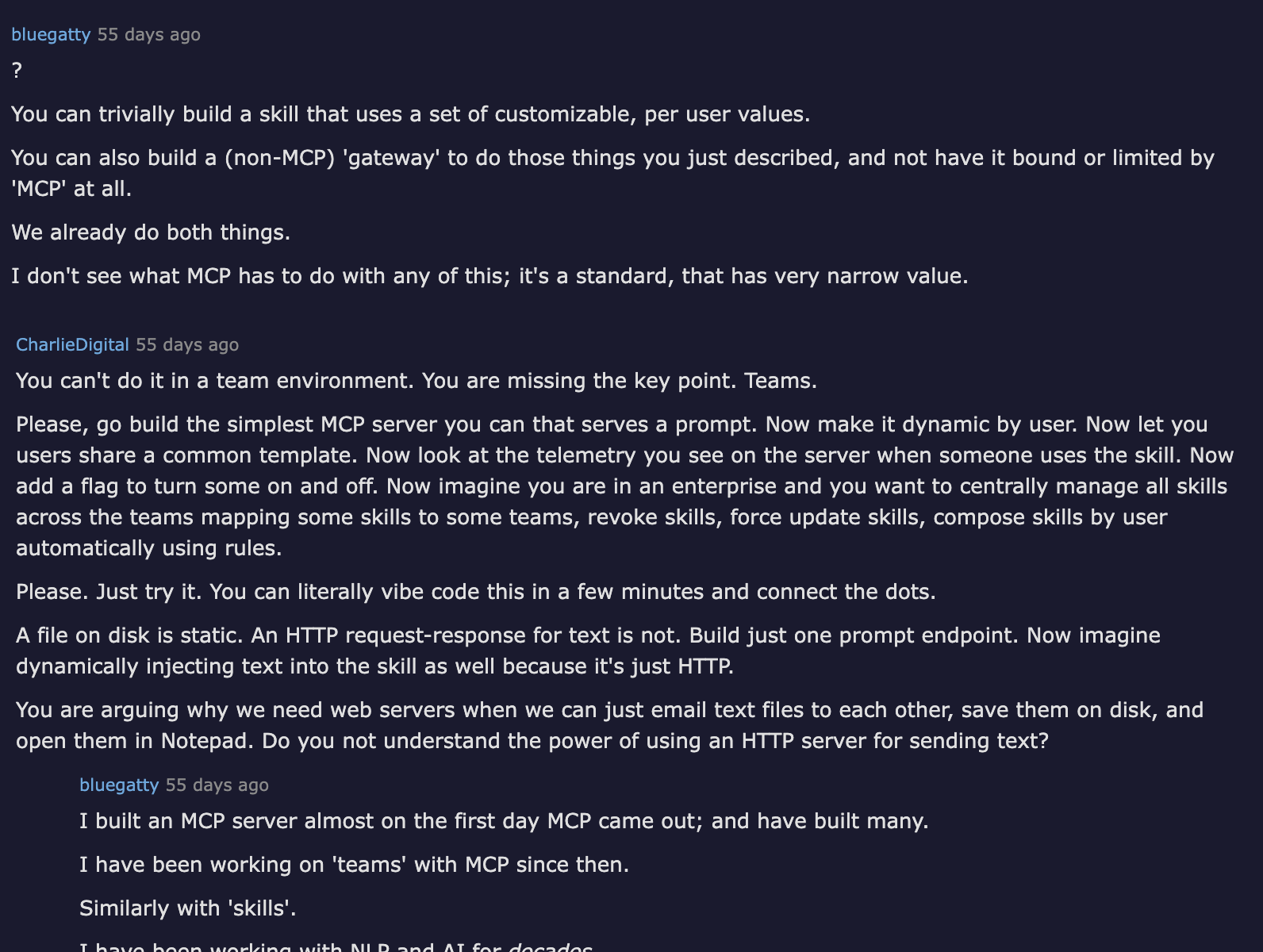
The HN community has been debating this exact tension. In one thread on skills vs. MCP, commenters split between “MCP has very narrow value” (the static-files-are-enough camp) and “you can’t do it in a team environment” (the enterprise-needs-HTTP camp). But both sides are arguing about the plumbing. Neither is talking about what the user sees while the plumbing works.
What This Means for You
If you are an MCP server author, a team building agent-powered features, or a founder shipping an agent product, here is what to do with this release.
1. Bundle Skills With Your MCP Server
This is the highest-ROI action from the November release. If you maintain an MCP server, add a SKILL.md that teaches the model:
- When to use each tool (and when not to)
- Common query patterns and expected results
- Edge cases your users have reported
- Authentication and permission requirements
The technical setup is straightforward: declare the resources capability, implement skills/list and skills/get, serve your files through resources/read. The AgentConn skills marketplace coverage tracks which ecosystems are adopting fastest.
2. Use Tasks for Anything Over 10 Seconds
If your server does work that takes more than 10 seconds, return a task handle instead of blocking. Implement the full state machine: working with progress messages, input_required for human-in-the-loop approval, completed with results, failed with actionable error messages, cancelled for user-initiated stops.
The pattern connects to AgentConn’s earlier coverage of idle-time billing and durable execution — agents that block during long operations waste compute and money. Tasks are the protocol-level fix.
3. Build a Status Layer Between MCP and Your UI
This is the action item nobody is talking about. MCP Tasks gives you states. Your UI needs to translate those states into human-readable, trust-maintaining feedback. Here is the minimum pattern:
On task creation: Immediately show “Starting [task name]…” with a contextual icon.
Every 2-3 seconds during working: Show a specific status message. Not “thinking” — something like “Analyzing 23 customer records” or “Running CI pipeline (step 3 of 7).” Vercel’s guidance is to use present-continuous phrasing in 10-40 characters.
On input_required: Show a clear prompt with the server identified and decline/cancel always available.
On completed or failed: Show the result or error immediately with an actionable next step.
The key insight from the agent loading state research is that plan previews are the highest-leverage fix. If the agent can tell the user “I’m going to do X, then Y, then Z” before starting, every subsequent status update lands in a frame the user already understands. Without that frame, each status message is a surprise.
The Status Layer Pattern
- Acknowledge within 1 second (confirms receipt)
- Plan preview within 2-3 seconds (sets expectations)
- Step-level updates every 2-3 seconds during execution (maintains trust)
- Interim results as they are available (rewards waiting)
- Completion with summary and next action (closes the loop)
This pattern works for chat agents, voice agents, and background tasks alike. The timing numbers come from Vercel’s Slack agent academy and are consistent with CHI research on agent trust.
4. Audit Your Skills Supply Chain
The AgentConn investigation into skills security found that 36% of agent skills had security flaws. MCP’s new approval model — SHA-256 verification, manifest comparison, host-level gating — is a step forward. But skills from third-party MCP servers are still untrusted code that runs with your agent’s permissions. Treat them like dependencies: pin versions, verify digests, review changes.
The Bigger Picture
The broader MCP roadmap debate has been lively. A 270-point HN thread on the roadmap drew 161 comments, with top reactions calling the original stateful protocol design “bone-headed” and welcoming the stateless shift.
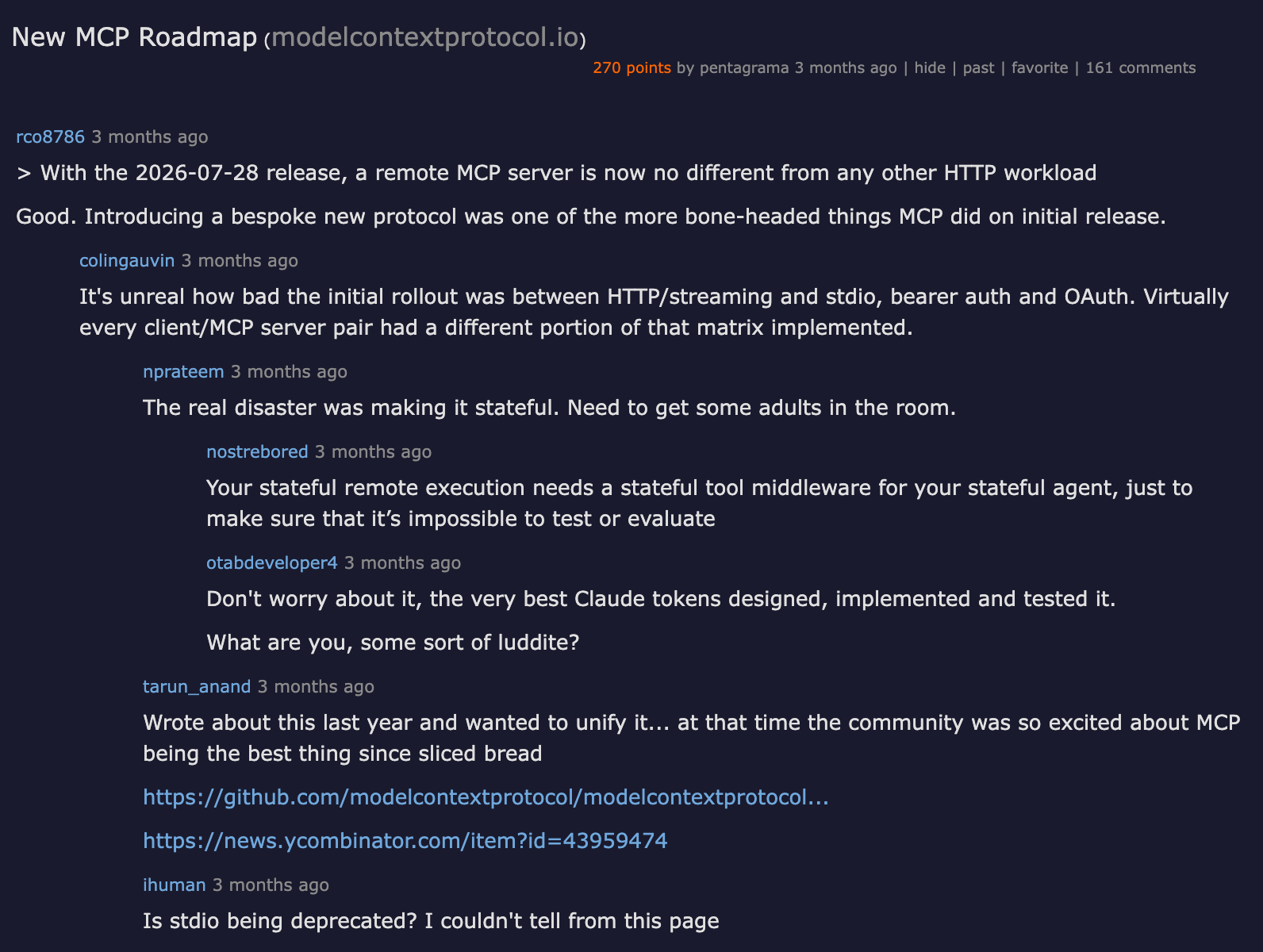
Two years into MCP, the protocol is settling into its adult shape. The July 2026 revision made MCP stateless at the transport layer — no more session IDs, no initialize handshake. Tasks and Elicitation moved to extensions. Skills got their own specification (SEP-2640). The donation to the Agentic AI Foundation means governance has shifted from Anthropic alone to a broader coalition.
The protocol is no longer just a tool connector. It is becoming an agent coordination layer — one where servers teach models how to use them, background work gets first-class status, and human input can be solicited mid-task. The skills-as-dotfiles movement is now backed by protocol-level infrastructure.
What is missing is the last mile. The gap between “the protocol supports progress notifications” and “the user trusts the agent” is a product problem, not a protocol problem. And it is the problem that separates agents people use from agents people abandon after one try.
Anthropic shipped 700 million monthly SDK downloads’ worth of plumbing this week. The 3-second silence gap is the product work that turns that plumbing into products people keep.