Field report · · AgentConn Team
mattpocock/skills vs Composio: Skill Directory Race
Two skill directories landed within 24h — one for Claude, one for Codex. Which one to publish into, and why the cross-vendor index is the real prize.
mattpocock/skills vs ComposioHQ/awesome-codex-skills: The Cross-Vendor Skill Directory Race Is Live
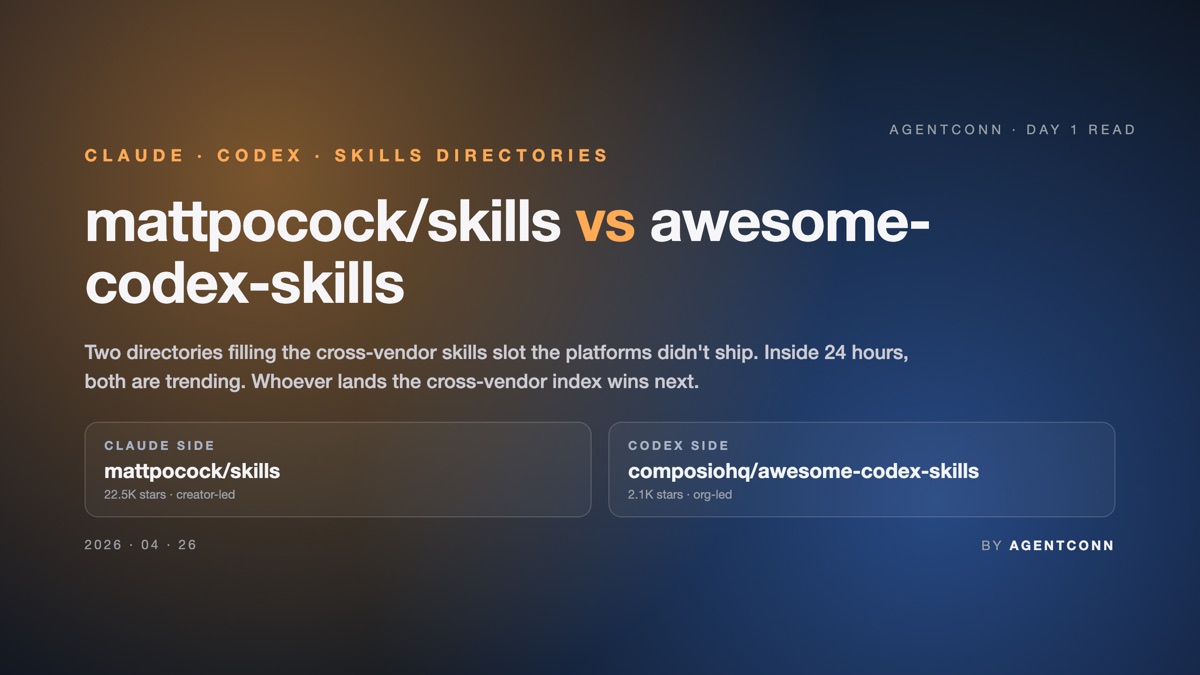
In the last 48 hours, two GitHub repositories tripped the same trending threshold for the same reason: developers needed a curated index of agent skills — runtime-loadable instruction bundles that extend a coding agent’s capabilities — and neither OpenAI nor Anthropic shipped a first-party one.
mattpocock/skills is the canonical Claude Code answer, sitting at 24.5K stars after a +2,507-star day-over-day spike that tripled prior momentum. ComposioHQ/awesome-codex-skills entered GitHub trending as a NEW ENTRANT at 2.1K stars on April 26 — exactly 24 hours after OpenAI confirmed there’s no GPT-5.5-Codex model and that the Codex CLI now runs on the unified frontier model.
If you’re building agent skills right now, you have a publishing decision to make. If you’re picking a platform for your team, you have an ecosystem-bet decision to make. This is the side-by-side that should drive both.
What Each Directory Actually Is
The two repositories share an architectural pattern (curated SKILL.md bundles with metadata + step-by-step instructions, installable into a coding agent’s runtime) but differ on every other dimension worth comparing.
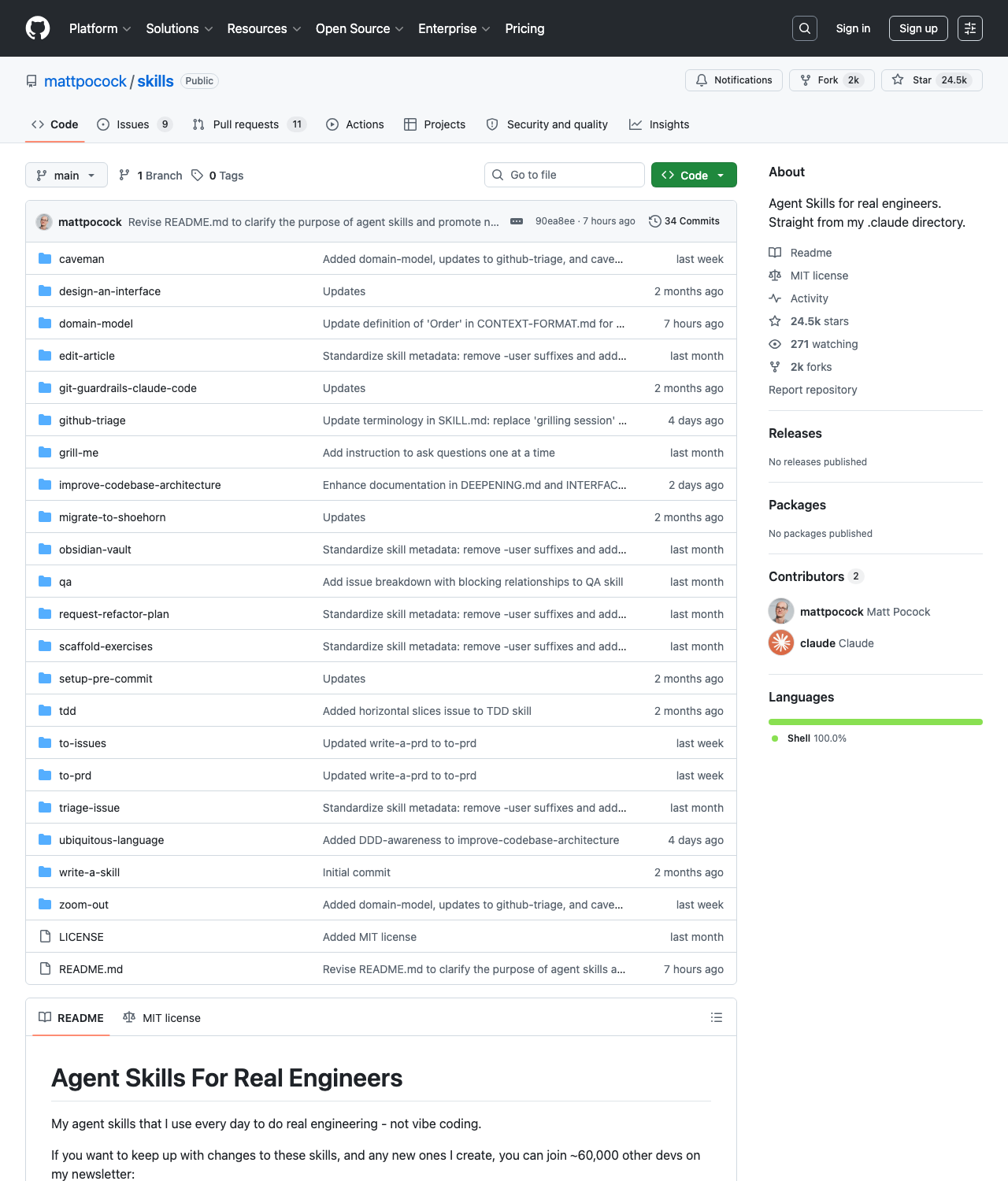
mattpocock/skills — Claude Code, creator-led
Matt Pocock — the TypeScript educator behind Total TypeScript — open-sourced his personal .claude/ directory as a public asset. The framing on the repo is direct: “Agent Skills for real engineers. Straight from my .claude directory.”
The directory currently spans five domains: Planning & Design, Development, Tooling & Setup, Writing & Knowledge, and Quality Assurance. Representative skills include:
to-prd— converts conversation context into a product requirements doc submitted as a GitHub issuetdd— implements test-driven development with red/green/refactor cyclesgrill-me— interviews you about a plan until every decision branch is resolvedimprove-codebase-architecture— identifies architectural improvements using domain language and decision recordssetup-pre-commit— configures Husky hooks with linting, formatting, type checking, and tests
Installation is one-liner ergonomics: npx skills@latest add mattpocock/skills/<skill-name>. The repo is MIT-licensed; activity shows 34 commits on main, 9 open issues, 11 open PRs, and 2K forks — enough to indicate a healthy contributor pipeline forming around what was originally one engineer’s personal workspace.
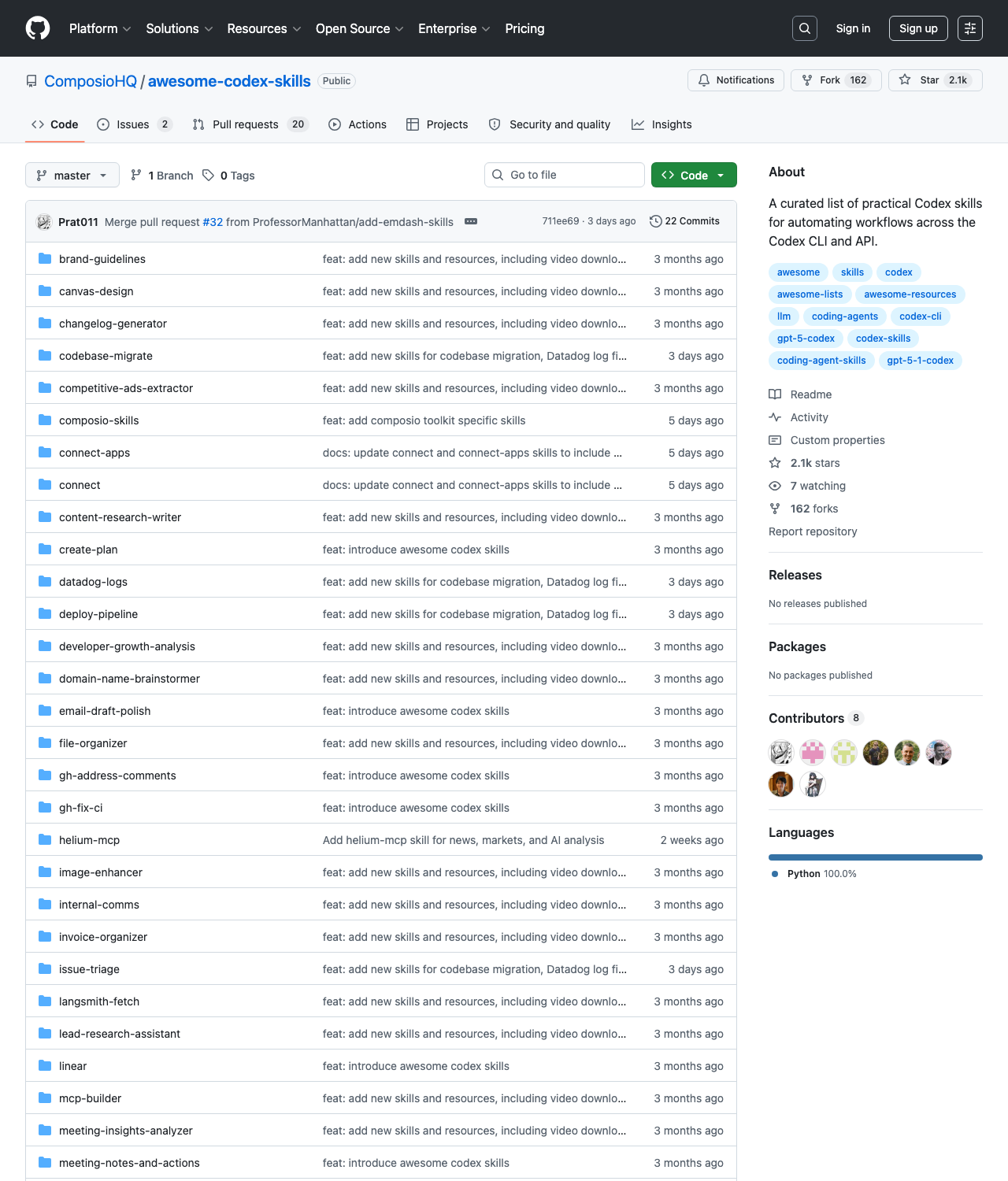
ComposioHQ/awesome-codex-skills — OpenAI Codex, organization-led
Composio is the tool-integration platform with 1,000+ pre-built integrations that already plays the agent-tooling layer for many production stacks. Their move on April 26 was to stake the Codex skills slot before OpenAI ships an official one.
The repo describes itself as “a curated list of practical Codex skills for automating workflows across the Codex CLI and API” and emphasizes that “Codex can send emails, create issues, post to Slack, and take actions across 1000+ apps.” That last claim is not coincidence — it’s positioning the directory as the front door to Composio’s existing tool catalog.
Composio’s own “Top 10 Codex Skills” article names the skills they’re highlighting:
- composio connect — “connects Codex to external apps so it can take real actions across your workflow”
- webapp-testing — testing real browser user flows before deployment
- mcp-builder — structured construction and assessment of MCP servers
- gh-fix-ci — inspect failing GitHub Actions, summarize failures, propose fixes
- notion-spec-to-implementation — turns rough docs into actionable roadmaps
- security-threat-model — generates repo-specific threat models
- frontend-skill — improves UI quality beyond default AI-generated component output
- create-plan — establishes structured execution blueprints before coding
- cli-creator — turns repetitive commands into reusable CLI tools
- stop-slop — strips recognizable AI writing patterns from prose
Activity snapshot: 161 forks, 20 open PRs in the first day. A category that did not exist on Tuesday now has a credible curation candidate by Saturday.
The Side-By-Side That Matters
| Dimension | mattpocock/skills | ComposioHQ/awesome-codex-skills |
|---|---|---|
| Target agent | Claude Code | OpenAI Codex (CLI + API) |
| Stewardship | Solo creator (Matt Pocock) | Organization (Composio team) |
| Stars (Apr 26) | 24.5K (+2,507/day) | 2.1K (+518/day, NEW ENTRANT) |
| Skill style | Personal workflow → public artifact | Tool-integration-first, multi-app |
| Install path | npx skills@latest add mattpocock/skills/<name> | Repo-curated list; install per-skill |
| Strongest in | Planning, TDD, code architecture | Real-world tool actions (GH, Slack, Notion, browser) |
| License | MIT | Open source, see repo |
| Commercial gravity | None — personal project | Funnels into Composio’s 1,000+ integration catalog |
| Cross-vendor support | Claude Code only | Codex-first; pattern is portable |
| Contributor surface | 11 open PRs, 9 open issues | 20 open PRs, 2 open issues |
The most important row is the second one. Stewardship determines durability. A solo-creator directory like mattpocock/skills depends on one person’s continued attention; an org-backed directory like awesome-codex-skills depends on a company’s strategic priorities. Both have a half-life — but they fail differently.
What The Race Looks Like From The Builder’s Side
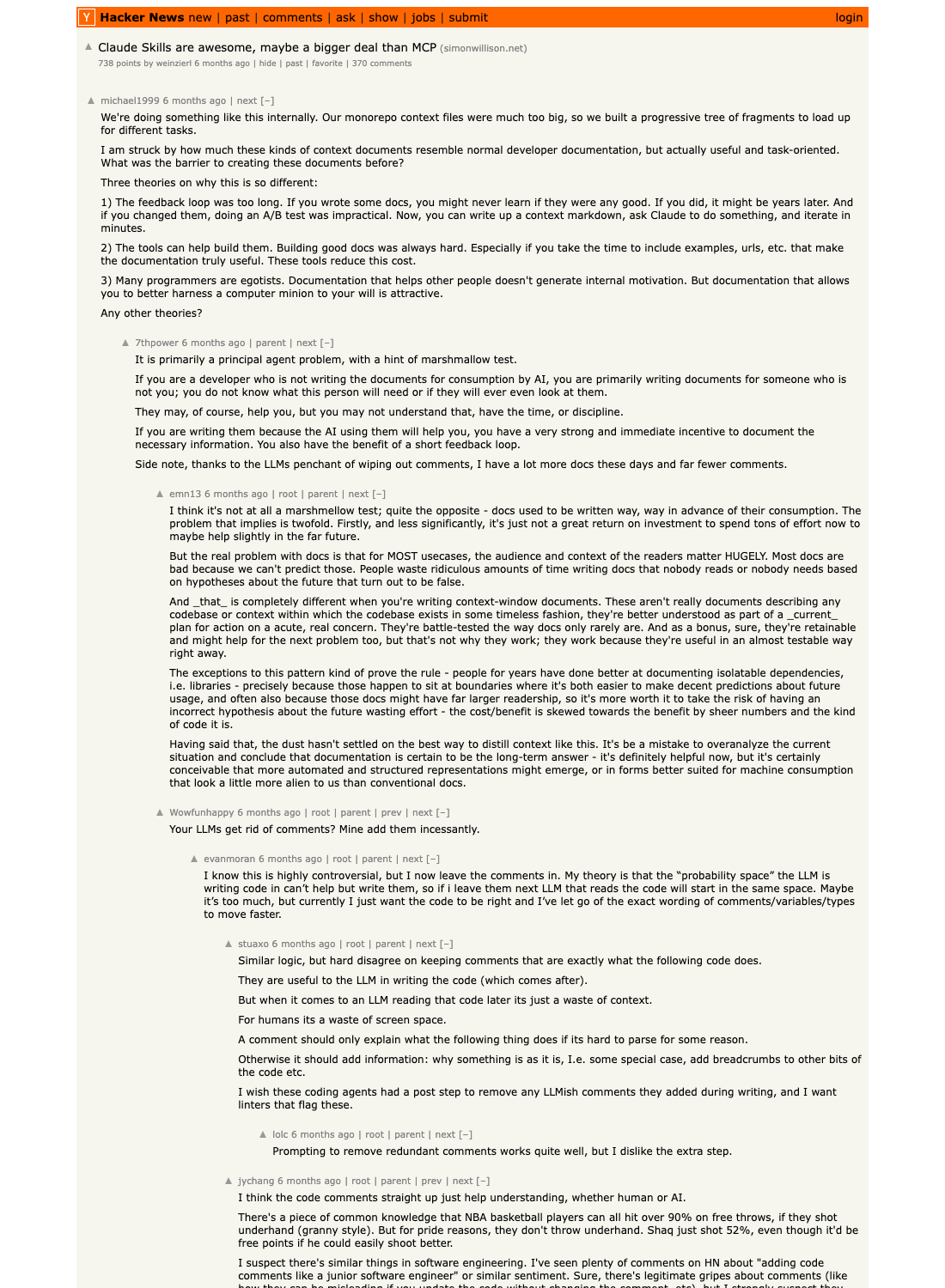
The HN community has been working through the implications of the skills pattern for months. The thread “Claude Skills are awesome, maybe a bigger deal than MCP” surfaced one of the sharper takes — that runtime-loaded skills are doing what MCP promised but with much lower setup friction:
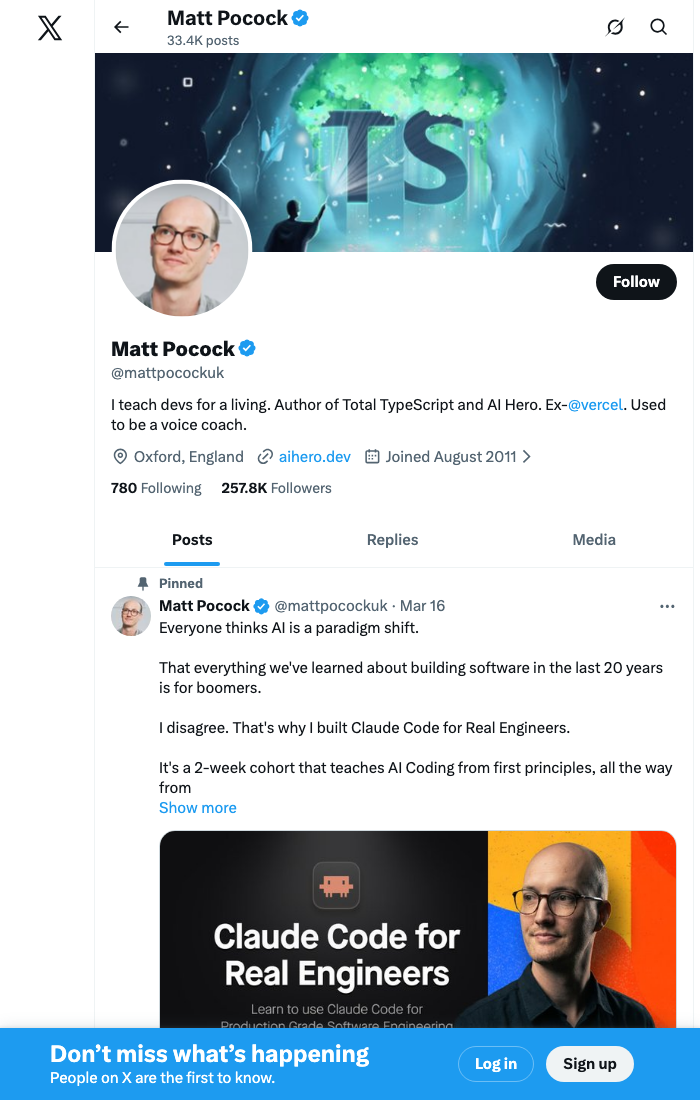
The April-25 Matt Pocock signal that pushed the directory into mainstream developer-Twitter is a single profile post — “Everyone thinks AI is a paradigm shift. That meaning we’re learned about building software in the last 20 years is for boomers.” — paired with the public release of the skill directory:
Show-HN-style entries like “Show HN: Agent Skills – 1k curated Claude Code skills from 60k+ GitHub skills” tell you the curation problem is already too big for any one person — even Matt Pocock’s directory is a hand-picked 21 skills, not a comprehensive index:

The submitter’s framing is the one that matters: “There are tons of skills in every industry and the ecosystem is noisy, so I’m trying to filter out the low-quality ones and highlight the practical ones that solve real problems.” That’s the curation thesis in plain English. Two top-trending repos and at least one third-party search engine (agent-skills.cc) are converging on the same gap.
The original “Claude Skills” thread on HN — back when this was still a small architectural choice rather than a category — reads like a different era now:
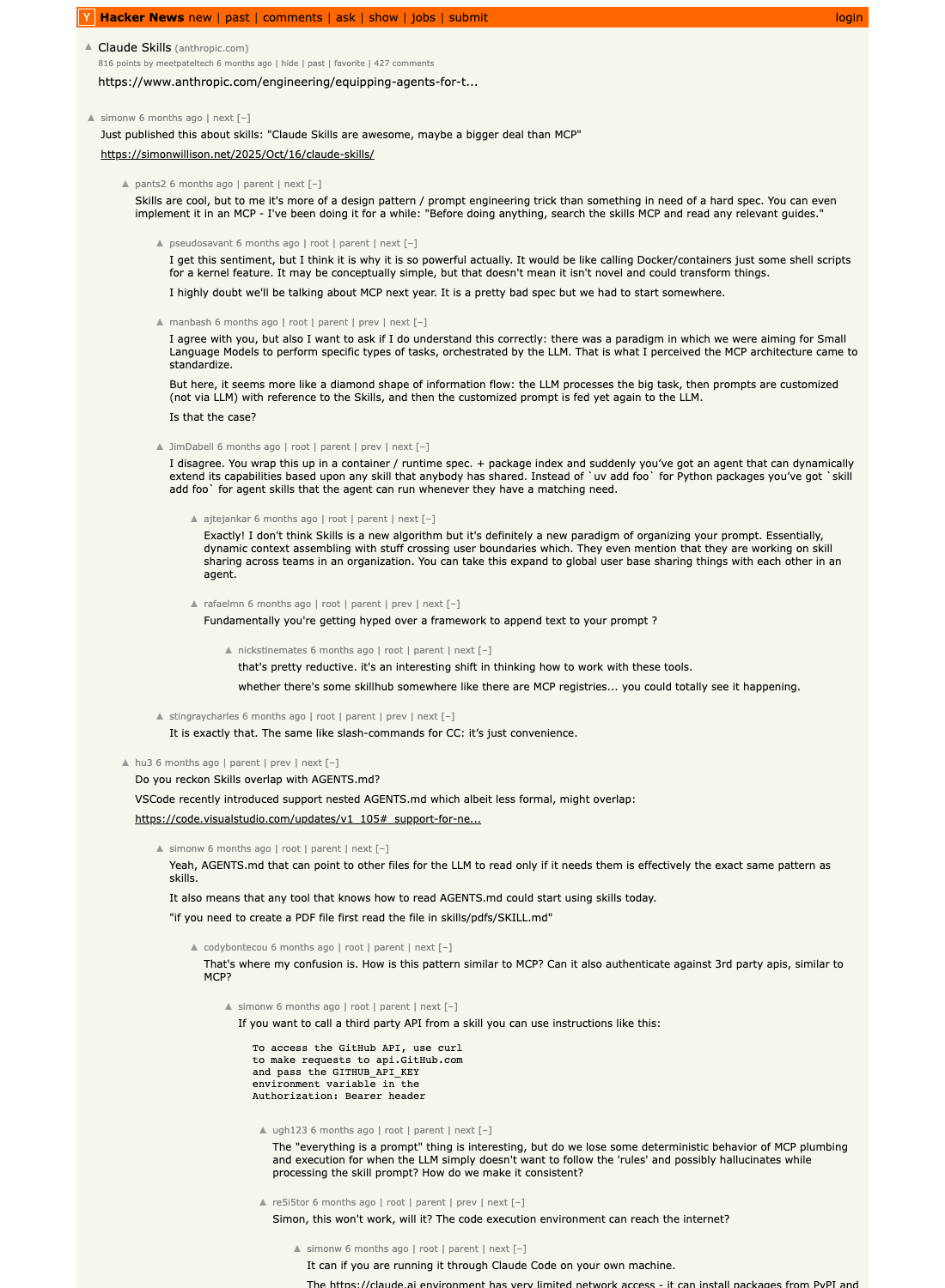
The thread’s tone is exploratory — engineers were trying to figure out what skills were for. Six months later, the answer is “they’re personal IP, organizational IP, and platform-curation surface — all at once.”
Which Directory Should You Publish Into?
If you’ve written or are about to write a skill, the publishing decision splits along three axes.
Axis 1: Which agent does the skill target? mattpocock/skills if you wrote a Claude Code skill. ComposioHQ/awesome-codex-skills if you wrote an OpenAI Codex skill. There is no cross-vendor option yet — and that is precisely the gap a third entrant could fill.
Axis 2: Is the skill a workflow pattern or a tool integration? Workflow patterns (TDD loops, planning, architecture review, prose cleanup) align with mattpocock/skills’ editorial style. Tool integrations that hit external APIs (GitHub, Slack, Notion, browser flows) align with awesome-codex-skills’ Composio-flavored framing.
Axis 3: Are you optimizing for personal recognition or organizational adoption? mattpocock/skills tends to feature individual creators by name. awesome-codex-skills tends to highlight skills that produce business outcomes. If your skill is a personal craft artifact, lean Pocock; if it’s a productivity wedge for a team, lean Composio.
A non-trivial fraction of skills will fit both; in that case, publish to both. The directories aren’t competitive from the contributor’s side — they cover different platforms and overlap is welcomed by both maintainers (no exclusivity clauses anywhere).
Which Platform Should You Build On?
The platform-bet question is harder. Here’s the honest read.
If you’re already on Claude Code: mattpocock/skills proves the runtime-skill pattern is mature enough to lean on. The community is bigger, the install ergonomics are smoother (npx skills@latest), and the directory has had a few months of shaking-out. The risk is single-creator dependency, mitigated by Matt’s high public profile.
If you’re on OpenAI Codex: awesome-codex-skills is the credible directory but it’s one day old on the trending board. Treat it as a leading indicator, not a settled standard. OpenAI may ship a first-party directory in the next four weeks (typical platform response when a third party stakes an unowned slot), in which case Composio either gets acquired, partners, or competes head-on. Build skills that travel — keep the SKILL.md format vendor-neutral so you can republish either way.
If you haven’t picked a platform yet: the existence of two directories filling the same architectural slot in the same week is itself the read. The platform fight is not “which model is best” — model quality is converging fast — but “which ecosystem layer is most defensible.” Skills directories are the first place builders look. The platform that owns the directory wins the network effect.
The Real Race: Cross-Vendor Index
Both current directories are vendor-locked. mattpocock/skills doesn’t host Codex skills; awesome-codex-skills doesn’t host Claude skills. There is no shared install path, no shared metadata schema, no shared search.
The next entrant — and based on the HN curation projects already taking shape, this is months away, not years — is the cross-vendor skills index. The directory that aggregates across Claude Code, Codex, Gemini CLI, Cursor, and whatever ships next. Whoever builds that wins a meta-tool position no first-party platform can credibly claim. (Each platform is incentivized toward lock-in; cross-vendor curation has to come from outside.)
Watch projects like VoltAgent/awesome-agent-skills (1,000+ skills compatible with Claude Code, Codex, Gemini CLI, Cursor) and agent-skills.cc — they’re early candidates. The three things to look for in the winner: open submission, vendor-neutral metadata schema, and a search experience that beats GitHub’s repo search by enough to matter.
What This Means For AgentConn Builders
Concretely, three actions for the team:
- If you’ve shipped a skill to date, list it on the directory matching its target agent. Don’t wait for a cross-vendor index — first-mover position in the existing two directories is the highest-leverage week of the year.
- Keep your SKILL.md format vendor-neutral. When the cross-vendor index lands, you want zero rewriting work. Use generic metadata fields (name, description, inputs, outputs, dependencies) rather than agent-specific YAML keys.
- If you’re considering building the cross-vendor index yourself, the slot is open. It’s likely a 4–8 week build for a credible v1. The hard part is moderation and vendor-relationship management, not search.
The skills-directory race is not a Claude-vs-Codex story. It’s an ecosystem-curation story playing out across both platforms simultaneously. The winners — at the directory layer and at the skill-author layer — will be visible by the next GitHub trending board for self-evolving and skill-loading agents. Builders who publish this week have a structural edge over builders who wait.
Two directories. One unowned cross-vendor slot. The race is live.