Field report · · AgentConn Team
The Orchestration Moat Is Dead. Google's AX Proves It.
Every cloud now ships an agent framework. AX shows the real moat moved from orchestration to workflows, data, and trust.
The Orchestration Moat Is Dead. Google’s AX Proves It.

Google’s Agent Executor — AX — hit #1 on Hacker News on September 21, 2026 with 637 points and 293 comments. On the same day, BuilderIO/agent-native gained 607 stars on GitHub, and agent-substrate — the Kubernetes layer underneath AX — added 438 more. Three agent-infrastructure projects trending simultaneously, from three different organizations, all converging on the same architectural thesis.
That thesis is simple, and it should alarm anyone who thought building an orchestration layer was a defensible business: the orchestration layer is now commodity infrastructure. Every major cloud provider ships one. They all look the same. And the real moat has moved somewhere else entirely.
The Convergence in One Sentence: AWS has Bedrock AgentCore + Strands. Microsoft has Agent Framework 1.0 (Semantic Kernel + AutoGen merger). Google has AX + ADK + Agent Substrate. OpenAI has the Agents SDK. They all ship sandbox isolation, durable execution, MCP/A2A gateways, and observability. The differences are cosmetic.
What AX Actually Is (And What It Isn’t)
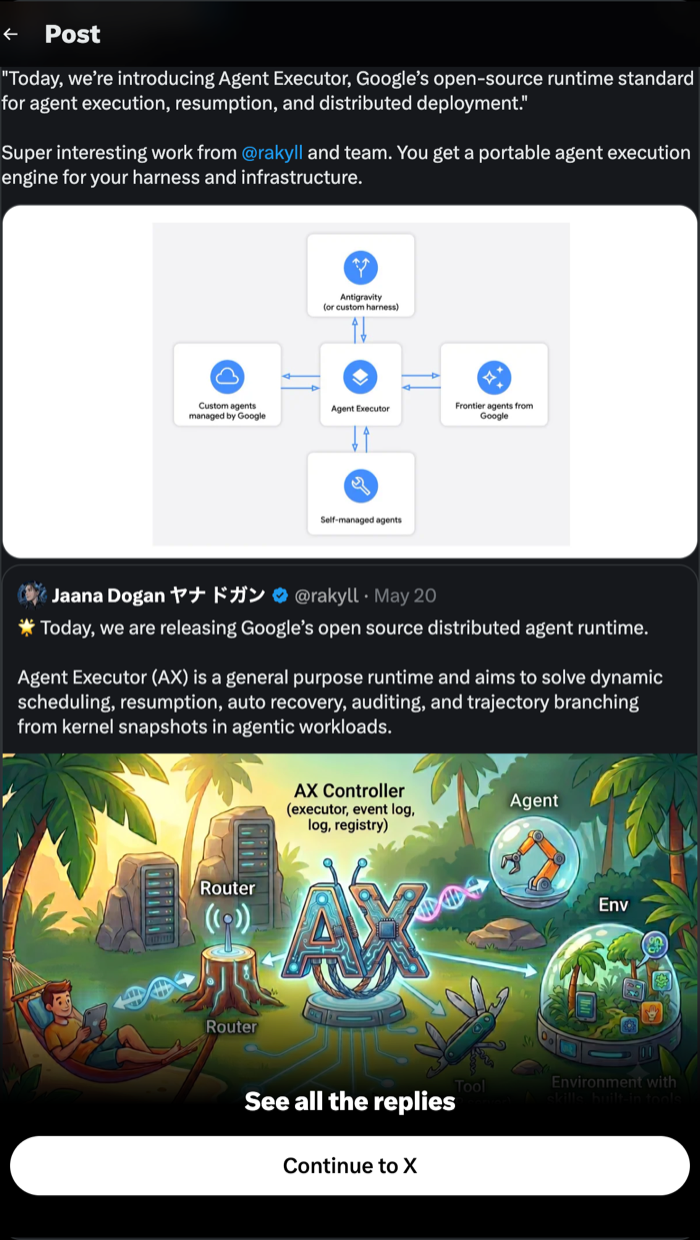
AX is not a framework for writing agents. Google’s official blog post and the GitHub README are explicit: AX is “not a managed service, not an agentic framework, not a specific harness.” It is a distributed agent runtime — a serving layer that sits beneath your harness, whatever that harness may be.
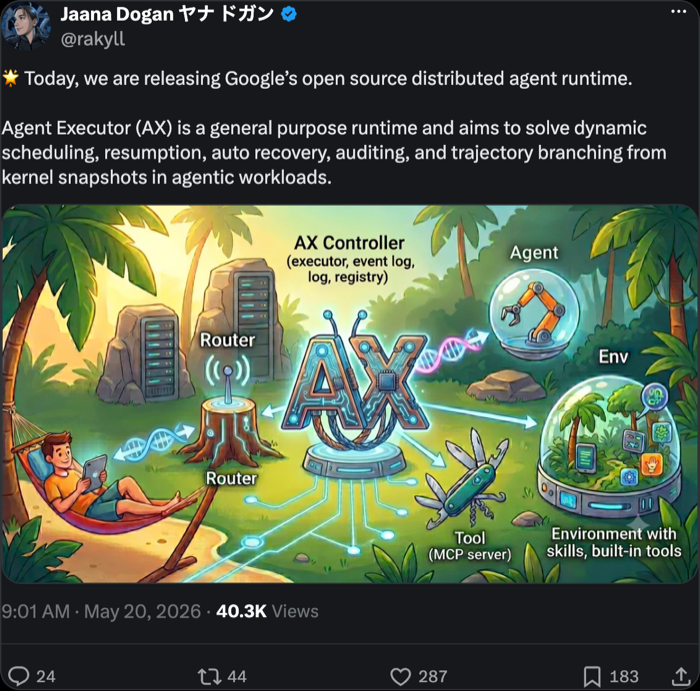
Written in Go and licensed Apache 2.0, AX provides four primitives:
- Task — Executes untrusted agent code in isolated sandboxes with CPU/memory constraints
- Workspace — Pre-configures Git repos, MCP servers, and skill packages for warm starts
- Gateway — Restricts outbound traffic to an explicit allowlist of permitted hosts
- Model — Manages LLM configuration and credential injection via Kubernetes secrets
The key insight is what AX solves: agents are neither stateless microservices nor batch jobs. They accumulate state, require isolation, consume resources wastefully when idle (agents spend over 90% of their lifespan waiting on model completions, tool calls, or human reviews), and need to resume after failures. Standard Kubernetes was built for thousands of long-running services, but agents create millions of sub-second tool calls that overwhelm traditional control planes.
This is where Agent Substrate enters — Google’s open-source layer that introduces new primitives to Kubernetes for session-tenant, stateful, resumable, and sandboxed execution. The stated goal: fit 10-20x more sandboxes into existing infrastructure and handle 100+ million agents per cluster.
If you’ve used Kubernetes, AX will feel familiar. It uses a kubectl-like CLI (ax apply, ax get, ax describe, ax ssh) and declarative YAML manifests. The orchestrator itself is stateless — state lives in Redis, Postgres, or GCS, making horizontal scaling straightforward.
The Kubernetes Play, Revisited
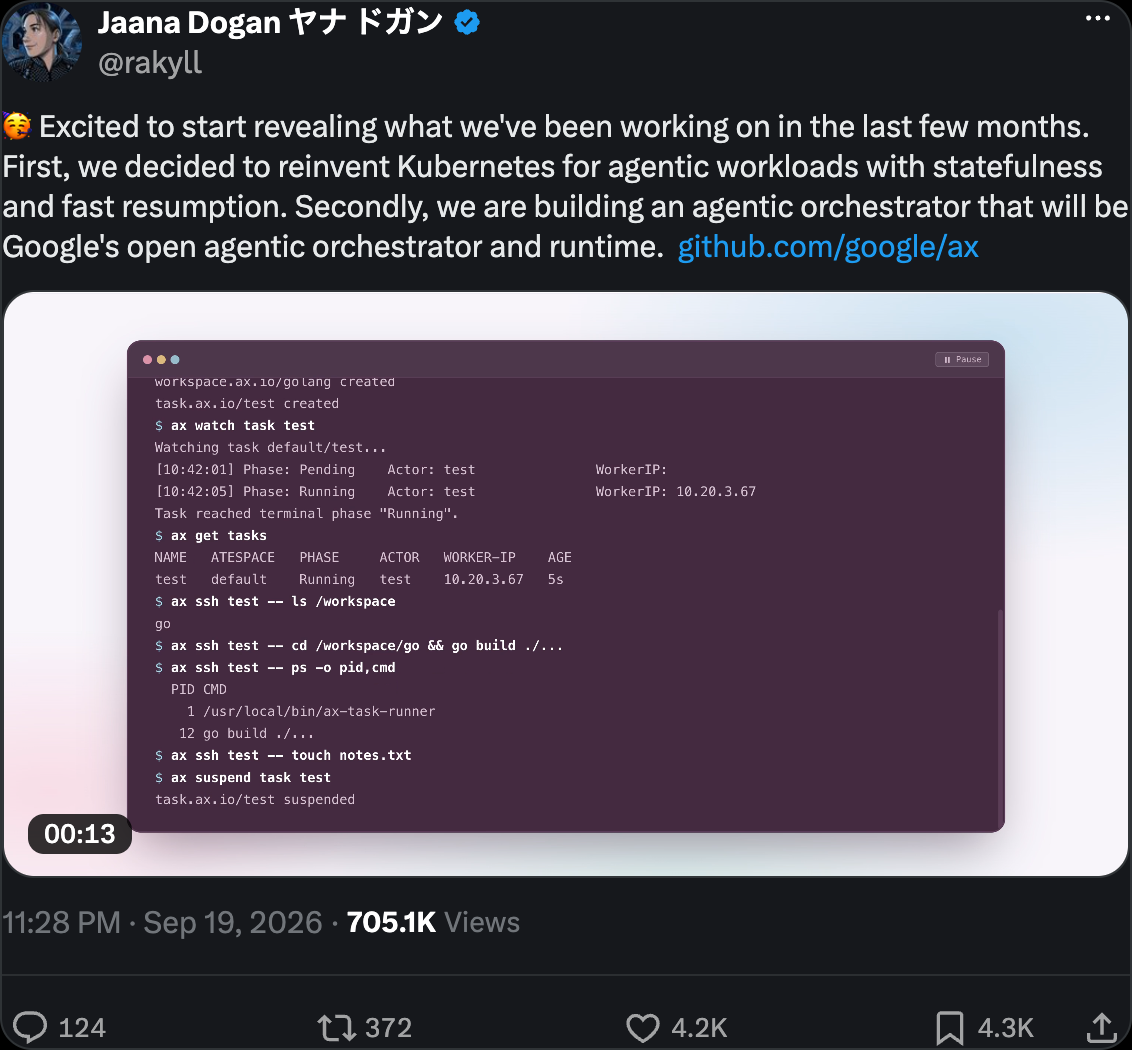
This is the move Google has made before: own the scheduling and compute substrate, let everyone else build on top. Kubernetes didn’t win because it was the best container orchestrator (early Kubernetes was infamously complex). It won because Google positioned it as the neutral ground — the layer every cloud vendor could adopt, and every tool vendor could target.
AX is the same bet, applied to agents. Jaana Dogan, the lead engineer, said it plainly: “We decided to reinvent Kubernetes for agentic workloads with statefulness and fast resumption.” And in a remarkably candid moment, she also revealed that when she gave Claude Code a description of the problem, it generated what Google’s team had built over the past year — in an hour. The orchestration layer itself is not the hard part. The infrastructure decisions underneath it are.
Why this matters for agent builders: AX is harness-agnostic. It works with LangChain/LangGraph, ADK, A2A protocol agents, and custom harnesses. If Google succeeds in making AX the Kubernetes-of-agents, your choice of framework becomes less important than your choice of runtime — exactly as container orchestration made your choice of PaaS less important than your deployment topology.
Every Cloud Now Ships the Same Thing
Let’s be honest about what happened in the last twelve months. Within a single year, every major cloud provider shipped an agent orchestration layer. And they all converged on the same architecture:
| Capability | AWS (AgentCore) | Microsoft (Agent Framework 1.0) | Google (AX + Substrate) | OpenAI (Agents SDK) |
|---|---|---|---|---|
| Sandbox Isolation | Bedrock Runtime | Foundry Hosted Agents | Agent Substrate | Managed Agents |
| Durable Execution | AgentCore Runtime | Semantic Kernel persistence | AX event log + snapshots | Agent lifecycle hooks |
| Framework-Agnostic | LangGraph, CrewAI, Strands | SK, AutoGen (merged), any | LangChain, ADK, any harness | OpenAI-native, multi-LLM |
| Protocol Support | MCP, A2A | MCP, A2A | MCP, A2A | MCP |
| Observability | CloudWatch + AgentCore traces | Azure Monitor + Agent telemetry | Cloud Trace + AX audit log | Traces API |
As The New Stack reported: “Runtime, memory, tool gateway, identity, observability, and governance now appear in Amazon Bedrock AgentCore, Microsoft Foundry, and the Gemini Enterprise Agent Platform, albeit under slightly different names.”
The convergence is so complete that Microsoft’s April 2026 merger of Semantic Kernel and AutoGen into a unified Agent Framework 1.0 reads less like product innovation and more like “we realized everyone is building the same thing, so we’d better consolidate our two competing versions into one.”
AWS, characteristically, took a different posture: instead of building yet another framework, Bedrock AgentCore positions itself as the framework-agnostic runtime. Deploy LangGraph agents, CrewAI agents, Google ADK agents, or Strands agents — AgentCore doesn’t care. It’s infrastructure, not opinion.
Sound familiar? That’s because it’s the same argument AX is making. Google and AWS are racing to be the neutral substrate. Microsoft is betting the integrated stack wins. And the startup frameworks — LangGraph, CrewAI, and others — are caught in the middle, watching their orchestration-layer value proposition dissolve into free, open-source cloud primitives.
What the Community Is Saying
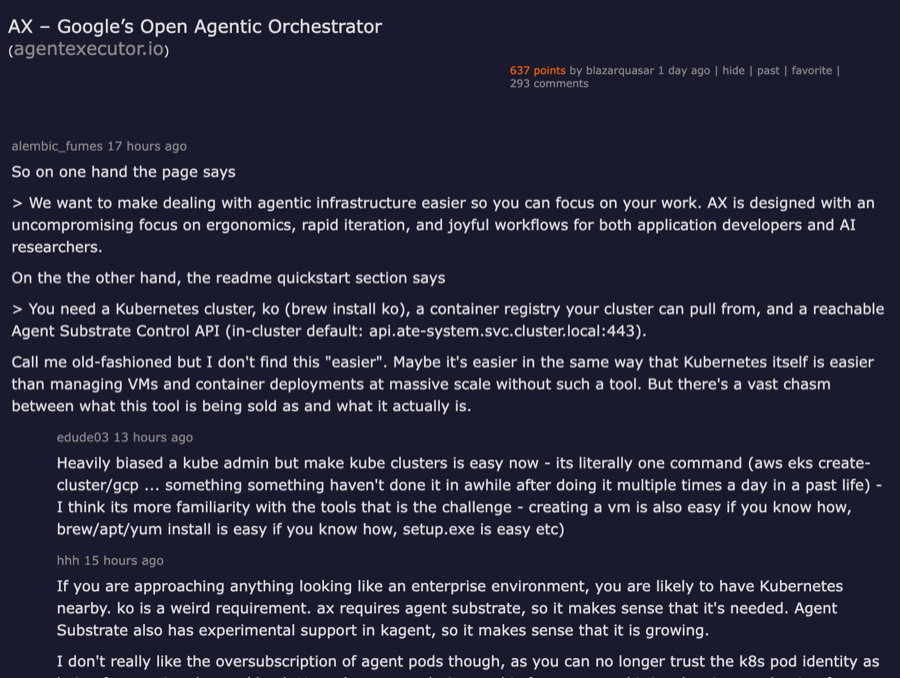
The HN thread crystallizes the tension between AX’s ambition and its current reality. The top comment, from user alembic_fumes, cuts straight to the gap:
“Marketing oversells simplicity while actual quickstart requires Kubernetes, ko, container registry, and complex setup — contradicting ‘easier’ messaging.”
This is the honest criticism AX deserves. If you’re a solo developer or a small team, AX is overkill. You don’t need a distributed agent runtime to run a single coding agent. Kubernetes is a prerequisite, not a nice-to-have. The counter-argument — that enterprises already have Kubernetes — is true but reveals who AX is actually for: platform teams at companies running agent workloads at scale, not individual developers building their first agent.
The recurring theme in the thread is Google’s abandonment track record. Multiple commenters cite killedbygoogle.com, questioning whether AX will join the graveyard. The Apache-2.0 license and open-source nature help mitigate this — if Google walks away, the code survives. But community trust has to be earned with years of maintenance, not just a permissive license.
What’s more interesting than the skepticism is the observation from commenter faizshah, who notes the current ecosystem is really fighting over four things: authorization, sandbox necessity, agent specification, and multi-agent coordination. AX addresses the first two well. The second two remain unsolved problems regardless of which runtime you choose.
Where the Moat Actually Moved
Here’s the thesis that nobody wants to hear: if every cloud provider ships the same orchestration primitives, orchestration is not your moat. Traefik’s analysis, titled “The Agent Framework Wars Are Over. Everyone Won. That’s the Problem,” nails it:
“Multi-framework is the destination, not a temporary state.”
The real competitive advantages have moved to three places:
1. Workflow-Specific Data and Memory. Your agent’s value isn’t in how it orchestrates tool calls — it’s in what it remembers, what evaluations it’s accumulated, and what domain-specific trajectories it’s learned from. This data is inherently non-portable. If your agent memory is trapped in one provider’s proprietary format, your orchestration-layer portability is theoretical.
2. Trust and Governance Policies. Which agents can access which tools, with what credentials, under what audit trail? This is where enterprises actually differentiate. AX’s Gateway primitive (outbound traffic allowlists) is a start, but real governance spans identity, RBAC, compliance, and cross-organizational trust — the kind of guardrail stack that takes years to build.
3. Evaluation and Quality Infrastructure. The teams winning at agents aren’t the ones with the best framework — they’re the ones with the best eval pipelines. How do you measure whether an agent actually completed a task correctly? How do you catch regressions when you swap models or update prompts? This meta-infrastructure is where the real institutional knowledge accumulates.
Contrarian Corner: Framework-agnosticism may be less real than the marketing suggests. Teams that invested deeply in LangGraph or CrewAI built institutional knowledge, custom tooling, and evaluation pipelines around specific abstractions. The organizational muscle memory around a framework — how your team debugs it, tests it, monitors it — may matter more than the framework’s technical portability. Switching costs are psychological and procedural, not just technical.
The GitHub Signals Tell the Same Story
The September 21 GitHub trending data confirms the shift. Agent-infrastructure repos are surging:
- BuilderIO/agent-native (+607 stars/day, 5.7k total) — a framework for agent-native applications with structured planning and generative UI. Not another orchestration wrapper; it’s building the application layer above orchestration.
- agent-substrate/substrate (+438 stars/day, 2.5k total) — the Kubernetes primitives AX runs on. Open-sourced alongside AX, gaining its own community.
- coder/coder (+461 stars/day, 16.3k total) — “Secure environments for developers and their agents.” The infrastructure-around-agents thesis, applied to development environments.
- anthropics/claude-code (+504 stars/day, 147k total) — the agentic coding tool keeps climbing, suggesting demand is at the harness level, not the runtime level.
- akitaonrails/ai-memory (+217 stars/day, 7.5k total) — long-term memory and handoff between different agent vendors. A portable-memory play, attacking exactly the lock-in concern.
The pattern: the repos gaining stars aren’t new orchestration frameworks. They’re infrastructure that works across frameworks — runtimes, sandboxes, memory layers, and application-layer abstractions. The agent orchestration tools market is consolidating into fewer, bigger platforms, and developers are voting with their stars for the layers above and below.
What This Means for You
If you’re building production agent systems, here’s the actionable playbook:
Stop evaluating frameworks on features. The feature lists are converging. Sandbox, durable execution, MCP support, multi-model — everyone has it or will have it by Q4. Instead, evaluate on:
-
Workflow portability: Can you move your agent workflows between runtimes without rewriting? If your orchestration logic is embedded in cloud-specific YAML, you’re building technical debt.
-
Governance independence: Is your observability and trust policy stack framework-agnostic? If switching frameworks means rebuilding your entire monitoring pipeline, your “portable” framework is a lie.
-
Data portability: Can you export your agent memory, evaluation datasets, and execution trajectories? The memory layer is the new vendor lock-in — more insidious than the old serverless lock-in because agent memory compounds over time.
-
Community and maintenance trajectory: AX has 6.2k GitHub stars, 270 forks, and Jaana Dogan leading development. That’s promising, but Google has killed projects with more traction. Bet on projects with diverse contributor bases, not just corporate backing.
For fleet orchestration at scale, AX and AgentCore represent serious options. For individual developers, the Anthropic Claude Agent SDK, OpenAI Agents SDK, or LangGraph remain more practical starting points. And for the startup frameworks? The smart ones are already pivoting from “orchestration” to “workflow-specific value” — evaluation tools, domain-specific skills, and memory systems that justify their existence in a world where orchestration is free.
Practitioner Checklist — Before You Pick a Runtime:
- Can I
ax ssh(or equivalent) into a running agent? Debuggability is non-negotiable. - Does the runtime support suspend/resume for human-in-the-loop workflows?
- What happens to my agent state if I switch providers? Export it and check.
- Is my governance policy enforced at the infrastructure level, or embedded in framework code?
- How does the runtime handle billing for idle agents? (This matters more than you think.)
The Next Twelve Months
The orchestration layer will finish commoditizing. It’s a matter of months, not years. By mid-2027, “which agent framework do you use?” will be as boring a question as “which container orchestrator do you use?” — the answer will be “whichever one my cloud provider bundles, plus maybe LangGraph for the parts that need customization.”
The interesting battles will be fought at the layer AX deliberately doesn’t own: the workflow layer. Who builds the best evaluation infrastructure? Who creates the agent memory system that actually compounds value? Who ships the governance platform that enterprises trust with production-critical agent deployments?
Google is betting that owning the compute substrate — the Kubernetes of agents — is enough. They may be right. But the lesson of the original Kubernetes adoption is instructive: Google built K8s and open-sourced it, but AWS made more money from EKS than Google ever made from GKE. Owning the substrate doesn’t guarantee owning the business. The moat is dead. Long live the new moat.