Field report · · AgentConn Team
Best AI Agents for Finance and Accounting (2026)
A comprehensive comparison of the best AI agents transforming finance and accounting in 2026. Covers Ramp AI, Vic.ai, Truewind, Stampli, Puzzle, Zeni, and more — with practical guidance on evaluation, compliance, and choosing the right tool for your team.
AI Agents Are Coming for Your Spreadsheets
Even the model makers see it. Sam Altman noted that GPT-5.4 is “really good at spreadsheets” — and that “a few finance people have finally said things to me like ‘huh I guess this AI thing is real.’”
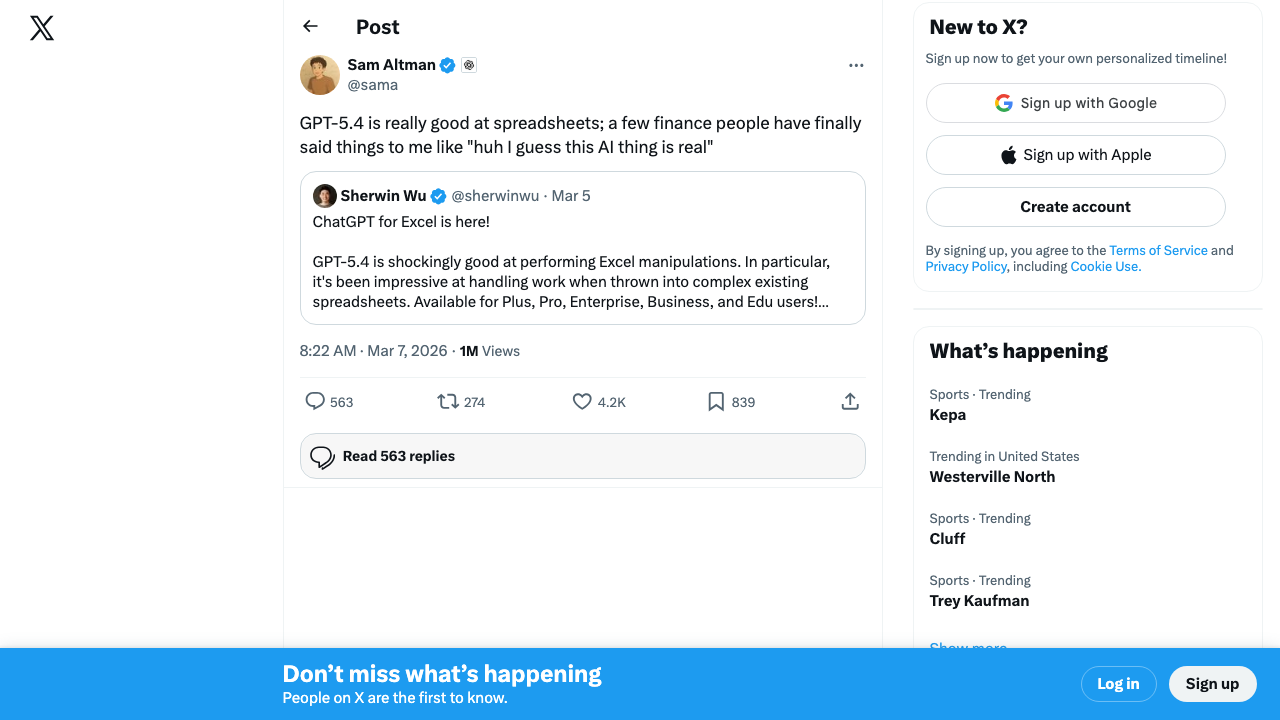 Source: @sama on X — 2,813 ❤️, 638K views
Here’s the uncomfortable truth about finance and accounting in 2026: if your team is still manually coding expenses, chasing receipt approvals over email, and spending the last week of every month reconciling transactions in spreadsheets — you’re not just behind the curve. You’re competing against teams that have autonomous agents doing that work around the clock.
The shift happened faster than most CFOs expected. What started as “AI-assisted” features inside existing tools has evolved into fully autonomous agents that handle real financial workflows end-to-end. Not chatbots that answer questions about your balance sheet. Actual agents that process invoices, enforce spend policies, reconcile accounts, and flag anomalies — with human oversight where it matters, and full autonomy where it doesn’t.
The catalyst? Companies like Ramp proved it works at scale. When a $32 billion fintech deploys AI agents handling real money across 50,000+ customers, the “wait and see” argument loses its teeth. Now every finance platform is racing to ship agents, and the landscape has become genuinely difficult to navigate.
 Ramp’s blog documents their rapid AI agent deployment across expense management, AP, and policy enforcement.
This guide cuts through the noise. We compare the leading AI agents for finance and accounting, break them into functional categories, and give you a practical framework for choosing the right tools — whether you’re a 10-person startup or a Fortune 500 finance team.
The Category Leaders
Ramp Intelligence — The Full-Stack Finance Agent
Best for: Mid-market to enterprise teams wanting agents embedded across the entire spend lifecycle.
Ramp has moved furthest, fastest. Their Intelligence platform deploys multiple specialized agents — an Accounting Agent that auto-codes transactions and handles GL mapping, and a Policy Agent that enforces spend rules, approves low-risk expenses autonomously, and escalates ambiguous cases to human reviewers.
What separates Ramp from the pack isn’t any single feature — it’s the data flywheel. With over 50,000 customers, Ramp’s agents learn from anonymized patterns across its entire customer base. Your Accounting Agent doesn’t just know your coding history; it knows how thousands of similar companies code similar expenses. That network effect compounds over time.
Key agent capabilities:
- Autonomous expense coding with multi-line item GL mapping
- Policy enforcement agent that approves, denies, or escalates based on your rules
- Real-time fraud detection scanning for anomalies and AI-generated fakes
- Three-way invoice matching (PO, receipt, invoice) without human intervention
- Software negotiation insights drawn from millions of anonymized transactions
- Employee-facing agent that answers policy questions via text
Strengths: Broadest agent coverage across expense management, AP, policy enforcement, and fraud detection. The data network effect is a genuine moat. Clean UX that finance teams actually adopt.
Limitations: Primarily a corporate card and spend management platform — not a full accounting suite. You’ll still need a GL (QuickBooks, NetSuite, Sage) underneath. Most powerful features require Ramp as your card provider.
Pricing: Free for the core platform (Ramp makes money on interchange). Premium features and higher-tier agent capabilities are available on paid plans.
Vic.ai — The AP Automation Specialist
Best for: Enterprise teams processing high invoice volumes who need near-zero-touch AP.
Vic.ai has been building AI for accounts payable longer than most competitors have existed. Their pitch is specific and measurable: 85% no-touch invoice processing rate by month six, with 99% accuracy — no templates, no manual coding rules, no setup required.
The platform uses proprietary AI models trained specifically on invoice data. Unlike general-purpose LLMs bolted onto accounting software, Vic.ai’s models understand the structure of invoices natively — line items, tax codes, vendor patterns, approval hierarchies. The result is an AP process that genuinely runs itself for the majority of invoices.
Key agent capabilities:
- Autonomous invoice capture, coding, and routing
- Self-learning GL coding that improves with every processed invoice
- Anomaly detection for duplicate invoices, pricing discrepancies, and unusual patterns
- Approval workflow automation with configurable escalation thresholds
- Native ERP integrations (NetSuite, SAP, Oracle, Sage, Microsoft Dynamics)
Strengths: Best-in-class no-touch rates for AP. Purpose-built AI (not a wrapper around GPT). Deep ERP integrations. Strong enterprise security posture.
Limitations: Focused exclusively on AP — doesn’t cover expense management, reconciliation, or financial planning. Enterprise pricing means it’s not practical for smaller teams. Implementation can take weeks for complex ERP environments.
Pricing: Enterprise pricing; typically based on invoice volume. Expect $2,000–$10,000+/month depending on scale.
Truewind — The Reconciliation Agent
Best for: Accounting teams and firms that lose days to monthly reconciliation and close processes.
Truewind attacks the single most time-consuming task in accounting: the monthly close. Their platform deploys specialized agents — a Transaction Assistant that auto-codes and builds prepaid and fixed asset schedules, a Reconciliation Agent that matches unstructured third-party data against your GL, and a Flux Assistant that performs variance analysis against historical patterns.
The reconciliation piece is particularly strong. Truewind’s OCR extracts data from PDFs (brokerage statements, donation reports, POS batches) and auto-posts journal entries to the general ledger. For accounting firms managing multiple clients, this is the difference between a five-day close and a two-day close.
Key agent capabilities:
- Transaction coding with automated prepaid and fixed asset schedule building
- PDF-based reconciliation using OCR and AI matching
- Flux analysis and anomaly detection against historical journal entries
- Support for specialized workflows: brokerage, donations, payroll, point-of-sale
- Audit-ready workpaper generation
Strengths: Purpose-built for the close process. Handles unstructured data (PDFs, statements) that trip up general-purpose tools. Strong for accounting firms managing multiple clients.
Limitations: Narrowly focused on reconciliation and close — not a full accounting platform. Requires clean GL data to match against. Newer entrant, so the integration ecosystem is still growing.
Pricing: Tiered pricing based on entity count and transaction volume.
Stampli — The Procure-to-Pay Agent
Best for: Finance teams that need AI embedded across the full procure-to-pay lifecycle, not just AP.
Stampli positions itself as a complete procure-to-pay platform with AI woven throughout. Their differentiator is integration depth — Stampli builds all ERP integrations in-house, which means tighter data sync and fewer broken automations than competitors relying on third-party connectors.
The AI layer (branded as “Stampli AI”) handles day-to-day invoice processing, coding suggestions, and approval routing. It adapts to how your finance team actually works — centralized or decentralized, strict or flexible — rather than forcing a one-size-fits-all workflow.
Key agent capabilities:
- AI-driven invoice processing with intelligent coding suggestions
- Full procure-to-pay workflow from request through payment
- In-house ERP integrations (not third-party middleware)
- Adaptive workflow engine that mirrors your team’s actual processes
- Approval automation with configurable rules and escalation
Strengths: Most complete procure-to-pay coverage. Best ERP integration quality (all built in-house). High customer satisfaction — consistently rated as a G2 Leader in AP Automation.
Limitations: AI capabilities are less autonomous than Vic.ai or Ramp — more “AI-assisted” than “AI-driven.” Premium pricing for smaller teams. Primarily focused on AP and procurement, not broader accounting.
Pricing: Custom enterprise pricing based on invoice volume and modules.
The Broader AI Economics Story
The financial implications of AI agents extend beyond accounting tools. Peter Diamandis highlighted that “Anthropic is growing revenue at 10x/year” — driven largely by agent-based products monetizing faster than chatbots.
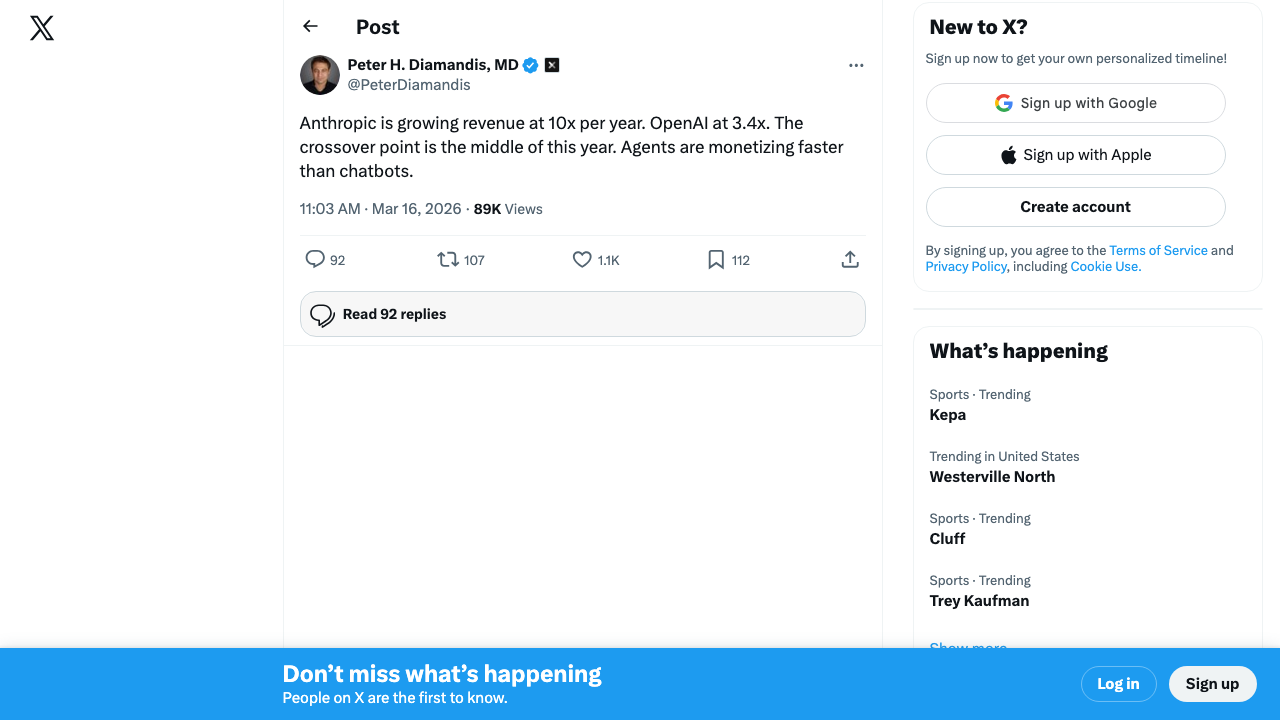 Source: @PeterDiamandis on X — 452 ❤️
Meanwhile, the cost dynamics are shifting fast. As Chamath noted, AI costs have tripled for many enterprises — making multi-model strategies and cost optimization a core finance concern, not just an IT one.
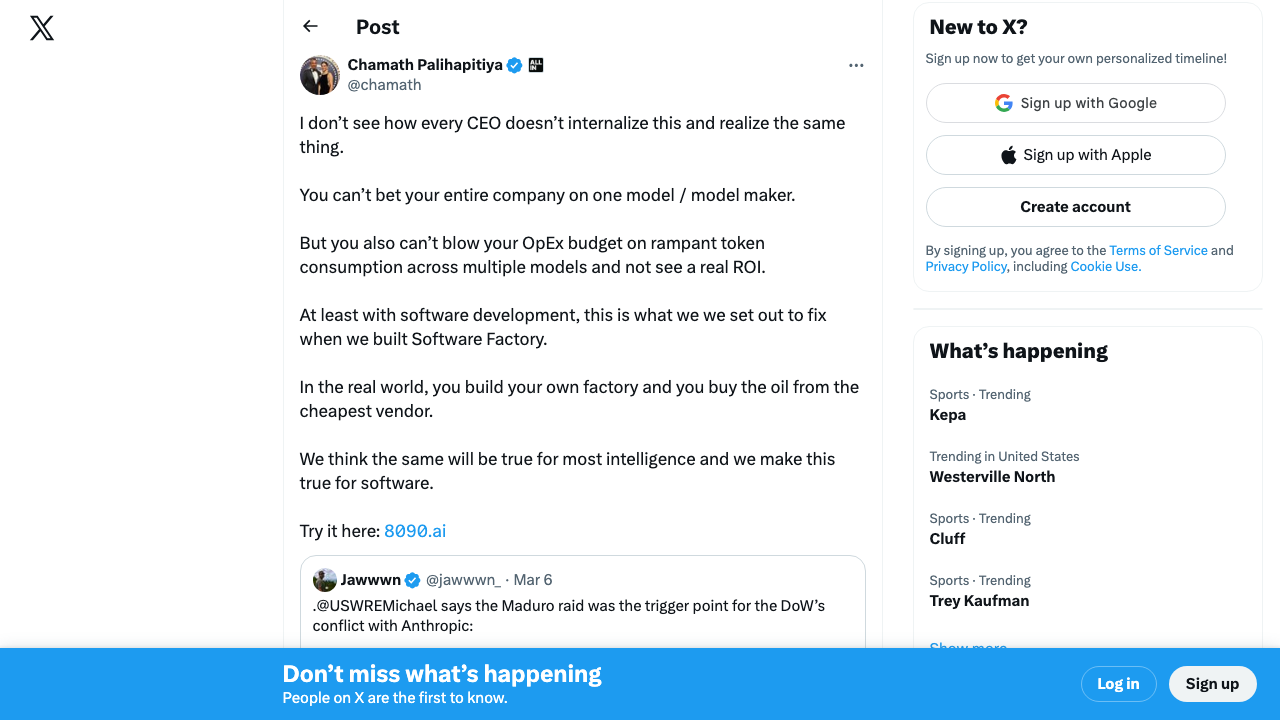 Source: @chamath on X
Puzzle — The AI-Native Accounting Platform
Best for: Startups and SMBs that want a QuickBooks replacement with AI built into the foundation.
Puzzle takes a different approach than most entries on this list: instead of layering AI on top of existing accounting software, they built an accounting platform with AI at its core. The result is 98% automated categorization, reconciliation that happens continuously (not monthly), and real-time financial dashboards showing burn, runway, and cash position.
For startups, the pitch is compelling. You get a full general ledger, automated revenue recognition, native integrations with the modern fintech stack (Stripe, Mercury, Ramp, Brex, Deel, Gusto), and AI that handles the busywork your bookkeeper used to do. Month-end close time drops by up to 50%.
Key agent capabilities:
- AI-powered transaction categorization (98% automation rate)
- Continuous reconciliation (not batch/monthly)
- Automated revenue recognition workflows
- Real-time dashboards with burn rate, runway, and cash analytics
- Native integrations with modern fintech and payroll tools
- Automated accuracy reviews that catch mistakes before close
Strengths: True AI-native architecture — not a legacy tool with AI bolted on. Best-in-class for startups and the modern fintech stack. Free migration support with white-glove onboarding.
Limitations: Less mature for complex enterprise accounting needs (multi-entity, international, complex revenue recognition). Smaller ecosystem than QuickBooks or NetSuite. Relatively young company.
Pricing: Tiered plans. Competitive with QuickBooks for startups; scales with transaction volume.
Zeni — The AI Bookkeeping + CFO Layer
Best for: Startups that want AI-powered bookkeeping combined with fractional CFO services.
Zeni blends AI automation with human financial expertise. Their platform handles bookkeeping autonomously — categorization, reconciliation, reporting — while providing access to a team of financial experts for strategic guidance. Think of it as an AI agent that handles the 90% of bookkeeping that’s repetitive, backed by humans for the 10% that requires judgment.
The newer addition is Zeni’s AI Agents layer, which adds real-time forecasting and financial planning capabilities. Ask questions about your finances in natural language and get answers grounded in your actual data.
Key agent capabilities:
- AI-automated bookkeeping and transaction categorization
- Real-time financial reporting and dashboards
- Natural language financial Q&A (ask questions about your data)
- AI-powered forecasting and scenario planning
- Tax preparation and compliance support
- Human financial expert team for strategic guidance
Strengths: Best hybrid model (AI + human experts). Particularly strong for startups that don’t have in-house finance staff. Tax services included. Full-service approach reduces vendor sprawl.
Limitations: The hybrid model means higher pricing than pure software solutions. Less control for teams that want to manage their own books with AI assistance. Primarily focused on US startups.
Pricing: Monthly plans starting around $500/month. Pricing varies based on transaction volume and service tier.
The Vibe-Coded Finance Future
The trend extends beyond enterprise tools. Writers like Craig Mod have demonstrated building custom accounting software via “vibe coding” — using AI to create bespoke financial tools rather than conforming to off-the-shelf solutions.
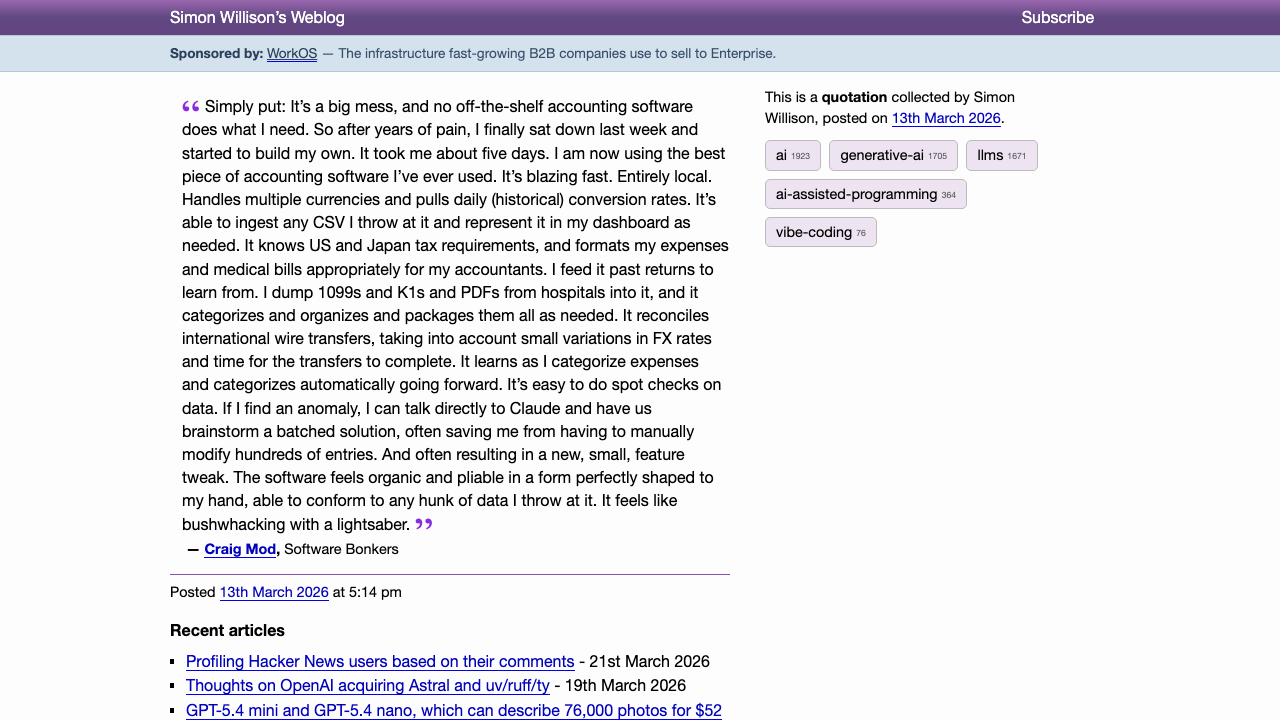 Source: Simon Willison’s Weblog — the “vibe coding” movement hits financial software
This isn’t just a novelty. It represents a future where every finance team has custom AI agents tailored to their specific workflows, approval chains, and compliance requirements — not one-size-fits-all SaaS.
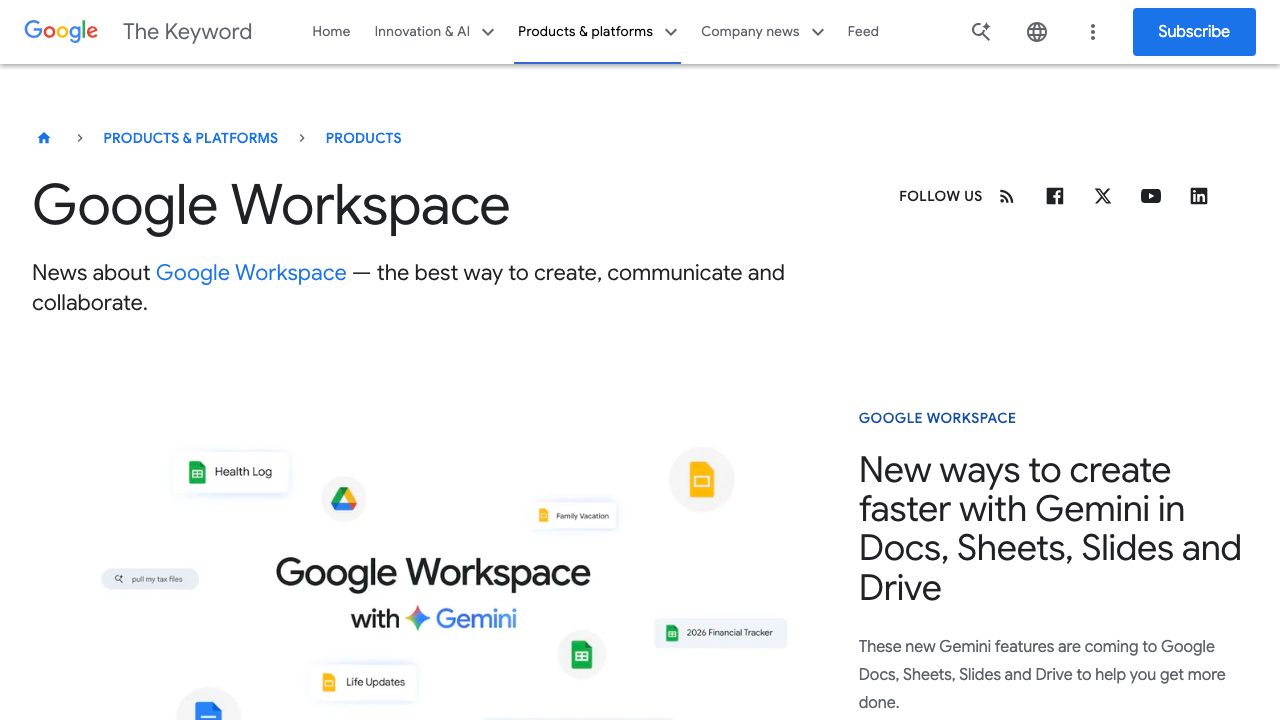 Google is embedding Gemini AI directly into Docs, Sheets, and Slides — making AI-native financial analysis available to every team with a Workspace account.
How to Evaluate AI Finance Agents
Not all AI agents are created equal, and finance is a domain where mistakes have real consequences — regulatory, financial, and reputational. Here’s what to look for:
Accuracy and Auditability
The most important metric. Ask vendors for their no-touch accuracy rate and how they measure it. A 95% coding accuracy rate sounds great until you realize 5% errors across thousands of transactions means hundreds of misclassified entries per month. Look for agents that maintain full audit trails — every decision the agent makes should be traceable and reversible.
Compliance and Security
At minimum, require SOC 2 Type II certification. For enterprise deployments, look for SOC 1 compliance as well. Understand how the vendor handles your financial data — is it used to train models? Can you opt out? Where is data stored? For regulated industries (financial services, healthcare), verify the vendor meets your specific compliance requirements (PCI DSS, HIPAA, etc.).
Human-in-the-Loop Design
The best AI finance agents know when to act and when to ask. Look for configurable thresholds — transactions below $X get auto-approved, above $X require human review. High-value decisions (vendor payments, policy exceptions, unusual transactions) should always have a human checkpoint. An agent that processes everything autonomously with no escalation path isn’t sophisticated — it’s dangerous.
Integration Depth
An AI agent is only as good as the data it can access. Surface-level integrations (CSV imports, basic API connections) limit what agents can do. Look for native, bidirectional integrations with your ERP, banking, payroll, and expense systems. The deeper the integration, the more context the agent has, and the better its decisions.
Cost vs. Value
Calculate the total cost of ownership, not just the subscription fee. Factor in implementation time, training, ongoing maintenance, and the cost of errors. Compare against the fully loaded cost of the manual processes you’re replacing — including the opportunity cost of your finance team’s time spent on repetitive work instead of strategic analysis.
Who Should Use What
Startups (seed to Series B): Start with Puzzle for AI-native accounting or Zeni if you want human experts bundled in. Add Ramp for expense management and corporate cards. This stack covers 90% of early-stage finance needs.
Mid-market (50–500 employees): Ramp Intelligence as your expense and policy engine, with Truewind or your existing GL for reconciliation and close. Add Vic.ai if AP invoice volume justifies the investment.
Enterprise (500+ employees): Vic.ai for AP automation at scale, Stampli for full procure-to-pay, Ramp for expense management and policy enforcement. Layer Truewind on top for reconciliation if your close process is still painful.
Accounting firms: Truewind for multi-client reconciliation and close, Puzzle as a modern GL alternative for startup clients. The combination dramatically improves margins on bookkeeping engagements.
The Bottom Line
AI agents in finance aren’t a future trend — they’re a current competitive advantage. The teams adopting them now are closing books faster, catching fraud earlier, enforcing policies more consistently, and freeing their finance professionals to focus on strategic work instead of data entry.
The key is matching the right agent to your actual workflow. Don’t buy an enterprise AP automation platform when you need a smarter expense tool. Don’t settle for AI-assisted features when your volume justifies fully autonomous processing.
Start with the pain point that costs you the most time, deploy an agent there, measure the impact, and expand. The tools are ready. The question is whether your finance team is still doing work that an agent should be handling.