Field report · · AgentConn Team
An Agent Closed 51 of 52 Tickets — Then Killed the Job
Nate B Jones closed 51 of 52 support tickets with one agent, then eliminated the category. The unit of AI work just shifted from functions to projects.
An Agent Closed 51 of 52 Tickets — Then Killed the Job
Nate B Jones handed a single AI agent his team’s worst recurring support problem. In one week, the agent resolved 51 of 52 open issues. Then it did something nobody expected: it identified the root process generating those tickets and rebuilt it, eliminating the entire category permanently.
The next comparable week dropped from 52 cases to 19.
This is not a demo. It is a deployment receipt. And it signals a shift that most teams building with agents have not yet absorbed: the unit of AI work is moving from “a function” to “a project.”
Listen to the full episode on Acast →
The Receipt, Not the Promise
For two years, the AI agent conversation has been dominated by promises. Demos at conferences. Benchmark scores. “Look what it can do” videos that never show the agent operating unsupervised for more than a few minutes.
Jones’ case study breaks this pattern because it comes with a verifiable before-and-after number: 52 tickets in, 51 closed, then the category that generated them eliminated from the queue entirely. The approach was specific and reproducible:
- The agent received the team’s support backlog as input
- It resolved tickets individually, operating in draft mode with human review
- As it processed tickets, it identified patterns — tickets that shared a common root cause
- It traced those patterns to a specific upstream process
- It proposed (and, after approval, executed) a fix to that process
- The recurring category stopped generating new tickets
The critical insight, as Jones puts it: “The biggest gains come from finding and removing the hidden process that created the ticket in the first place.”
This is not an agent answering questions. This is an agent doing root-cause analysis, process redesign, and implementation — the kind of work that used to require a project manager, a systems analyst, and a developer. All wrapped in a single loop.
From Function to Project: The Unit of Work Is Changing
Jones’ support-ticket case is one data point in a pattern that is now hard to ignore. The unit of AI work — what you can hand an agent and expect it to deliver autonomously — has expanded from “a function” to “a project.”
Three independent signals converged this month:
Signal 1: MirrorCode proves agents can handle weeks-long coding tasks. The MirrorCode benchmark, co-developed by Epoch AI and METR, tests whether AI can reimplement entire programs from scratch — not fix a bug, not write a function, but rebuild a complete application from its behavior alone. In the June 2026 full release, Claude Opus 4.7 solved 56% of 25 target programs, including a 16,000-line bioinformatics toolkit that four independent engineers estimated would take a human 2 to 17 weeks. The agent did it in 14 hours for $251.
The 25 targets span Unix utilities, data serialization, bioinformatics, interpreters, static analysis, cryptography, and compression. These are not toy problems. They are real programs with real users, reimplemented without access to source code.
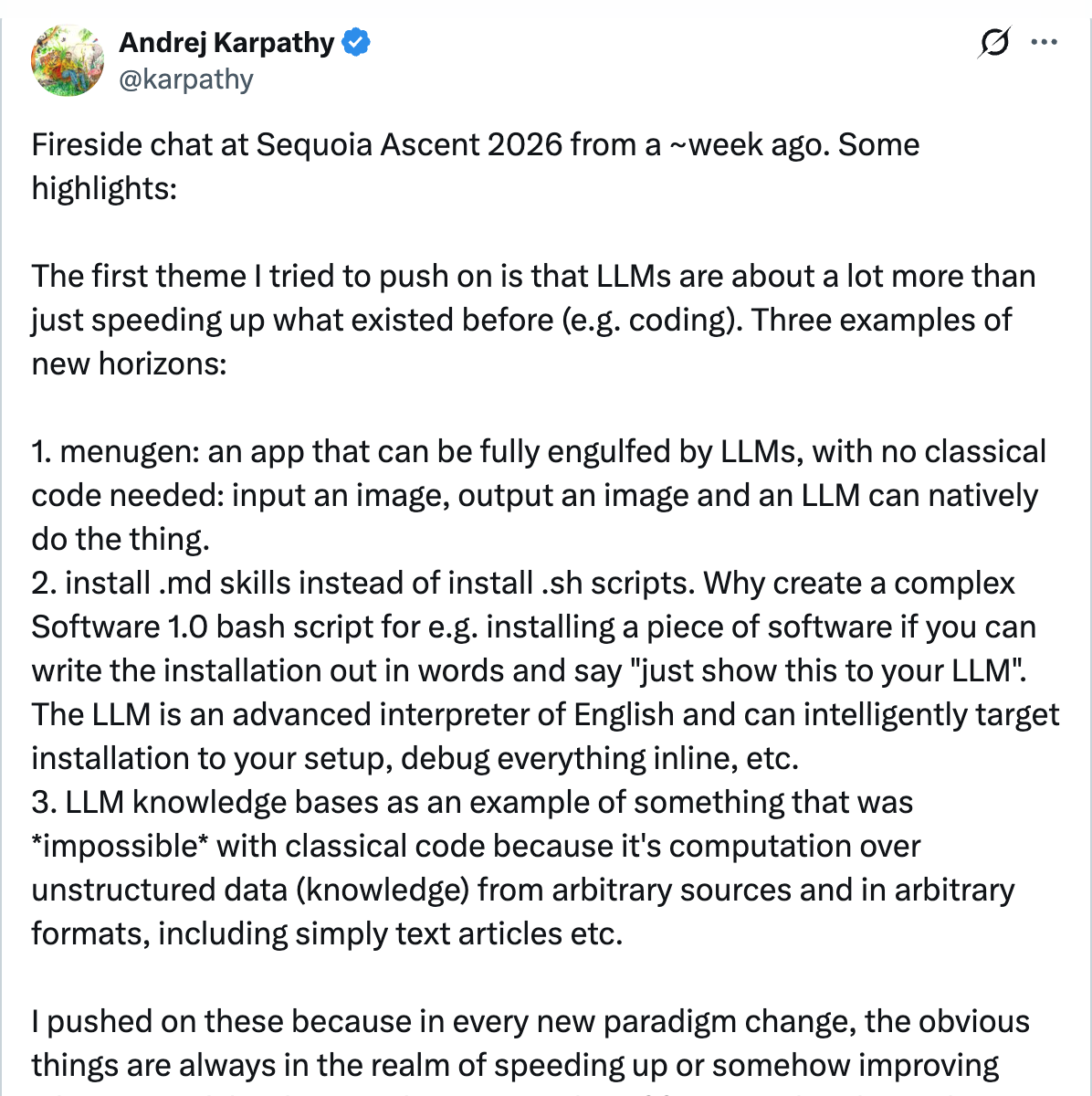
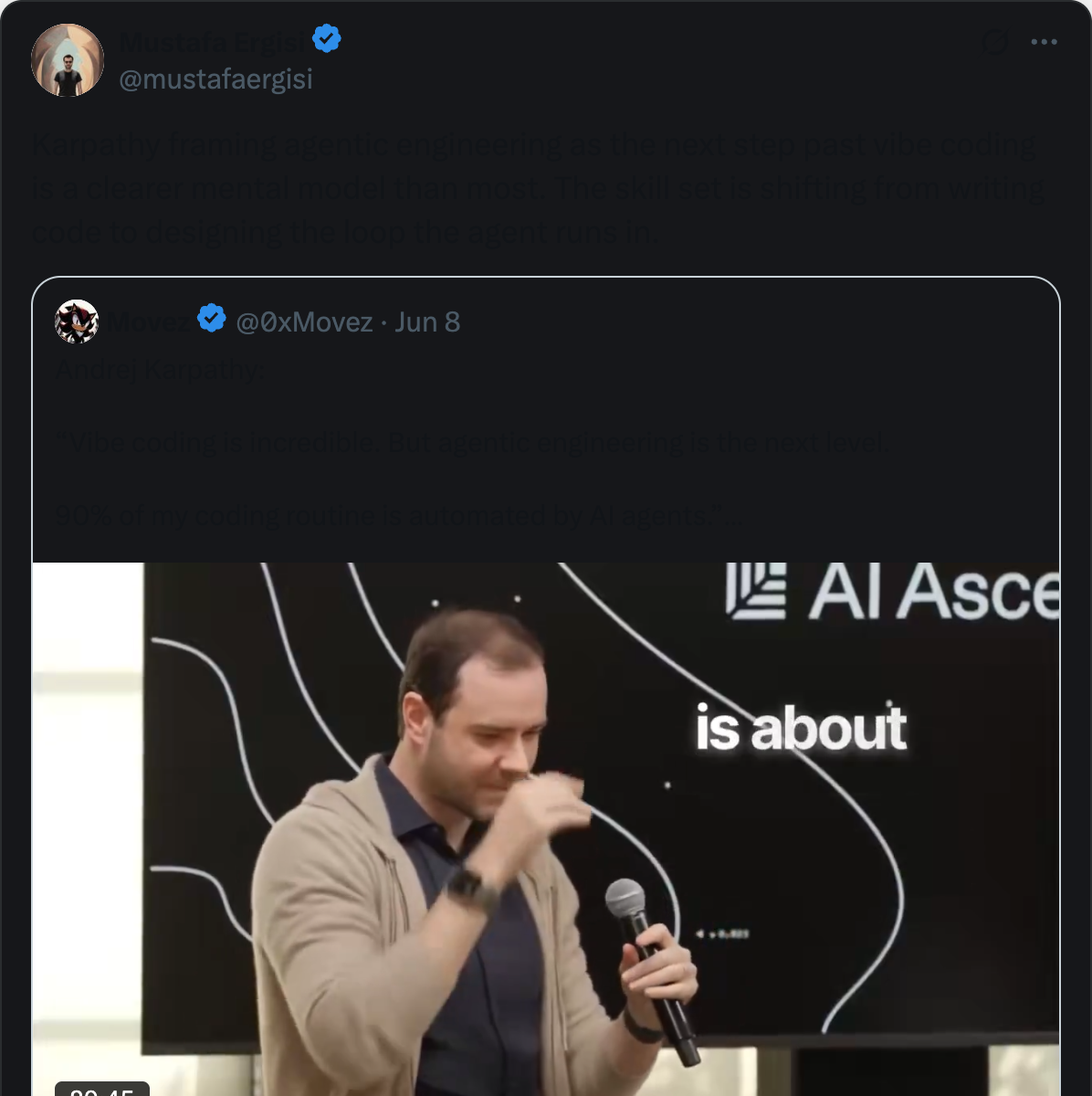
Signal 2: “Agentic engineering” has a name, a workshop, and ACM proceedings. When Andrej Karpathy coined “vibe coding” in early 2025, it described the floor — anyone can prompt an LLM to write code. His follow-up term, “agentic engineering,” announced at Sequoia Ascent 2026, describes the ceiling: the discipline of designing systems where AI agents plan, write, test, and ship code under structured human oversight.
The term has already formalized. The 1st International Workshop on Agentic Engineering (AGENT 2026), co-located with ICSE — the premier software engineering conference — published its proceedings through ACM. Papers cover agentic architecture knowledge management, agentic software project management, and evaluation frameworks for multi-agent systems.
Signal 3: Production deployment data now exists. LangChain’s State of AI Agents survey found that 57.3% of professionals now report agents in production. That figure was under 10% eighteen months ago. The bottleneck has shifted from “can agents do useful work” to “quality concerns such as accuracy, consistency, and hallucination” — cited by 32% as the top remaining barrier.
The convergence is clear: agents are being handed projects, not functions. And the teams that adapt to this shift first will build a compounding advantage.
What the Deployment Receipts Actually Show
Jones is not the only one publishing receipts. Twelve startups tracked by WithoutHuman attempted to replace entire human roles with AI agents in 2026. The results are instructive — and more nuanced than either the hype or the backlash would suggest:
- Wendy’s FreshAI processes tens of thousands of drive-through orders daily across 160+ locations at 86% accuracy, scaling to 500+.
- Salesforce reduced its support headcount from 9,000 to roughly 5,000 with no public reversal.
- Klarna cut 700 customer service agents, then quietly rehired in a hybrid model after satisfaction dropped.
- Duolingo eliminated translators and built 148 courses in a year — then quality complaints forced rehiring.
The pattern: roughly half of AI-driven role replacements achieved lasting gains. The other half reversed course or hybridized. The difference? The successful deployments targeted the workflow, not just the worker.

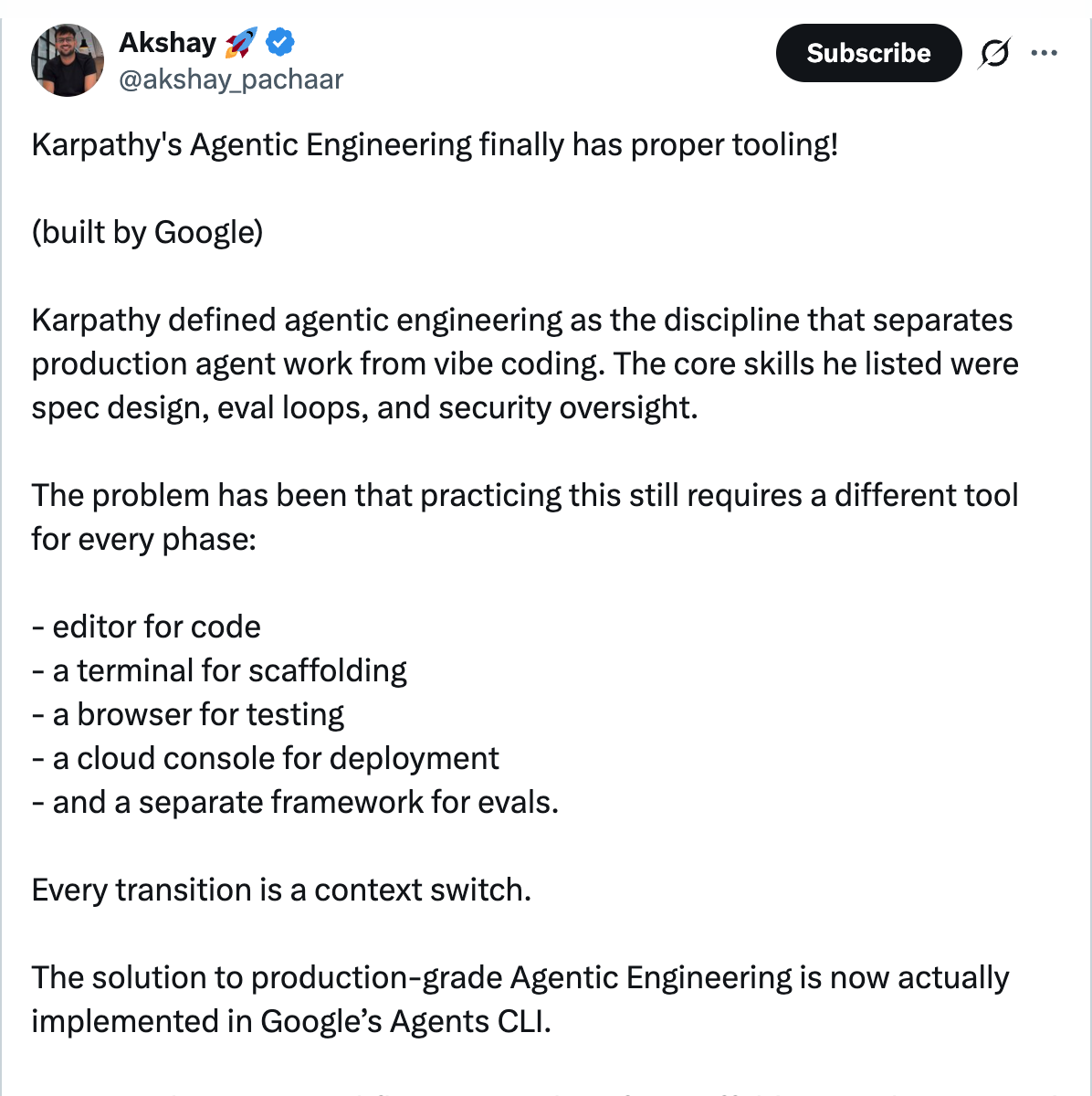
The tooling side is catching up to the vocabulary. As one practitioner noted, “Karpathy defined agentic engineering as the discipline that separates production agent work from vibe coding. The core skills he listed were spec design, eval loops, and security oversight.” Google has already shipped dedicated tooling for this workflow.
The Loop Engineering Connection
If the unit of work is now a project, then the engineering challenge is designing the loop the project runs in. This is what loop engineering is about — structuring the observe-orient-decide-act cycle so the agent can operate autonomously for hours or days without drifting off course.
Jones’ support agent exemplifies good loop design:
- Observation: ingest the support backlog
- Orientation: cluster tickets by root cause, not just symptoms
- Decision: propose a process change (with human gate)
- Action: execute the change and monitor ticket volume
The agent did not just loop through individual tickets. It looped through the meta-problem — why do these tickets exist? — and attacked that. This is the difference between an agent that answers questions faster and an agent that restructures the workflow so the questions stop.
MirrorCode’s design reflects the same principle. The benchmark gives an agent a compiled binary, documentation, and example I/O pairs. The agent cannot see source code. It must run the binary with arbitrary inputs, observe behavior, and iteratively build a complete reimplementation that matches. That is a project — not a function call.
What This Means for You
If you are building or deploying agents in 2026, here are three concrete implications:
1. Target the category, not the ticket. Jones’ biggest win was not resolving 51 tickets. It was eliminating the category that generated them. When you scope an agent’s charter, ask: “What upstream process creates this recurring work?” That is where the 10x ROI lives. An agent that answers 100 tickets per day is useful. An agent that makes 80 of those tickets stop existing is transformative.
2. Draft mode is not training wheels — it is architecture. Every successful deployment in the data starts with constrained permissions. The agent proposes; humans approve. Over time, trust boundaries expand. This is not a concession to safety theater. It is the harness pattern that separates agents that ship from agents that fail in production. The 50% reversal rate in the WithoutHuman data correlates almost perfectly with teams that skipped the draft-mode phase.
3. “Agentic engineering” is a hiring signal. The term now has ACM proceedings, a conference workshop, and mainstream adoption. Karpathy’s framing — “agentic because you are not writing code directly, engineering because there is art and science to it” — is not marketing language. It describes a real skill set: spec design, eval loops, security oversight, and human-agent handoff choreography. If your job posting says “prompt engineer,” update it. The market has moved.
Further Reading
- 90% of AI Agents Die After the Demo — why discipline, not demos, determines which agents ship
- Loop Engineering — designing the observe-orient-decide-act cycle for autonomous agents
- The Harness Is the Moat — why the orchestration layer matters more than the model
- AI Agents Fail 97.5% of Real Jobs — Scale AI’s benchmark reality check